
Original recipe estimate: Approx. 15 hours (approx. 2½ hours active)
Up to 4 hours soaking bones under refrigeration, 20 min blanching, up to 10 hours main boiling and around 100 min transitions/reduction/plating. Prepare chāshū meanwhile: 90 min is only a guide, cook thoroughly, cool promptly, then refrigerate at least 3 hours. The 960-min plan assumes this parallel workflow; longer cooking/cooling can exceed it. Additional storage cooling of finished broth is not included.
Origin & original sources
- Cuisine
- Japan
- Origin of this version
- Japan · Fukuoka · Hakata; roots in Kurume
- Original name
- 博多豚骨ラーメン
- Source languages
- Japanese, German
See the source references for the documented version and its context.
6 original sourcesWhat goes with it
In this recipe: Tonkotsu shio tare – measure yield after straining
1 Authenticity and sources
Fukuoka’s tourism association describes Kurume as the origin of tonkotsu ramen and presents the story of the white broth at the Sankyū stall as a traditional account. Hakata and Nagahama developed differently; extra-thin straight noodles and kaedama are especially associated with Nagahama. This open-pot, long-cooking version is an editorial home-kitchen combination, not an unchanged restaurant recipe. Ramenchef’s tare provides a specific seasoning comparison; its Honteri ingredient is explicitly distinguished from hon-mirin. The exact historical 27% noodle formulation could not be fully confirmed from today’s Cookpit retrieval and is not presented as a verified source translation. Vigorous boiling disperses fat and dissolved components to make the broth cloudy, without milk or cream.
- Official Kurume tourism website – Kurume ramen · Japanese · accessed 22 July 2026
- Fukuoka tourism association – regional ramen history · Japanese · accessed 19 October 2026
- Ramenchef – tonkotsu shio tare · Japanese · accessed 19 October 2026
- Mizkan – Honteri mirin-style seasoning · Japanese · accessed 19 October 2026
- Cookpit – noodle basics, not confirmation of the full formula · Japanese · accessed 19 October 2026
- BfR – supplementary cooking and cooling guidance · German · accessed 19 October 2026
2 Ingredients
Editorial overall formulation. Tare uses Honteri, not hon-mirin; measure the actual yield. Garlic/kombu are working allowances. Keep broth reserve separate and plan kaedama additionally. The 27% noodle formula is not a currently fully verified source formula.
White tonkotsu broth – target yield approx. 2.4 litres
- 2000 g Split pork long bones and knee bones (豚げんこつ, buta genkotsu)
- 1000 g Pork back or neck bones (豚背骨, buta sebone)
- 500 g Split pig’s trotters (豚足, tonsoku)
- 7000 ml Cold water (For the main batch)
- 6000 ml Boiling water (Top-up allowance; actual need depends on the pot and evaporation)
- 300 g Yellow onions (Halved)
- 60 g Garlic (Whole peeled cloves)
- 100 g Green parts of Japanese long onion (長ねぎ, naganegi)
Tonkotsu shio tare – measure yield after straining
- 60 ml Japanese light-coloured soy sauce (薄口醤油, usukuchi shōyu)
- 60 ml Fish sauce (ナンプラー, nam pla)
- 20 ml Honteri (mirin-style seasoning) (ミツカンほんてり, みりん風調味料; source ingredient, not hon-mirin)
- 15 g Garlic (Peeled cloves, split; 15 g editorial allowance, not a verified conversion from whole bulbs)
- 3 g Dried kombu (3 g editorial allowance; the original piece measure cannot be converted to a fixed gram weight)
- 4 g Monosodium glutamate (うま味調味料)
Chāshū
- 750 g Pork belly, in one piece (Skin removed)
- 150 ml Sake
- 150 ml Japanese dark soy sauce (濃口醤油, koikuchi shōyu)
- 300 ml Water
- 75 g White sugar
- 30 g Fresh ginger (Sliced)
- 15 g Garlic (Lightly crushed)
- 80 g Green parts of Japanese long onion (naganegi)
- 8 ml Neutral vegetable oil
Extra-thin Hakata noodles – 6 portions
- 500 g Japanese ramen flour or strong wheat flour
- 135 ml Cold water (27 % relative to 500 g flour; historical editorial formulation, not a currently verified source conversion)
- 10 g Fine salt
- 8 g Kansui powder (かんすい; food-grade noodle salts only, check manufacturer composition and dosage)
- 5 g Egg-white powder
- 5 g Vital wheat gluten
- Potato starch for separating noodles (as needed, very sparingly; previously mentioned only in the method)
Classic garnishes
- 15 g Dried wood ear mushrooms (木耳, kikurage)
- 100 g Thin spring onions (Very thin rings)
- 60 g Pickled red ginger (紅生姜, beni shōga; optional)
- 12 g Toasted white sesame seeds (Optional)
- 6 sheets Toasted nori (Small sheets, optional)
Use your specialist ingredients again
Documented ingredient connections, including optional variations and side dishes. Check each recipe for its full ingredients and quantities.
Koikuchi shōyu
- Chāshū: Japanese dark soy sauce · 濃口醤油, koikuchi shōyu
More recipes using this ingredient:
Usukuchi shōyu
- Tonkotsu shio tare – measure yield after straining: Japanese light-coloured soy sauce · 薄口醤油, usukuchi shōyu
More recipes using this ingredient:
Sake
- Chāshū: Sake
More recipes using this ingredient:
Nam pla · Thai fish sauce
- Tonkotsu shio tare – measure yield after straining: Fish sauce · ナンプラー, nam pla
More recipes using this ingredient:
- Pad Kra Pao – Stir-fried pork with holy basil
- Tom Kha Gai – Chicken soup with galangal and coconut
- Phat Thai Kung Sot – Stir-fried rice noodles with prawns
- Khao Soi Gai – Chiang Mai egg noodles in coconut curry with chicken
- Tom Yam Kung Nam Sai – Clear Thai prawn soup
- Kaeng Khiao Wan Gai – Thai green curry with chicken
- Massaman Nuea – Beef Massaman curry with sweet potatoes
Dried kombu
- Tonkotsu shio tare – measure yield after straining: Dried kombu · 3 g editorial allowance; the original piece measure cannot be converted to a fixed gram weight
More recipes using this ingredient:
Roasted nori
- Classic garnishes: Toasted nori · Small sheets, optional
More recipes using this ingredient:
3 Method
- Soak the bones under refrigeration: Have the butcher split the genkotsu and trotters. Soak the bones in cold water in a sufficiently large container in the refrigerator for 2–4 hours, changing the water at least twice. Avoid splashes onto ready-to-eat food and clean the sink and utensils afterwards. Do not forcefully break whole hard bones at home.
- Blanch and clean the bones: Cover with fresh water, bring to the boil and blanch vigorously for about 20 min. Carefully drain. When safe to handle, remove adhering clots and splinters and clean the pot. Continue cooking without prolonged intermediate storage. Soaking and blanching water is additional working water and is discarded.
- Build the emulsion: Put the cleaned bones and listed main-batch water in a tall pot with ample room to prevent boiling over. Divide the batch between suitably large pots if necessary. Skim grey foam initially, then maintain a lively rolling boil for about 8–10 hours. Check frequently, loosen the bottom and top up with boiling water to keep the bones covered. The 6-litre top-up allowance is a plan, not guaranteed consumption; never leave unattended or let it boil dry.
- Add the aromatics late: Add only the onions, garlic and long-onion greens from the broth group for the final roughly 2 hours of the long cooking phase; do not add another two hours. Stir well and loosen soft adhering pieces. Do not smash hard bones in the hot pot. Aim for opaque, full-bodied broth; exact timing depends on bones, pot and hob.
- Measure the broth and allocate the reserve: Carefully strain first coarsely, then through a fine metal sieve, removing any bone splinters. For six bowls, reduce to about 2.4 litres or top up with boiling water; plan proportionally for other serving counts. Six portions of 330–350 ml use 1.98–2.10 litres, leaving 300–420 ml in reserve. For storage, immediately divide among small shallow containers, cool rapidly below 7 °C in an ice bath and refrigerate for use within two days or freeze.
- Make the tare and measure its actual yield: Briefly bring the tare-group ingredients, including Honteri, to the boil in a small pan and simmer very gently for about 10 min. Cool promptly, strain finely and measure the resulting amount. The 140 ml starting liquid does not promise 150 ml finished sauce. Reserve an initial dose of up to 20 ml per bowl; if less than 120 ml remains for six bowls, make a proportional extra batch or divide what you have among the bowls and taste. Do not dilute to an invented yield. Add more tare only from an available reserve to taste; keep refrigerated.
- Shape and brown the chāshū: Roll the pork belly tightly and tie with food-safe string. Brown all over in the oil from the chāshū group and carefully pour off excess rendered fat. Have clean tongs ready and clean hands, surfaces and utensils after raw-meat contact.
- Cook and chill the chāshū promptly: Add the remaining chāshū-group ingredients, bring to the boil and braise gently under a paper drop lid. About 90 min is an initial guide; turn regularly and add hot water if needed. Measure at least 70 °C for 2 min in the thickest centre and continue until tender. Cool the meat and liquid promptly below 7 °C in suitable small containers, using an ice bath and dividing the roast if needed. Do not leave it to cool fully in a deep hot pot. Once adequately chilled, refrigerate for at least 3 hours to firm up, then remove the string and slice thinly.
- Mix the noodle dough: Dissolve the salt and food-grade kansui in the listed water. The 8 g allowance is for the powder used, not a universal dosage for all alkaline products; manufacturer instructions must be compatible. Mix flour, egg-white powder and gluten, then gradually work in the liquid to form evenly moist crumbs. The 27% water level is the archived editorial formula; never taste raw dough or flour.
- Roll and divide the noodles: Rest the crumbs covered for 20–30 min, press into a slab and laminate gradually in a machine explicitly suitable for very firm dough. Never force a struggling home pasta machine; use ready-made Hakata noodles if necessary. Roll to about 1.0–1.2 mm and cut 1.1–1.3 mm wide. Separate with a little potato starch. Divide the actual dough into six equal portions: a calculated 663 g before losses, roughly 110 g each, not a measured yield. Keep covered and refrigerated until cooking shortly afterwards.
- Prepare garnishes and meat: Soak kikurage in drinking water according to the package instructions, refrigerated if necessary. Discard the water, remove hard bases, rinse and cook thoroughly in fresh water as directed; a blanket one minute is not a reliable instruction. Slice finely. Wash and finely slice spring onions. Reheat chāshū slices thoroughly in some braising liquid to at least 70 °C for 2 min. Set out optional garnishes separately.
- Homogenise the broth again: Reheat chilled broth thoroughly while stirring, then boil vigorously for several minutes. Stir separated fat back in; the broth must be uniformly hot. Keep only the amount needed hot and refrigerate reserves. Do not plan slow overnight cooling or unattended continued boiling.
- Cook noodles and assemble the bowls: Cook a small noodle sample in plenty of boiling water and adjust timing to the actual thickness and product; 30–60 seconds is only a starting point for very thin fresh noodles, not a universal cooking time. Do not serve noodles with a raw-flour centre. Mix the reserved tare dose with 330–350 ml hot broth per warmed bowl and taste. Add one freshly cooked, well-drained noodle portion. Follow package instructions for bought noodles.
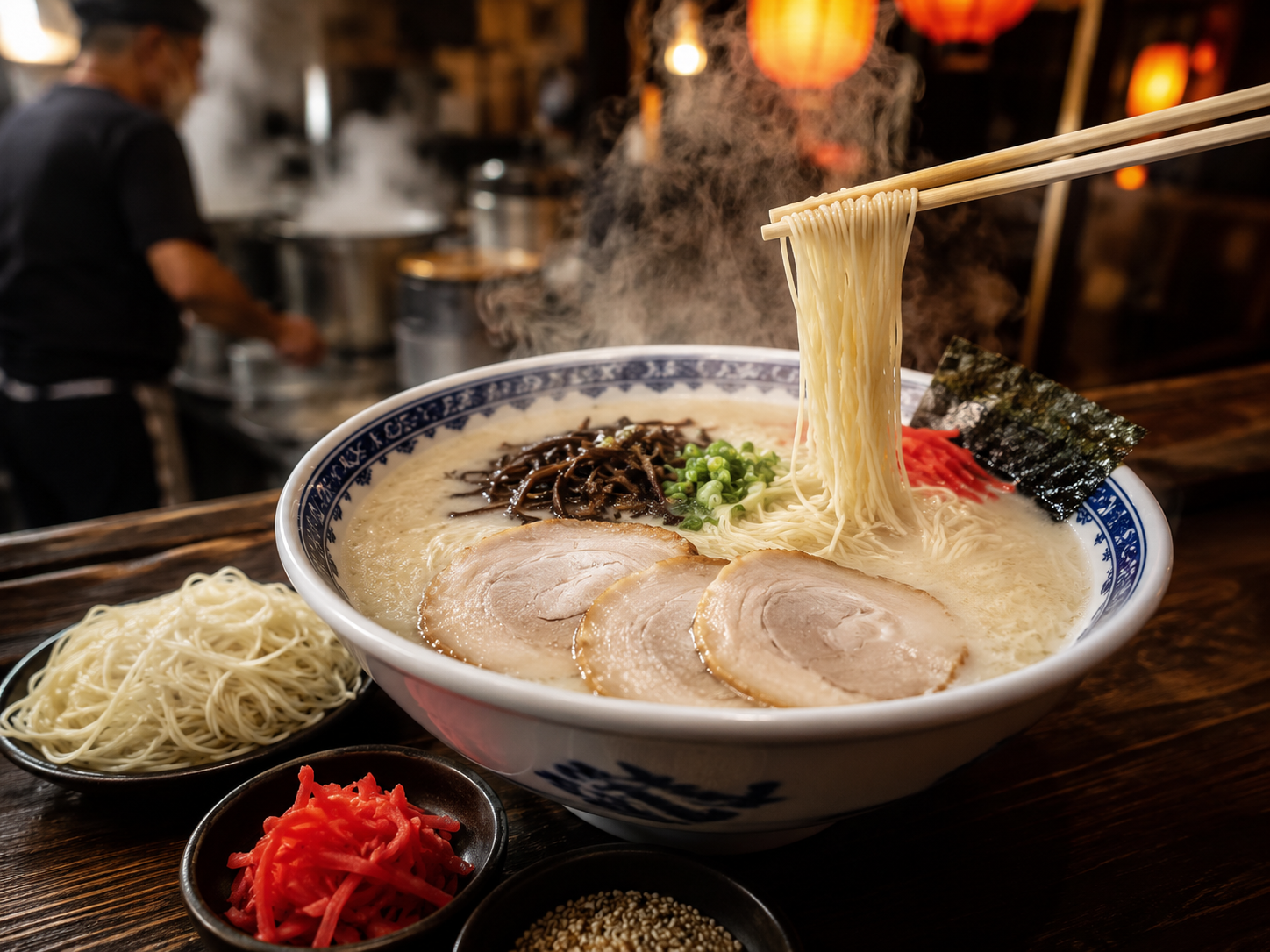
- Portion and serve immediately: Divide the cooked, reheated chāshū among the bowls; 2–3 thin slices are a guide, not a guaranteed 80 g portion. Add kikurage and spring onions, offering beni shōga, sesame and nori optionally at the table. Eat immediately. Cool unused cooked components promptly in shallow containers and use within two days refrigerated or freeze.
- Plan kaedama separately: The six dough portions are for six first bowls. For each refill, prepare an extra roughly 100–110 g fresh Hakata noodles and extra tare if needed; neither is automatically included in the base batch. Cook freshly for the appropriate time, drain and add to still-hot remaining broth. Season only to taste; any extra 5–10 ml tare must come from a separately planned reserve.
Archivist’s notes
- Kurume is the historical root of white tonkotsu broth; Hakata/Nagahama are particularly associated with extra-thin, straight, low-hydration noodles and kaedama.
- The white colour comes from strong mechanical emulsification of fat and collagen. Milk, cream, coconut milk and flour do not belong in it.
- The archived noodle calculation is 135/500 = 27% water, 2% salt, 1.6% kansui and 1% each egg-white/gluten powder. The full formula was not verified from the current Cookpit retrieval and remains labelled as an editorial formulation for suitable machines. The current search excerpt instead mentions 28–32%, but is not a fully read recipe source.
- Usukuchi is lighter in colour but usually saltier than koikuchi. Dose the tare separately from the unsalted broth.
- Black garlic oil, māyu, is chiefly associated with Kumamoto ramen and is deliberately not used here.
- Cool large quantities of broth rapidly in shallow containers in an ice bath; use within 2 days or freeze.
- Quantity status: the complete bone, meat and noodle formulation is an editorial combination. Tare liquids and MSG equal one fifth of the Ramenchef source; 15 g garlic and 3 g kombu are working allowances, not exact bulb/piece conversions. Honteri is a mirin-style seasoning, not hon-mirin. Measure the final yield and plan extra noodles and tare for refills.
Alternatives usable in Europe
- Ramen flour → strong white wheat flour with about 12–13 % protein, plus the specified gluten and egg-white powder.
- Homemade noodles → fresh or frozen ramen noodles expressly labelled Hakata/Kyūshū style, extra thin straight.
- Kansui powder → use only food-grade liquid kansui with an appropriate manufacturer dosage, accounting for its water contribution; no blanket 1:1 conversion and never household cleaning products. If a compatible dosage is unavailable, choose ready-made Hakata noodles.
- Naganegi → robust European leek for the cooking liquid, thin spring onion as a garnish.
- Beni shōga → buy from a Japanese food shop; sweet, broadly sliced sushi gari is not an equivalent substitute.
- Japanese fish sauce → Thai nam pla, expressly used in the source formula; not Worcestershire sauce or anchovy paste.
- Honteri → hon-mirin changes alcohol, sweetness and composition and is not the identical source ingredient. This documented tare uses Honteri; a different version requires separate seasoning adjustment.
Nutrition
Nutrition not calculated: No reproducible calculation is documented for this tonkotsu bowl. Raw bone and pig-trotter weights cannot be treated as the amount of broth consumed. Fat and protein transferred into the broth, tare brand and dose, cooked noodle weight, and the chāshū and garnishes actually served affect the result. The former assumptions of 80 g chāshū and about 600 g total weight per bowl are not supported by a measured yield. Kaedama is an additional noodle refill. Previous estimates have been archived.
Nutrition not calculated: No reproducible calculation is documented for this tonkotsu bowl. Raw bone and pig-trotter weights cannot be treated as the amount of broth consumed. Fat and protein transferred into the broth, tare brand and dose, cooked noodle weight, and the chāshū and garnishes actually served affect the result. The former assumptions of 80 g chāshū and about 600 g total weight per bowl are not supported by a measured yield. Kaedama is an additional noodle refill. Previous estimates have been archived.
| Nutrient | per 100 g | per serving |
|---|---|---|
| Energy | not calculated | not calculated |
| Protein | not calculated | not calculated |
| Fat | not calculated | not calculated |
| Carbohydrate | not calculated | not calculated |
| Salt | not calculated | not calculated |
Image: our own AI-generated illustration of the dish.