
Original recipe estimate: Approx. 2 hours
Several neta, plus rice with 10 min of draining, an unspecified cooking time and 15 min of resting afterwards. Mirin sauces and tamagoyaki must cool completely. Without a defined rice programme and cooling schedule, 120 min is not a reliable total time. Fish suitable for eating raw remains a separate requirement of this recipe.
Origin & original sources
- Cuisine
- Japan
- Origin of this version
- Japan · Tokyo (historic Edo Bay)
- Original name
- 江戸前握り寿司
- Source languages
- Japanese
See the source references for the documented version and its context.
3 original sources1 Authenticity and sources
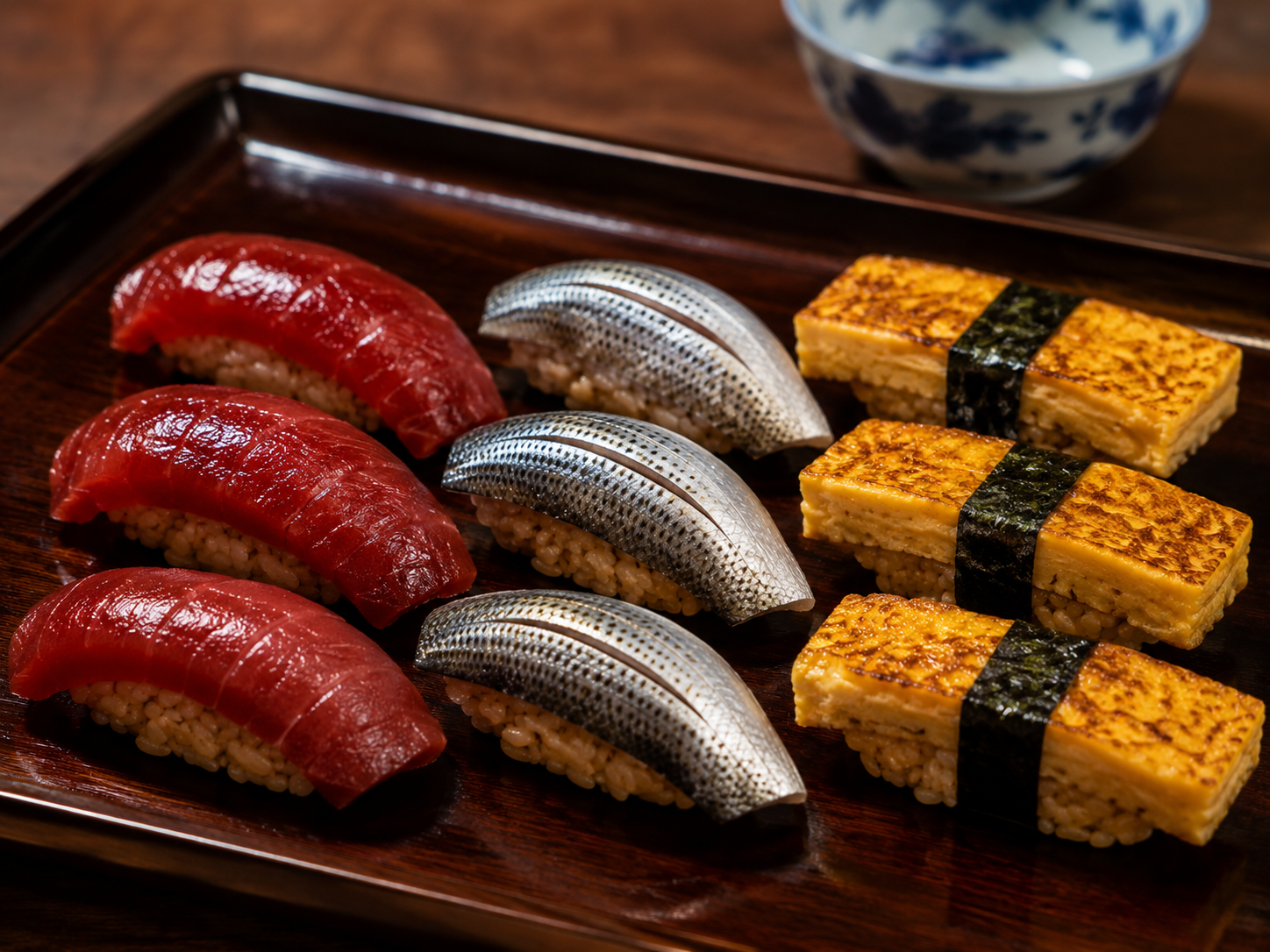
Edomae is not an arbitrary sushi platter, but the craft of treating fish from historic Tokyo: marinating, salting, curing in vinegar, cooking and finishing with sauce. This archive version focuses on three classic neta: zuke maguro, vinegar-cured kohada and tamagoyaki. The key is shari seasoned with akazu, red sake-lees vinegar. Salmon, avocado and mayonnaise are deliberately left out.
- MAFF – Nigiri sushi (Tokyo) · Japanese · accessed 29 August 2026
- Sushi Kano (Edogawa) – How to make nikiri shōyu · Japanese · accessed 29 August 2026
- Ginza Watari – Preparing kohada · Japanese · accessed 29 August 2026
2 Ingredients
Akazu shari – 赤酢のシャリ
- 300 g Japanese short-grain rice (Sushi-meshi)
- 330 ml Water (For cooking)
- 30 ml Sake (清酒 / seishu)
- 12 cm Kombu (昆布)
- 60 ml Red sushi vinegar (赤酢 / akazu)
- 2 g Sugar (Fine)
- 5 g Salt (Fine)
Zuke maguro – づけ鮪
- 180 g Tuna loin (赤身 / akami, expressly suitable for eating raw)
- 30 ml Koikuchi shōyu (濃口醤油)
- 10 ml Hon-mirin (本みりん)
Kohada – 小肌
- 200 g Kohada / Konoshiro (Butterflied, expressly suitable for eating raw)
- 30 g Salt (For salting the fish)
- 120 ml Red sushi vinegar (赤酢 / akazu, for curing)
Tamagoyaki & finishing – 玉子焼き
- 4 pieces Eggs (Size M)
- 60 ml Ichiban dashi (一番だし)
- 10 g Sugar (Fine)
- 5 ml Usukuchi shōyu (薄口醤油)
- 8 ml Neutral oil (For the tamagoyaki pan)
- 30 ml Koikuchi shōyu (For nikiri shōyu)
- 10 ml Sake (For nikiri shōyu)
- 10 ml Hon-mirin (For nikiri shōyu)
- 2 g Kombu (For nikiri shōyu)
- 12 g Hon-wasabi (本わさび, freshly grated)
Use your specialist ingredients again
Documented ingredient connections, including optional variations and side dishes. Check each recipe for its full ingredients and quantities.
Koikuchi shōyu
- Zuke maguro – づけ鮪: Koikuchi shōyu · 濃口醤油
- Tamagoyaki & finishing – 玉子焼き: Koikuchi shōyu · For nikiri shōyu
More recipes using this ingredient:
Usukuchi shōyu
- Tamagoyaki & finishing – 玉子焼き: Usukuchi shōyu · 薄口醤油
More recipes using this ingredient:
Hon-mirin
- Zuke maguro – づけ鮪: Hon-mirin · 本みりん
- Tamagoyaki & finishing – 玉子焼き: Hon-mirin · For nikiri shōyu
More recipes using this ingredient:
Sake
- Akazu shari – 赤酢のシャリ: Sake · 清酒 / seishu
- Tamagoyaki & finishing – 玉子焼き: Sake · For nikiri shōyu
More recipes using this ingredient:
Dried kombu
- Akazu shari – 赤酢のシャリ: Kombu · 昆布
- Tamagoyaki & finishing – 玉子焼き: Kombu · For nikiri shōyu
More recipes using this ingredient:
3 Method
- Salt and cure the kohada: Cover both sides of the butterflied kohada evenly with 30 g salt and leave for 20 minutes. Rinse off the salt under cold water, dry the fish carefully and cure in akazu for 20 minutes. Lift out, pat dry and keep cold until shaping.
- Cook the rice: Wash the rice thoroughly and drain for 10 minutes. Cook with the water, sake and kombu; once cooking finishes, leave covered for 15 minutes. Remove the kombu.
- Cut and fold the akazu shari: Dissolve the sugar and salt in the akazu. Transfer the hot rice to a dampened hangiri, distribute the seasoning over it and turn with cutting strokes of a shamoji while fanning the rice. Do not stir or press; cover with a damp cloth and keep lukewarm.
- Make the zuke maguro: Briefly heat the hon-mirin to let the alcohol evaporate, mix with the koikuchi shōyu and cool completely. Cut the tuna into six even pieces, marinate for 10 minutes, lift out and pat dry.
- Make the nikiri shōyu: Heat the sake and hon-mirin and let the alcohol evaporate. Add koikuchi shōyu and kombu, warm gently without boiling. Cool completely; this sauce will be brushed on later, not served as a dip.
- Roll the tamagoyaki: Mix the eggs, dashi, sugar and usukuchi shōyu. In a lightly oiled tamagoyaki pan, fold several thin layers into a firm, juicy roll. Cool and cut into six pieces.
- Shape and finish the nigiri: Gently press about 20 g shari into each oblong mound. Add a trace of hon-wasabi, top with zuke maguro, kohada or tamagoyaki and shape with only two or three gentle movements. Brush the maguro and kohada very lightly with nikiri and serve immediately.
- Serve as a complete bite: Edomae nigiri is already balanced: no soy-sauce dish, no pickled ginger on the nigiri and no Western sauces. Each bite is eaten just as it was shaped.
Archivist’s notes
- Edomae describes the work on the neta: zuke marinating, salting, vinegar curing, cooking and brushing with nikiri. It is not an arbitrary selection of raw fish.
- Akazu is made from sake lees and gives shari its light amber colour and depth. Balsamic or red wine vinegar does not belong in this sushi.
- In Tokyo, kohada is traditionally salted first and then cured in vinegar. Its texture and acidity deliberately contrast with the leaner maguro.
- Buy only fish expressly intended for eating raw from a trusted specialist, keep it very cold throughout and prepare it on the day of purchase.
Alternatives usable in Europe
- Akazu → look for red sushi vinegar or sake-lees vinegar at Japanese specialist shops. Alternative usable in Europe: Japanese rice vinegar (komezu); the characteristic depth of Edo shari will be missing.
- Kohada / Konoshiro → order from a Japanese fishmonger; do not substitute herring, mackerel or salmon. If unavailable, omit these nigiri instead.
- Hon-wasabi → freshly grated real wasabi is ideal; ordinary horseradish paste is not an equivalent substitute.
- Hangiri → the traditional wooden tub regulates moisture. Alternative usable in Europe: a wide, non-reactive bowl; it does not replicate the tub’s effect on the rice.
Nutrition
Not calculated. No reproducible nutrition calculation is documented for this recipe. The previous serving basis was inconsistent; the amounts of rice, fish and sauce eaten and the finished weight are not documented. Earlier estimates are preserved in the audit archive. Missing values do not mean zero.
Not calculated. No reproducible nutrition calculation is documented for this recipe. The previous serving basis was inconsistent; the amounts of rice, fish and sauce eaten and the finished weight are not documented. Earlier estimates are preserved in the audit archive. Missing values do not mean zero.
| Nutrient | per 100 g | Per portion |
|---|---|---|
| Energy | not calculated | not calculated |
| Protein | not calculated | not calculated |
| Fat | not calculated | not calculated |
| Carbohydrate | not calculated | not calculated |
| Salt | not calculated | not calculated |
Image: our own AI-generated illustration of the dish.