
Original recipe estimate: 2 hours to approx. 14 days
Separate variants: A at least 2 hr refrigerated, optionally overnight; B about 24 hr salting plus cooling the marinade and another 24 hr; C at least 2 weeks following Pal System, without a guaranteed fermentation endpoint; D preparation and cooling plus at least 2 hr refrigerated; E roughly 2 weeks developing the bed plus the first vegetable batch. No shared total duration; the archived 14-day upper limit is not a completion promise.
Origin & original sources
- Cuisine
- Japan
- Origin of this version
- Japan · nationwide / Kyoto / Tokyo
- Original name
- 日本の漬物 五種
- Source languages
- Japanese
See the source references for the documented version and its context.
7 original sources1 Authenticity and sources
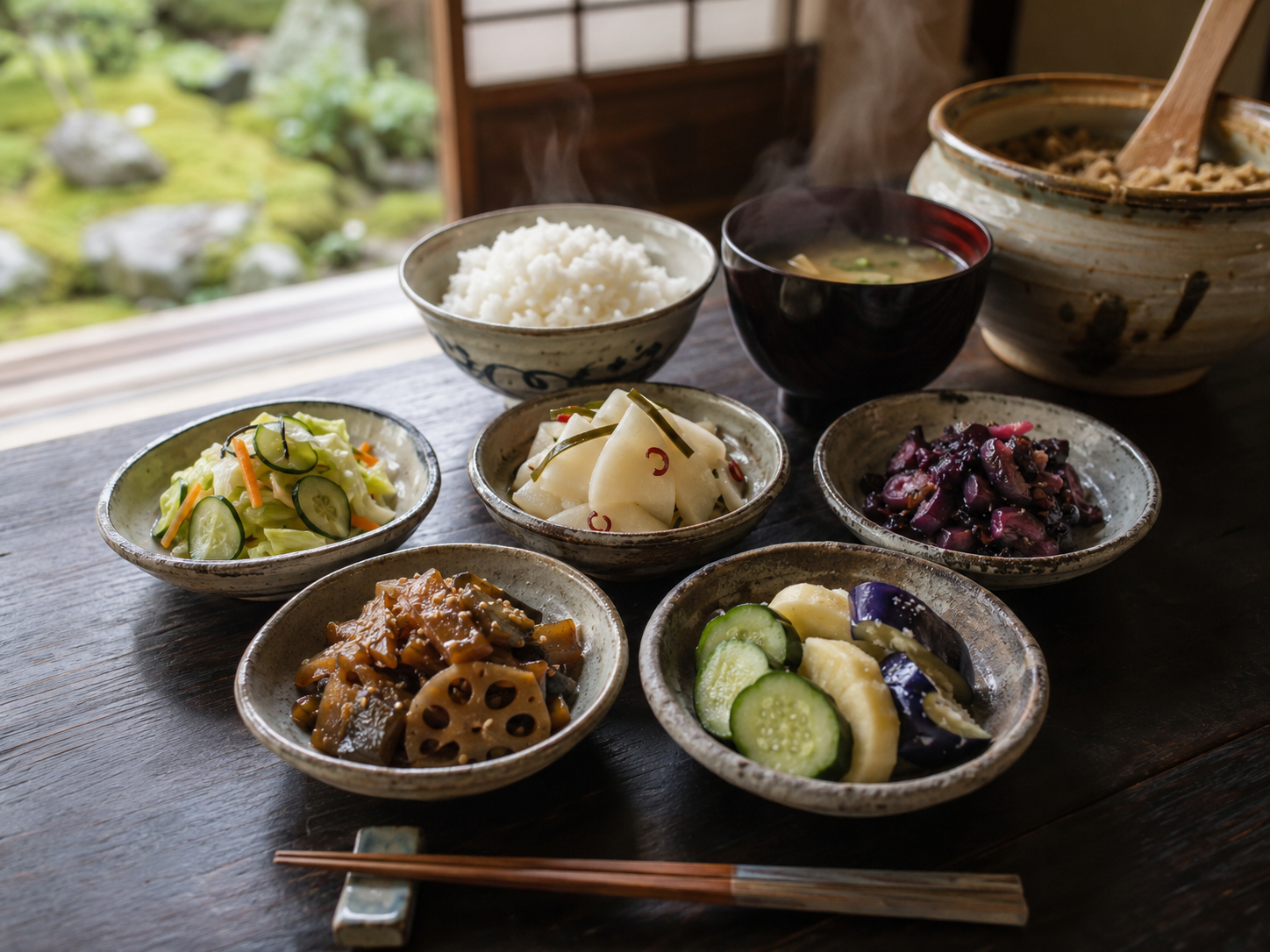
Five separate tsukemono illustrate different Japanese pickling techniques: asazuke, senmaizuke, shibazuke, fukujinzuke and nukazuke. Sources are NHK, Japan’s Ministry of Agriculture MAFF and the Pal System cooperative. Home-kitchen weights and explicitly identified adjustments supplement these methods. Shibazuke now follows Pal System’s documented aubergine-and-shiso version; the former mixed-vegetable formula was not a proportional conversion of the MAFF list. Prepare the variants separately; each has its own maturation time.
- 農林水産省 – 漬物 · Japanese · accessed 22 July 2026
- NHK きょうの料理 – 野菜の浅漬け · Japanese · accessed 22 July 2026
- 農林水産省 – 千枚漬け · Japanese · accessed 22 July 2026
- 農林水産省 – しば漬け · Japanese · accessed 22 July 2026
- NHK きょうの料理 – 福神漬け · Japanese · accessed 22 July 2026
- NHK きょうの料理 – ぬか漬け · Japanese · accessed 22 July 2026
- Pal System – しば漬け(山田奈美監修) · Japanese · accessed 19 October 2026
2 Ingredients
A (asazuke) uses 4 g salt for 250 g vegetables: 1.6%, rounded from the source’s roughly 1.5%. A–E are separate methods. E allows niboshi (fish) instead of shiitake stems, so the collection is not unconditionally vegetarian or vegan. Fermentation times are guides, not safety guarantees.
A · 野菜の浅漬け – Asazuke
- 150 g White cabbage (3–4 cm long, about 2 cm wide)
- 70 g Japanese cucumber (Thin slices, 2–3 mm thick)
- 30 g Carrot (Thinly sliced on the diagonal)
- 4 g Fine sea salt (4 g for 250 g vegetables = 1.6%; rounded from NHK’s roughly 1.5%)
- 2 g Kombu (Very fine threads — kiri-kombu)
B · 千枚漬け – Senmaizuke
- 1000 g Shōgoin turnip (聖護院かぶ; alternatively, a large white turnip)
- 20 g Fine sea salt
- 45 g Dried kombu
- 1 pieces Dried red chilli (Taka no tsume; deseeded)
- 200 ml Japanese rice vinegar (Komezu)
- 90 g White sugar
- 40 ml True mirin (Hon mirin)
C · しば漬け – Shibazuke
- 700 g Small Japanese aubergines (Slices 5 mm thick)
- 210 g Fresh red shiso leaves (赤紫蘇 – aka-jiso; leaves only, without stems)
- 42 g Unrefined sea salt (6% of the aubergine weight; not 6% of all ingredients)
D · 福神漬け – Fukujinzuke
- 200 g Daikon radish (Quarter slices 3 mm thick)
- 100 g Japanese aubergine (Quarter slices 3 mm thick)
- 100 g Japanese cucumber (Halved lengthwise and thinly sliced)
- 100 g Lotus root (蓮根 — renkon; 2–3 mm thick)
- 5 g Fine sea salt
- 45 ml Japanese dark soy sauce (Koikuchi shōyu)
- 20 g White sugar
- 15 ml Japanese rice vinegar
- 15 ml True mirin
- 5 g Kombu (Small pieces, 1 cm)
- 10 g Fresh ginger (Very fine matchsticks)
- 3 g Toasted white sesame seeds (Working weight for 1 tsp; the former 9 g did not match the source quantity)
E · ぬか漬け – Nukadoko
- 1000 g Fresh raw rice bran (生ぬか — nama-nuka)
- 150 g Coarse unrefined sea salt
- 800 ml Water (Boiled and cooled completely)
- 100 ml Japanese lager
- 3 pieces Dried red chillies (Stems and seeds removed)
- 10 g Dried kombu (Editorial weight assumption; the NHK source specifies a 10 cm piece, not a gram weight)
- 5 g Dried shiitake stems or niboshi (Optional, in a spice bag)
- 200 g Outer cabbage leaves or vegetable scraps (Allowance for the starting phase; replace in portions, do not add all at once)
E · First batch of nukazuke vegetables
- 200 g Japanese cucumbers (2 pieces)
- 200 g Daikon radish (Two long pieces)
- 160 g Small Japanese aubergines (2 pieces)
- 8 g Coarse sea salt (For rubbing, as needed)
Use your specialist ingredients again
Documented ingredient connections, including optional variations and side dishes. Check each recipe for its full ingredients and quantities.
Koikuchi shōyu
- D · 福神漬け – Fukujinzuke: Japanese dark soy sauce · Koikuchi shōyu
More recipes using this ingredient:
Hon-mirin
- B · 千枚漬け – Senmaizuke: True mirin · Hon mirin
- D · 福神漬け – Fukujinzuke: True mirin
More recipes using this ingredient:
Dried kombu
- B · 千枚漬け – Senmaizuke: Dried kombu
- D · 福神漬け – Fukujinzuke: Kombu · Small pieces, 1 cm
- E · ぬか漬け – Nukadoko: Dried kombu · Editorial weight assumption; the NHK source specifies a 10 cm piece, not a gram weight
More recipes using this ingredient:
Japanese rice vinegar · Komezu
- B · 千枚漬け – Senmaizuke: Japanese rice vinegar · Komezu
- D · 福神漬け – Fukujinzuke: Japanese rice vinegar
More recipes using this ingredient:
3 Method
- A – Cut the vegetables and weigh the salt: Cut the cabbage, cucumber and carrot as listed. For the base batch, use 250 g prepared vegetables and 4 g salt. This is 1.6%, a rounded working amount compared with NHK’s roughly 1.5%. Scale vegetables and salt together when changing the batch size.
- A – Pickle cold: Briefly massage vegetables, salt and kombu in a food-safe bag, press out the air and close. Refrigerate immediately for at least 2 hr. This home version also refrigerates the initial stage; NHK starts at room temperature.
- A – Refrigerate overnight: For stronger seasoning, leave in the refrigerator overnight. Squeeze gently before serving. Prepare fresh and use promptly; no tested shelf life is claimed here.
- B · Prepare the turnip: Peel the Shōgoin turnip generously, past the fibrous outer ring, and cut into even slices about 2 mm thick.
- B – Salt in advance: Layer the turnip slices evenly with 20 g salt, cover with a clean plate and weight, and salt for about 24 hr in the refrigerator. Drain the released liquid. MAFF specifies a full day; refrigeration is our home-kitchen adjustment.
- B · Boil the pickling liquid: Bring the rice vinegar, sugar and mirin to the boil only until the sugar has fully dissolved, then cool completely.
- B – Pickle in the marinade: Layer the turnip, cut kombu and deseeded chilli. Add the fully cooled marinade, weigh down lightly and refrigerate for another roughly 24 hr. Remove small portions with clean utensils.
- C – Prepare aubergine and shiso: For this Pal System version, use only group C’s quantities: aubergine, fresh red shiso leaves and salt. Wash and dry the aubergine and slice about 5 mm thick; wash the shiso thoroughly and drain well. Line a clean acid- and salt-resistant container with a suitable food-safe bag.
- C – Layer and weigh down: Repeat layers of salt, aubergine, salt and shiso, finishing with shiso and salt. Carefully press air out of the bag, twist the opening closed, add a weight and cover the container. The weight approximately matches the aubergine amount: 700 g for the base batch.
- C – Check the liquid: The next day, drain any dark brown liquid that has appeared. Press out the air again and replace the weight. Afterwards, the aubergine must remain submerged in its liquid. Do not top up with unsalted water. If submersion cannot be maintained, do not continue this batch under these instructions.
- C – Observe fermentation: Pal System describes a summer ferment at room temperature with at least 2 weeks of maturation. It gives no reliably transferable temperature range; the former 20–24 °C and 3–7 day prescription is removed. Time alone, purple colour or a sour smell does not prove safe fermentation. Transfer to a clean container and refrigerate after maturation only if the batch has developed properly. Discard mouldy, foul-smelling, abnormally deteriorated or uncertain batches; do not try to rescue them by skimming or tasting.
- D – Precook lotus and salt the vegetables: Thinly slice daikon, aubergine, cucumber and lotus. Briefly precook the lotus separately in boiling water, drain and cool. Mix all vegetables with 5 g salt, cover and leave for about 30 min, then squeeze thoroughly. The salt weight is our home-kitchen rounding.
- D – Heat the seasoning: Mix soy sauce, sugar, rice vinegar and mirin in a microwave-safe container. Following NHK, heat at 600 W for about 1 min, stir and cool completely. Adjust heating for a different batch size. The vegetables are not repeatedly boiled in the sauce.
- D – Marinate cold: Put the squeezed vegetables in a suitable bag with kombu, ginger and sesame. Add the cooled seasoning, press out the air and close.
- D – Let the flavours develop: Refrigerate for at least 2 hr and mix before serving. Use clean utensils. The former repeatedly reduced version was not a translation of this NHK method.
- E – Heat both halves of the bran: Divide the raw rice bran in half. Heat each half separately, uncovered, in a sufficiently large microwave-safe bowl at 600 W for about 5 min, mixing during heating and avoiding scorching. Heat both halves; neither is deliberately left raw. Cool slightly and distribute 75 g of the salt over each half. Adjust heating and vessel size for a different batch size.
- E – Mix the nukadoko: Work the beer and half the cooled water into the first half of the salted bran. Gradually add the second half and remaining water. Mix thoroughly to the bottom: the consistency should resemble firm miso and hold together when squeezed. Add a little extra water only if the mixture is too stiff.
- E · Aromatics and sutezuke: Work in the chilli, kombu and optional spice bag. Bury the outer cabbage leaves completely, clean the rim, smooth the surface and cover loosely.
- E – Develop the bed: Keep covered in a dark, cool place. During the starting phase, mix thoroughly to the bottom 2–3 times daily; replace the sutezuke vegetables every 2–3 days and do not eat them. Use the allowance in portions as needed. NHK describes about 10 days of care and roughly 2 weeks until the bed develops; this is a guide, not an automatic safety endpoint. Do not continue using a batch that develops abnormally.
- E · Add the first vegetables for eating: Peel strips from the cucumbers, slit the aubergines lengthwise and divide the daikon. Salt sparingly, bury completely in the mature nukadoko and smooth the surface.
- E – Check the first vegetable batch: Bury the vegetables completely in the developed bed, smooth the surface and keep the rim clean. NHK gives half a day to overnight as a general flavour guide; temperature, vegetable thickness and bed condition change the duration. The former fixed times for each vegetable are not established by this source. Remove, scrape off adhering bran, rinse the vegetables and cut.
- E – Maintain regularly: Mix the developed bed thoroughly 1–2 times daily; clean the rim and smooth the surface after each removal. Store in a dark, cool place or in the refrigerator; refrigeration slows pickling. NHK gives no separate refrigerated mixing interval or replenishment formula here. If replenishment is needed, use complete maintenance instructions appropriate to the bed; do not automatically add 15% salt to every addition. Maintain commercial nukadoko only according to its manufacturer.
Archivist’s notes
- Shibazuke is a true lactic acid fermentation. Its acidity develops without vinegar; red shiso supplies aroma and a natural purple-red colour.
- Traditional fukujinzuke originated in Tokyo and uses up to seven vegetables. The naturally coloured soy version is amber-brown, not bright red.
- The Shōgoin turnip is a large, flat Kyoto turnip with particularly fine flesh. Kohlrabi has an unsuitable firm, cabbage-like texture.
- The shibazuke quantities are 70% of the Pal System version: 700 g aubergine, 210 g fresh shiso leaves and 42 g salt. The 6% salt basis is the aubergine alone. Cucumber, myōga and chilli from the former mixture are not included in this documented variant.
- Nama-nuka is raw rice bran; this NHK version heats all the bran before starting the bed. Seasoned or already fermented nukadoko is a different product and must not be started again using the same salt and water list.
- Smell and colour are observations, not safety tests. Discard the entire affected batch if there is visible mould, a rotten smell, unusual slime or uncertain fermentation; do not taste it. These ferments are not shelf-stable preserves.
- Always weigh salt for fermentation. Arbitrarily reducing it changes texture, flavour and microbial safety.
- Traditional takuan is deliberately omitted: dried daikon with long-term rice-bran fermentation deserves its own seasonal recipe card.
- Quantity status: senmaizuke retains MAFF’s specified quantities; rice vinegar, hon-mirin and one chilli are explicit home-kitchen choices. Fukujinzuke: 45 ml soy sauce and 15 ml each of vinegar and mirin correspond to the volume measures; 5 g salt, 20 g sugar and 5 g kombu are working weights. Sesame is corrected to 3 g as a working weight for the source teaspoon. Nukadoko: beer and water follow Japanese cooking cups; aromatics, starting-vegetable allowance and the first vegetable batch are editorial quantities.
Alternatives usable in Europe
- Japanese cucumber → small, low-seed snack or pickling cucumbers; remove the seeds if using a large salad cucumber.
- Shōgoin turnip → a large white turnip or spring turnip, peeled very generously.
- For shibazuke, use fresh unsalted red shiso leaves; do not make an unverified substitution with salted or frozen shiso within this fermentation formula.
- Nama-nuka: use food-grade raw rice bran. Commercial nukadoko is a separate alternative used according to its manufacturer; do not add the salt and water quantities listed here to it.
Nutrition
Nutrition not calculated: No reproducible shared nutrition range is documented for the five separate tsukemono methods. Drained weight, salt removed or absorbed, retained pickling liquid and sugar uptake differ between batches. The rice-bran bed and discarded sutezuke vegetables are not counted as food consumed. Source values for individual recipes or different serving sizes are not a calculation for this collection. Values per 50 g of drained vegetables would require a separate calculation for each variant. Previous estimated ranges have been archived.
Nutrition not calculated: No reproducible shared nutrition range is documented for the five separate tsukemono methods. Drained weight, salt removed or absorbed, retained pickling liquid and sugar uptake differ between batches. The rice-bran bed and discarded sutezuke vegetables are not counted as food consumed. Source values for individual recipes or different serving sizes are not a calculation for this collection. Values per 50 g of drained vegetables would require a separate calculation for each variant. Previous estimated ranges have been archived.
| Nutrient | per 100 g | per serving |
|---|---|---|
| Energy | not calculated | not calculated |
| Protein | not calculated | not calculated |
| Fat | not calculated | not calculated |
| Carbohydrate | not calculated | not calculated |
| Salt | not calculated | not calculated |
Image: our own AI-generated illustration of the dish.