
Original recipe estimate: Approx. 1 hr 40 min
Up to 55 min for the initial chicken cooking, plus about 75 min for separate roasting and pounding the paste, frying it in coconut fat, combining the curry, boiling and frying noodle batches, and preparing the table accompaniments. Some noodle and accompaniment preparation can take place while the chicken cooks; the 100-min headline is tight for all these tasks.
Origin & original sources
- Cuisine
- Thailand
- Origin of this version
- Thailand · Northern Thailand / Chiang Mai
- Original name
- ข้าวซอยไก่ (Khao Soi Gai)
- Source languages
- Thai
See the source references for the documented version and its context.
4 original sources1 Authenticity and sources
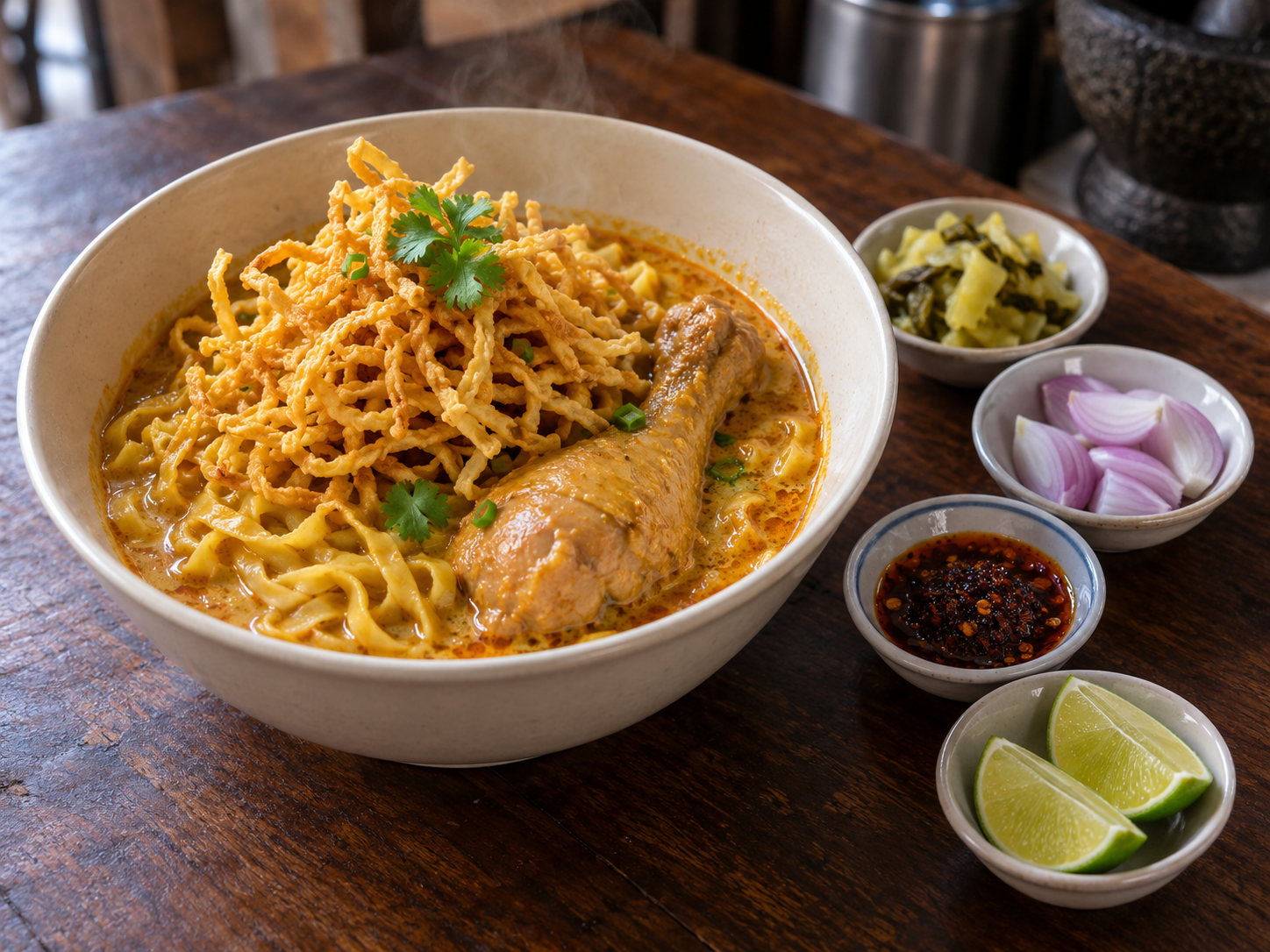
Khao Soi is a defining curry noodle soup of Northern Thailand, particularly associated with Chiang Mai. Accounts from Chiang Mai University and Thai PBS describe its connections with several cultures, including Shan/Myanmar and Yunnan Hui. These do not establish a single city of invention or an unchanged original version. This archive version specifically follows ข้าวซอยไก่ (Khao Soi Gai): chicken drumsticks are cooked until tender in thin coconut milk, then combined with a separately fried spice paste. Some of the fresh flat egg noodles are boiled, while another portion of the same noodles is deep-fried until crisp. Pickled mustard greens, raw shallots, chilli fried in oil and lime are added only at the table. The two noodle textures, warm curry broth and sour, spicy accompaniments define this version. The specific chicken version and its paste are based on HalalThailand. KRUA.CO is used only as a comparison for noodle textures and serving style: it describes a different beef recipe using ready-made red curry paste. The paste chosen here is therefore not a definitive ingredient list for every Khao Soi tradition. Rice noodles, peanut sauce, hoisin and sesame are not added to this version. Basis for the quantities: HalalThailand’s main quantities remain unchanged; assigning them to four large main-course servings is an editorial decision. The source gives no serving count. Its spoon and piece measures are also included alongside the paste ingredients. Their gram values are expressly approximate kitchen guidelines, not exact conversions without weighing; the measuring spoons used here are 1 tbsp = 15 ml and 1 tsp = 5 ml. The noodle, accompaniment and oil quantities, and the starting amounts for seasoning, are editorial additions because the chicken source does not specify them. Cooking times are guidelines; this version has not been test-cooked.
- HalalThailand – วิธีทำข้าวซอยสูตรมุสลิมล้านนา เข้มข้นรสจัดจ้าน พร้อมเครื่องเคียง · Thai · accessed 7 September 2026
- KRUA.CO – ข้าวซอยเนื้อ · Thai · accessed 7 September 2026
- Faculty of Medicine, Chiang Mai University – ข้าวซอย · Thai · accessed 7 September 2026
- Thai PBS – ข้าวซอยอาหารหลากวัฒนธรรม · Thai · accessed 7 September 2026
2 Ingredients
For the fresh Khao Soi paste
- 18 g Large dried red Thai chillies (Approximate kitchen guideline. (พริกแห้งเม็ดใหญ่ – phrik haeng met yai), stems removed; source: 7 pieces. Original reference for the base recipe yielding 4 large servings.)
- 2 g Small dried Thai chillies (Approximate kitchen guideline. (พริกแห้งเม็ดเล็ก – phrik haeng met lek); source: 5 pieces. Original reference for the base recipe yielding 4 large servings.)
- 4 g Coriander seeds (Approximate kitchen guideline. (เม็ดผักชี – met phak chi); source: ½ tbsp. Original reference for the base recipe yielding 4 large servings.)
- 2 g Black cardamom seeds (Approximate kitchen guideline. (กระวานดำ – krawan dam); source: seeds from 3 pods, discard the pod shells. Original reference for the base recipe yielding 4 large servings.)
- 20 g Galangal (Approximate kitchen guideline. (ข่า – kha), finely sliced; source: 2 tbsp. Original reference for the base recipe yielding 4 large servings.)
- 15 g Lemongrass (Approximate kitchen guideline. (ตะไคร้ – takhrai), finely slice the pale, tender part; source: 2 tbsp. Original reference for the base recipe yielding 4 large servings.)
- 10 g Fresh turmeric (Approximate kitchen guideline. (ขมิ้น – khamin), peeled and sliced; source: 1 tbsp. Original reference for the base recipe yielding 4 large servings.)
- 10 g Makrut lime peel (Approximate kitchen guideline. (ผิวมะกรูด – phiu makrut), very finely sliced; source: peel from 1 fruit. Original reference for the base recipe yielding 4 large servings.)
- 100 g Thai shallots ((หอมแดง – hom daeng))
- 25 g Thai garlic (Approximate kitchen guideline. (กระเทียม – krathiam); source: 10 cloves. Original reference for the base recipe yielding 4 large servings.)
- 36 g Shrimp paste (Approximate kitchen guideline. (กะปิ – kapi); source: 2 tbsp, estimated here at approximately 1.2 g/ml. Original reference for the base recipe yielding 4 large servings.)
- 6 g Thai curry powder (Approximate kitchen guideline. (ผงกะหรี่ – phong kari); source: 1 tbsp. Original reference for the base recipe yielding 4 large servings.)
- 6 g Fine salt (Approximate kitchen guideline. Source: 1 tsp. Original reference for the base recipe yielding 4 large servings.)
For the curry and noodles
- 1000 g Bone-in, skin-on chicken drumsticks ((น่องไก่ – nong gai))
- 500 g Thick first-press coconut cream ((หัวกะทิ – hua kathi), divided into two equal parts)
- 1500 g Thin second-press coconut milk ((หางกะทิ – hang kathi); see the sourcing note below)
- 6 g Fine salt for the chicken (Approximate kitchen guideline. Source: an additional 1 tsp. Original reference for the base recipe yielding 4 large servings.)
- 20 g Palm sugar ((น้ำตาลปี๊บ – nam tan pip), starting amount; add more if needed)
- 15 ml Genuine Thai fish sauce ((น้ำปลา – nam pla), starting amount; add more if needed)
- 5 ml Dark Thai soy sauce ((ซีอิ๊วดำ – si-io dam), optional to adjust the colour; editorial starting amount)
- 500 g Fresh flat egg noodles for Khao Soi ((เส้นข้าวซอย / บะหมี่ไข่เส้นแบน))
- 500 ml Neutral oil for deep-frying (Depending on the pot; the amount absorbed is lower)
- 10 ml Neutral oil for the noodle cooking water
- 15 g Coriander leaves (Roughly torn)
- 15 g Spring onion greens (Finely sliced)
To serve separately
- 160 g Pickled mustard greens ((ผักกาดดอง – phak kat dong), well drained and roughly chopped)
- 100 g Raw Thai shallots (Cut into thin wedges)
- 15 g Dried chillies (Coarsely ground, for the table condiment (พริกผัดน้ำมัน – phrik phat nam man))
- 30 ml Neutral oil for the table condiment
- 160 g Whole limes (Approximate kitchen guideline. Cut into wedges; editorial guideline for about 2 fruits for the base recipe yielding 4 large servings)
Use your specialist ingredients again
Documented ingredient connections, including optional variations and side dishes. Check each recipe for its full ingredients and quantities.
Si-io dam
- For the curry and noodles: Dark Thai soy sauce · (ซีอิ๊วดำ – si-io dam), optional to adjust the colour; editorial starting amount
No other verified connection in the archive yet.
Nam pla · Thai fish sauce
- For the curry and noodles: Genuine Thai fish sauce · (น้ำปลา – nam pla), starting amount; add more if needed
More recipes using this ingredient:
- Pad Kra Pao – Stir-fried pork with holy basil
- Tom Kha Gai – Chicken soup with galangal and coconut
- Hakata tonkotsu ramen
- Phat Thai Kung Sot – Stir-fried rice noodles with prawns
- Tom Yam Kung Nam Sai – Clear Thai prawn soup
- Kaeng Khiao Wan Gai – Thai green curry with chicken
- Massaman Nuea – Beef Massaman curry with sweet potatoes
3 Method
- Prepare the paste: Gently dry-roast the dried spices, chillies and fresh aromatics separately; leave the makrut peel, shrimp paste, curry powder and salt unroasted. Do not let anything blacken. Pound everything in batches in a mortar to form a cohesive paste.
- Cook the chicken first: Put the drumsticks, thin coconut milk and the salt allocated to the chicken into a sufficiently large pot. Simmer gently until the meat is cooked through and tender; allow 40–55 minutes as a guideline. Lift out the chicken, reserving all the cooking liquid. The source’s brief instructions are implemented here as a separate initial cooking stage; the cream and paste follow only in the next step.
- Fry the paste in coconut fat: Heat the first half of the coconut cream in a second pot until it releases its fat. Fry the paste in it, stirring until fragrant, then work in the second half of the cream. Add the reserved coconut cooking liquid and bring to the boil.
- Combine and season: Season with the starting amounts of palm sugar and fish sauce, then return the chicken to the pot. Only now taste and adjust the seasoning if needed; salt and shrimp paste are already present. If using the optional dark soy sauce, add it sparingly to adjust the colour. Keep warm. In this chicken version, lime remains an accompaniment at the table.
- Prepare the chilli condiment and noodles: Briefly stir the ground table chillies in their allocated oil over low heat until fragrant; do not let them turn dark. Set aside. Loosely separate one quarter of the egg noodles, pat off surface moisture and deep-fry in batches over medium heat until golden and crisp. Drain. Cook the remaining three quarters in vigorously boiling water with the allocated oil until just cooked; thickness and pack instructions determine the time. This division is an editorial guideline, not a gram allocation from the chicken source.
- Assemble: Divide the boiled noodles among large serving bowls. Distribute the chicken evenly and pour over the hot curry broth. Top with coriander, spring onion and the crisp noodles.
- Serve the accompaniments: Set out the mustard greens, raw shallots, chilli condiment and lime wedges separately. Add them to taste only while eating.
Archivist’s notes
- Khao Soi noodles: look for fresh, flat yellow egg noodles. Thin rice vermicelli, udon, ramen or dried Italian tagliatelle produce neither the right texture nor the characteristic crisp topping. Alternative usable in Europe: fresh Chinese egg noodles with a low alkaline content and a flat ribbon shape.
- Distinguish the coconut milks correctly: hang kathi here means the thin second pressing; ordinary full-fat canned coconut milk is not a like-for-like substitute at the same quantity. Alternatives usable in Europe: unsweetened coconut cream for hua kathi and unsweetened coconut milk diluted with water for hang kathi. As an editorial starting point, mix equal weights of coconut milk and water to reach the required total amount, taking the product’s concentration and fat content into account. This dilution is a sourcing aid, not a specification from the original source. To encourage the fat to separate, use a product without stabilisers if possible.
- Black cardamom: the source explicitly names กระวานดำ and uses only the seeds. It identifies neither a botanical species nor a specifically Thai origin for the commercial product. No such origin or fixed smoky note is therefore promised. Ask the retailer for the black cardamom intended for this Northern Thai paste; do not silently treat green cardamom as equivalent. The spice is not arbitrarily omitted from this version.
- Makrut and shrimp paste: makrut lime peel and kapi belong in the paste chosen here. Lime juice does not replace the peel; European anchovy paste is not used in place of kapi.
- Mustard greens: pickled mustard greens must remain sour and crisp. Kimchi, sauerkraut, pickled gherkins and sweet cucumber salad are not suitable sourcing substitutes.
- No shortcut to yellow curry: ready-made yellow curry paste can only be an emergency variation clearly declared as a simplified everyday option. For this archive version, the defining spices of the Khao Soi paste are pounded in a mortar from scratch.
Alternatives usable in Europe
Nutrition
No nutritional values have been calculated for this archive version. Coconut milk concentration, the edible proportion of the chicken and absorbed frying oil affect the values.
| Nutrient | per 100 g | per large main-course serving |
|---|---|---|
| Energy | not calculated | not calculated |
| Protein | not calculated | not calculated |
| Fat | not calculated | not calculated |
| Carbohydrate | not calculated | not calculated |
| Salt | not calculated | not calculated |
Image: our own AI-generated illustration of the dish.