
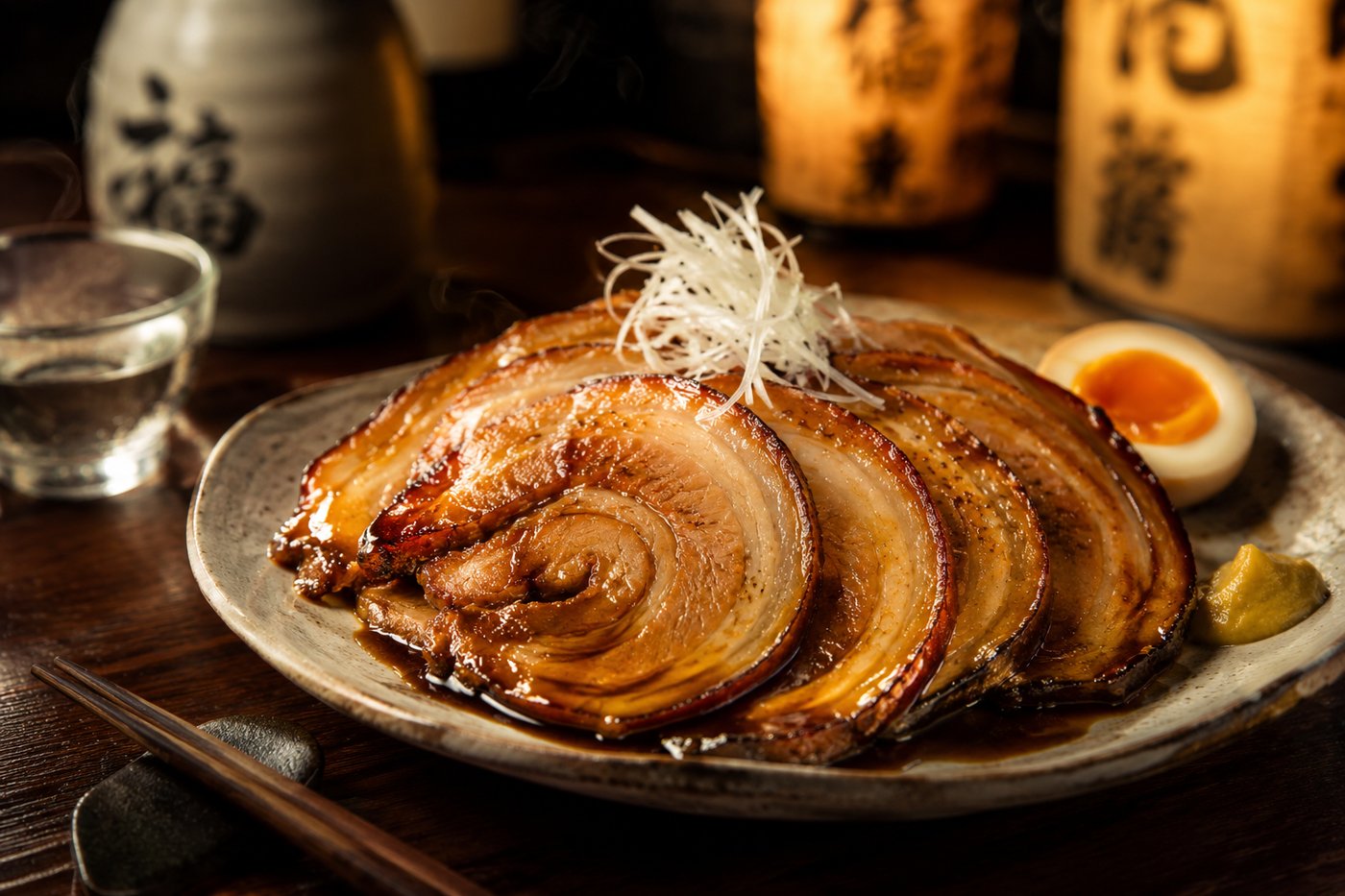
Original recipe estimate: Approx. 180 min archived estimate; total including cooling unspecified
90–120 min of initial simmering and approx. 60 min of braising, plus preparation, searing, rapid cooling and refrigerated resting. No required room-temperature rest. Cooling duration has not been measured; an overnight rest is only in the refrigerator. 180 min is not the full total time.
Origin & original sources
- Cuisine
- Japan
- Origin of this version
- Japan
- Original name
- 煮豚チャーシュー
- Source languages
- Japanese
See the source references for the documented version and its context.
6 original sourcesWhat goes with it
In this recipe: Braising liquid / Tare
1 Authenticity and sources
Japanese nibuta chāshū is gently cooked and sliced as a ramen topping. 麺と釣人 demonstrates both belly and shoulder followed by marinating. Our existing belly version combines initial simmering with additional braising in a sake-and-sugar tare; its exact quantities are not a literal adaptation of that blog. The earlier reference to hamukoubou.jp cannot substantiate quantities without a specific verified recipe address. Searing adds browned flavours; belly is a deliberately fatty choice, not the only suitable cut. The meat rests in the refrigerator after rapid cooling.
- 麺と釣人 – Basic chāshū for ramen · Japanese · accessed 22 July 2026
- Kikkoman – shoulder and mirin chāshū (variation evidence) · Japanese · accessed 18 October 2026
- MHLW – hygiene, core temperature and rapid cooling · Japanese · accessed 18 October 2026
- MAFF – household food hygiene · Japanese · accessed 18 October 2026
- Takara – salt-free cooking seishu (product definition) · Japanese · accessed 20 October 2026
- Fundokin – pork belly chashu (separate quantity comparison) · Japanese · accessed 20 October 2026
2 Ingredients
Weigh pork belly raw and use sake without added salt. The 300 ml water belongs only to the initial tare; additional pre-cooking and top-up water is needed. Kitchen twine is equipment. The full quantity basis of this tare remains under review.
Meat
- 500 g Pork belly, in one piece (豚バラブロック – 500 g raw, boneless pork; not a cooked serving weight)
- 1 pieces Kitchen twine (タコ糸, tako-ito – equipment; choose the length to fit the roll and remove before eating)
- 15 ml Neutral vegetable oil (For searing)
Aromatics for simmering
- 1 pieces Leek stalk (green part) (長ネギの青い部分)
- 20 g Fresh ginger (生姜, sliced)
- 2 pieces Garlic cloves (にんにく, lightly crushed)
Braising liquid / Tare
- 100 ml Japanese soy sauce (Koikuchi Shōyu) (濃口醤油)
- 100 ml Sake (清酒 / 日本酒 without added salt; cooking seishu explicitly labelled salt-free is also suitable)
- 300 ml Water (initial water for the tare only; extra water for pre-cooking and topping up as needed)
- 36 g Cane sugar (Kibizatō) (キビ砂糖 – weigh directly; 36 g is not a documented spoon conversion)
Use your specialist ingredients again
Documented ingredient connections, including optional variations and side dishes. Check each recipe for its full ingredients and quantities.
Koikuchi shōyu
- Braising liquid / Tare: Japanese soy sauce (Koikuchi Shōyu) · 濃口醤油
More recipes using this ingredient:
Sake
- Braising liquid / Tare: Sake · 清酒 / 日本酒 without added salt; cooking seishu explicitly labelled salt-free is also suitable
More recipes using this ingredient:
3 Method
- Prepare: Keep the pork belly refrigerated until preparation, pat dry and work promptly. Leaving meat at room temperature does not replace a doneness check. Clean hands and utensils after handling raw pork; use clean utensils for cooked meat.
- Tie the meat: Tie the piece into an even roll with kitchen twine. Thickness and shape affect cooking time.
- Sear: Heat the listed oil and brown the roll on all sides. This develops flavour; it does not seal the surface against moisture loss.
- Simmer with the aromatics: Put the meat in a suitably sized pot, cover with additional water and add leek greens, ginger and garlic. This water is separate from the tare water. Bring to the boil, then simmer gently for approx. 90–120 min. Replace evaporated water to keep the meat covered; use a suitable otoshibuta drop lid.
- Braise in tare and check doneness: Combine soy sauce, sake, the measured tare water and sugar in a suitably sized pot. Lift the meat from the initial cooking water, add it to the tare and simmer gently for approx. 60 min, turning occasionally. Do not let the liquid cook dry; add a little water if needed. With a clean thermometer, check that the thickest centre reaches at least 75 °C for 1 min. A skewer should also enter easily; continue gentle cooking if needed. Time alone establishes neither safety nor tenderness.
- Cool rapidly and rest chilled: Immediately transfer the meat and tare to clean, small, shallow containers; divide a thick roll into smaller pieces if necessary. Cool the containers rapidly in an ice-water bath without letting bath water enter; stir the tare with a clean spoon. Refrigerate promptly and continue cooling, covered. Do not leave the large pot to cool completely at room temperature. An overnight rest takes place only in the refrigerator; it is not a cooling period on the counter.
- Slice and reheat: Slice the cold meat with a clean knife and remove the twine. Thoroughly reheat only the portion needed in hot broth or tare, reaching at least 75 °C for 1 min at the centre. A blowtorch may then brown the surface but does not replace thorough reheating. Serve immediately; keep the rest refrigerated and use promptly or freeze in portions.
Archivist’s notes
- Quantity status: 500 g raw pork belly, 100 ml koikuchi, 100 ml sake without added salt, 300 ml initial tare water and 36 g sugar remain the existing archive combination. Neither Men to Choujin nor Kikkoman substantiates this complete mixture. Fundokin’s comparison using its own sweet soy sauce and 50 ml sake does not validate these quantities either. Full quantity review remains open; no cooking trial or measured yield.
- Cut and cooking time: The blog timings describe its own pieces. Both shoulder and belly are used; thickness, temperature and desired texture matter. There is no universal time limit for every shoulder piece.
- Mirin: This tare still uses sake and sugar. That does not imply a general ban on mirin: both the blog and a Kikkoman recipe use mirin, and Kikkoman also uses shoulder. The former blanket protein explanation has been removed.
- Separate archived variation: The blog documents 90 ml Koikuchi Shōyu plus 30 ml mirin and approx. 60 min of marinating. This is not an extra step in the main version. Rapidly cool fully cooked meat and marinate this variation under refrigeration; then reheat thoroughly as described. The cooling procedure is an editorial safety clarification.
- Ramen broth: Cooking in broth is a separate variation. It replaces the initial cooking water, not automatically the tare. Do not merely warm raw meat in serving broth; cook it thoroughly and handle the broth hygienically.
- Product and water basis: cooking sake is not always salted. Takara explicitly documents salt-free cooking seishu; check the label for added salt for this version. The 300 ml is not the total water requirement. For a targeted trial, record roll diameter, internal pot diameter, pre-cooking water, each top-up and remaining tare separately. The approximate eight topping portions do not establish a yield of 60 g each.
Alternatives usable in Europe
- Koikuchi Shōyu → regular Japanese soy sauce (e.g. Kikkoman); NOT sweet soy sauce or Chinese dark soy sauce.
- Sake → Japanese seishu without added salt, including salt-free cooking seishu. European fallback: dry sherry as a flavour-changing substitute; do not equate it with salted cooking rice wine.
- Kibizatō → brown raw or whole cane sugar; ordinary sugar as a fallback.
- Tako-ito → unbleached kitchen or butcher’s twine.
Nutrition
Not calculated. No reproducible nutrition calculation is documented for the finished pork-belly chāshū. Fat lost during the initial simmer, oil actually eaten, salt and sugar absorbed from the tare and drained finished yield are not specified. The former 60 g portion was an unconfirmed assumption. Commercial comparison products do not establish values for this recipe. Earlier estimates are preserved in the audit archive; missing values do not mean zero.
Not calculated. No reproducible nutrition calculation is documented for the finished pork-belly chāshū. Fat lost during the initial simmer, oil actually eaten, salt and sugar absorbed from the tare and drained finished yield are not specified. The former 60 g portion was an unconfirmed assumption. Commercial comparison products do not establish values for this recipe. Earlier estimates are preserved in the audit archive; missing values do not mean zero.
| Nutrient | per 100 g | per topping portion |
|---|---|---|
| Energy | not calculated | not calculated |
| Protein | not calculated | not calculated |
| Fat | not calculated | not calculated |
| Carbohydrate | not calculated | not calculated |
| – of which sugars | not calculated | not calculated |
| Salt | not calculated | not calculated |
Image: our own AI-generated illustration of the dish.