
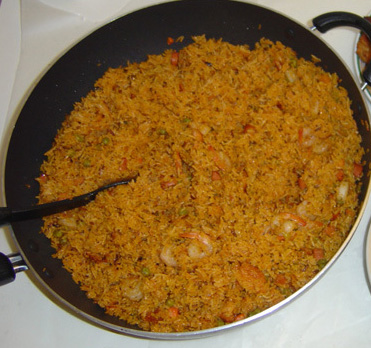
Original recipe estimate: Approx. 75 min
Total time remains open: final rest set editorially at 10 minutes; rice cooking and the bottom-pot endpoint depend on sauce, rice variety, heat and cookware. First crust check after 1–2 min; no fixed smoking endpoint. Dodo, chicken and coleslaw are separate.
Origin & original sources
- Cuisine
- Nigeria
- Origin of this version
- West Africa · Nigeria
- Original name
- Jollof Rice
- Source languages
- English (Nigeria)
See the source references for the documented version and its context.
3 original sources1 Authenticity and sources
Party Jollof is the Nigerian celebration version of rice in tomato and pepper sauce. The browned layer at the base of the pot, known as bottom pot, contributes a toasted aroma. The Kitchen Butterfly article read again on 14.10.2026 supports this technique but supplies no complete ingredient quantities for our archive version. The earlier detailed origin and exclusivity claims were not sufficiently supported by that reference and have been withdrawn. Existing gram and millilitre quantities remain provisional archive values, not a verified source conversion or an in-house cooking test.
- Kitchen Butterfly – Around the World in Bottom Pot · English (Nigeria) · accessed 22 July 2026
- Nigerian Food TV – jollof with additional rice precooking · English (Nigeria) · accessed 20 October 2026
- All Nigerian Recipes – doneness and further cooking, different rice preparation · English (Nigeria) · accessed 20 October 2026
2 Ingredients
Weigh rice dry and only rinse it; do not additionally precook. Stock cubes are a historical allowance: check the label and existing stock seasoning. Extra hot water as needed; liquid ratio still unverified. Final rest set editorially at 10 minutes.
Tomato and pepper base (blended)
- 350 g Ripe beefsteak tomatoes
- 450 g Red peppers (Original: tatashe – large, mild pointed peppers)
- 150 g Red onion
- 18 g Scotch bonnet chillies (Original: ata rodo, about 2 chillies)
- 60 ml Water
Seasoning
- 3 g Dried thyme (about 1 tbsp)
- 7 g Curry powder (about 1 tbsp)
- 2 Bay leaves
- 2 Chicken or beef stock cubes (Historical allowance of 2 cubes, not a fixed dosing instruction: check size, salt content and dilution on the product label; do not automatically add them to already seasoned stock.)
- Salt and white pepper (as needed)
Frying base and rice
- 120 ml Neutral vegetable oil
- 150 g Red onion (finely diced)
- 70 g Tomato paste
- 4 Garlic cloves (finely chopped)
- 15 g Ginger (grated)
- 800 g Parboiled long-grain rice (Weigh dry: commercially parboiled long-grain rice, only rinsed and drained here, not additionally precooked.)
Stock and finishing ingredients
- 775 ml Hot chicken or beef stock (Historical range 750–800 ml, still unverified; taste the stock before adding and adjust cubes/salt accordingly. Keep extra hot water available for further cooking if needed.)
- 30 g Butter
- 1 Tomato (sliced)
- 1 Small red onion (sliced)
3 Method
- Blend the base: Blend the tomatoes, peppers, onion, Scotch bonnet chillies and water until smooth.
- Build the frying base: Heat the oil in a large, heavy pot and soften the diced onion for 3–5 minutes. Stir in the tomato paste and fry for about 5 minutes until darker red and fragrant; do not let it blacken. Fry the garlic, ginger and bay leaves for 2 minutes.
- Reduce the sauce: Pour in the blended base and reduce uncovered over medium heat for about 15–20 minutes. It should thicken and lose its raw taste; visible oil is a cue, not proof on its own. Tomato moisture, pot width and heat change the reduction time required.
- Season: Stir in the thyme, curry powder and pepper. Taste the prepared stock before adding cubes or salt: do not automatically combine seasoned stock with the entire cube allowance. Add cubes gradually according to the label and taste, then cook for 2–3 minutes. Adjust salt carefully after adding the stock and again at the end.
- Coat the rice: Add the rinsed, drained rice and fold it through the sauce until every grain is coated.
- Steam: Pour in the hot stock from the ingredient list; this remains an unverified archive quantity, not a guaranteed liquid rule. Bring briefly to the boil, cover tightly and steam over low heat for about 20–30 minutes. Avoid unnecessary opening and stirring, but check immediately if you smell burning. Then taste several grains. If they are still hard and no free liquid remains, add a little hot water, cover tightly again and continue cooking gently; check again before adding more. Do not top up while free liquid remains. The total needed also depends on the reduced sauce.
- Develop the bottom-pot flavour (Party Jollof technique): Only once the rice is cooked and free liquid is absorbed, increase the heat in a controlled way. Use a suitable uncoated pot within its manufacturer limits. After 1–2 min, gently check the base with a spoon: aim for a thin golden to caramel-brown crust with a toasted aroma. Do not wait for visible smoke. Stop the heating before the bottom blackens or if the smell becomes acrid. Remove the pot from the hot hob and rest, covered, for 10 minutes. This final rest is an editorial working instruction, not a verified source value or an in-house trial.
- Finish: Fold in the butter and the sliced tomato and onion. Remove the bay leaves.
- Serve: Fluff gently with a fork without vigorous stirring. Traditionally served with fried plantain (dodo), chicken or coleslaw.
Archivist’s notes
- Tatashe (red pointed peppers) → sometimes sold fresh in African food shops; ordinary mild red pointed peppers or red bell peppers are an alternative.
- Ata rodo (Scotch bonnet) → part of the West African chilli trio described in the archive. Look in African food shops; mild European chillies do not preserve its characteristic flavour.
- Open the lid only as needed and avoid constant stirring. A necessary doneness or scorching check takes priority over a rigid rule never to open the pot. Dry rice that is still hard needs more moisture and gentle cooking before any crust-forming stage.
- Bottom pot means a carefully browned crust, not black char. The first check after 1–2 min is not a guaranteed endpoint; heat and cookware affect the result.
- Rice basis and source comparison: this version weighs 800 g commercially parboiled rice dry and only rinses it. Nigerian Food TV and All Nigerian Recipes describe additional precooking. Their liquid rules must therefore not be transferred unchanged to this method. A dependable ratio of reduced sauce, rice and stock remains unresolved; no cooking trial. The new 10-minute final rest is explicitly editorial.
Alternatives usable in Europe
- Ata rodo (Scotch bonnet) → habanero, a closely related fruity, hot chilli; mild chillies change the intended character.
- Tatashe (red pointed peppers) → ordinary mild red pointed peppers or red bell peppers.
- Maggi/Knorr cubes → check the product and label at African food shops. Different varieties do not automatically have the same size, salt content or dosage. Availability and flavour strength relative to other products are not confirmed here.
- Parboiled long-grain rice → keep the same rice variety for a reproducible quantity trial. Basmati requires its own adjustment of preparation, water and cooking time; it is not a universally lower-liquid, one-for-one alternative.
Nutrition
Not calculated. The previous energy figures per 100 g and per portion were mathematically inconsistent. No reproducible calculation or reliable portion weight is documented for this recipe. Stock cubes, seasoning, bottom-pot crust eaten and finished yield are not documented as a calculation basis. Historical figures are preserved in the audit archive; missing values do not mean zero. Side dishes are separate.
Not calculated. The previous energy figures per 100 g and per portion were mathematically inconsistent. No reproducible calculation or reliable portion weight is documented for this recipe. Stock cubes, seasoning, bottom-pot crust eaten and finished yield are not documented as a calculation basis. Historical figures are preserved in the audit archive; missing values do not mean zero. Side dishes are separate.
| Nutrient | per 100 g | per portion |
|---|---|---|
| Energy | not calculated | not calculated |
| Protein | not calculated | not calculated |
| Fat | not calculated | not calculated |
| Carbohydrate | not calculated | not calculated |
| Salt | not calculated | not calculated |
Image: Wikimedia Commons: Jollof rice.jpg – Salamisa (public domain)