
Original recipe estimate: Approx. 30 min with cooled dashi; 75–90 min with freshly made dashi
The dashi required by the recipe is ready and at the appropriate temperature.
Allow about 30 minutes with prepared, cooled dashi, prepared prawns and cooked ginkgo: cut the fillings, strain the egg mixture, fill the cups, steam over high heat for 1 minute and gently for 10–12 minutes, then check doneness. Fresh dashi also needs soaking, heating, straining and cooling; allow roughly 75–90 minutes in total. Check the actual doneness before serving.
Origin & original sources
- Cuisine
- Japan
- Origin of this version
- Japan; nationwide, with a historic tradition in Nagasaki
- Original name
- 茶碗蒸し (Chawanmushi)
- Source languages
- Japanese
See the source references for the documented version and its context.
9 original sources1 Authenticity and sources
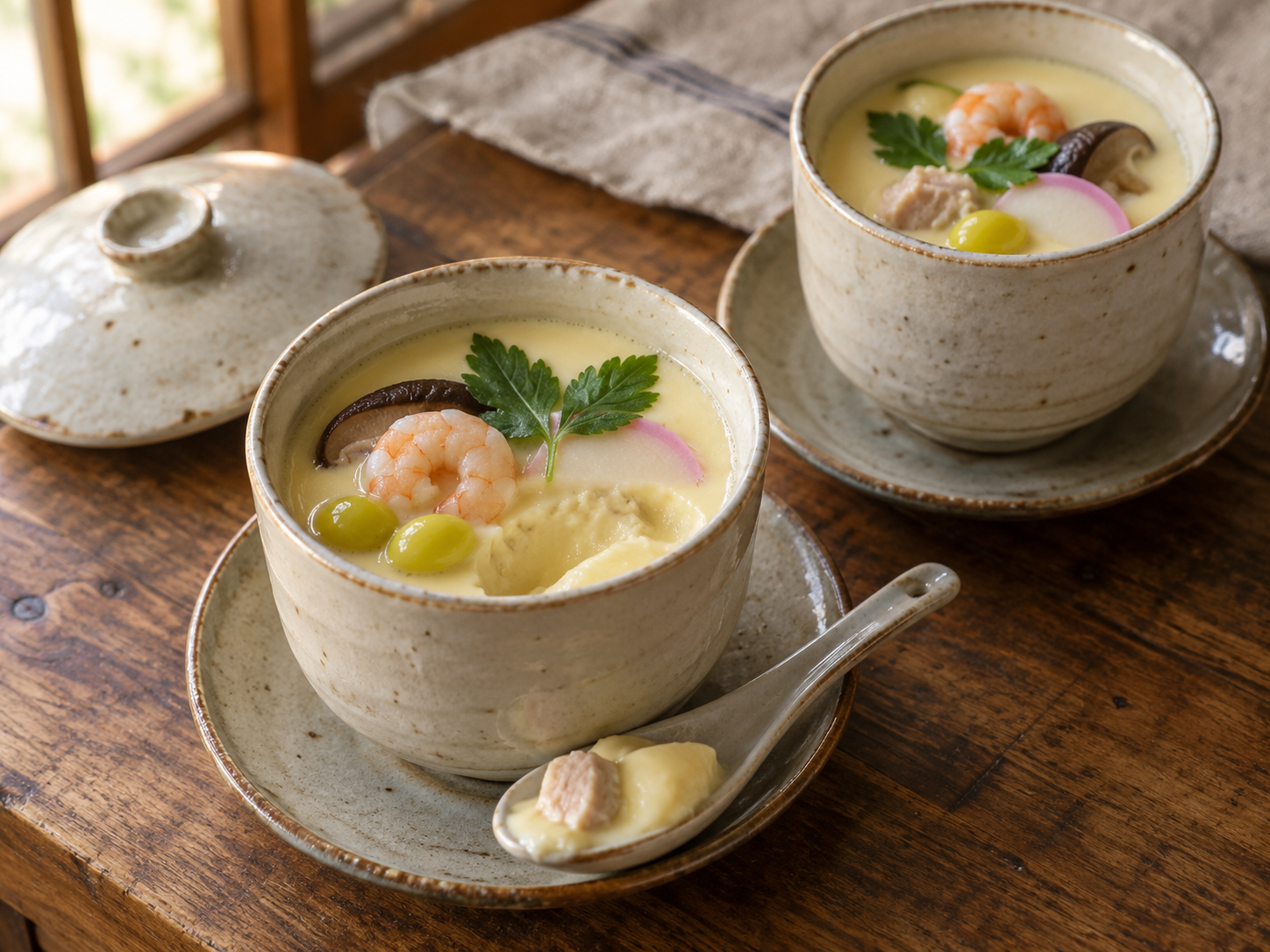
Chawanmushi is a delicately steamed, savoury egg custard. This version follows Japan’s Hattori cookery school: two eggs to 350 ml dashi, with usukuchi and traditional fillings. Stirring without incorporating air, straining and gentle steaming preserve its silky texture. Usukuchi keeps the custard pale; it is not a reduced-salt soy sauce. The historic restaurant Yossou describes earlier forms in Kyoto and Osaka and their later spread to Nagasaki. This is not a reconstruction of Yossou’s own recipe.
- Hattori cookery-school recipe · Japanese · accessed 22 September 2026
- Yossou · Japanese · accessed 22 September 2026
- MAFF: 茶碗蒸し · Japanese · accessed 22 September 2026
- Kikkoman: 基本の茶碗蒸し · Japanese · accessed 22 September 2026
- Kikkoman: 茶碗蒸し · Japanese · accessed 22 September 2026
- Kikkoman: Japanese measuring spoons · Japanese · accessed 22 September 2026
- Japanese salt information centre · Japanese · accessed 22 September 2026
- Japan Soy Sauce Association · Japanese · accessed 22 September 2026
- Higashimaru Usukuchi · Japanese · accessed 22 September 2026
2 Ingredients
Egg custard mixture
- 100 g Egg, without shell (2 eggs) (Approximate shopping weight. The piece count in brackets applies to the original quantity (4 portions).)
- 350 ml Prepared, unsalted kombu-katsuo dashi, cooled
- 2 g Fine dry salt
- 2.5 ml Usukuchi shōyu (薄口しょうゆ)
- 2.5 ml Hon-mirin (本みりん)
Fillings
- 50 g Chicken tenderloin (sasami / ささみ; 1 piece) (Approximate shopping weight. The piece count in brackets applies to the original quantity (4 portions).)
- 40 g Small prawns, peeled and deveined (4 pieces) (Approximate shopping weight. The piece count in brackets applies to the original quantity (4 portions).)
- 20 g Fresh shiitake, tough stems removed (2 small mushrooms) (Approximate shopping weight. The piece count in brackets applies to the original quantity (4 portions).)
- 20 g Kamaboko (かまぼこ; 4 small fan-shaped slices) (Approximate shopping weight. The piece count in brackets applies to the original quantity (4 portions).)
- 16 g Cooked, drained ginkgo nuts (ginnan / ぎんなん水煮; 8 pieces) (Approximate shopping weight. The piece count in brackets applies to the original quantity (4 portions).)
- 4 g Mitsuba (糸三つ葉; 4 stems with leaves) (Approximate shopping weight. The piece count in brackets applies to the original quantity (4 portions).)
- 2.5 ml Usukuchi shōyu to lightly coat the chicken and prawns
If making dashi from scratch – a small batch
- 500 ml Water (Only for making dashi from scratch; use 350 ml of the batch. Do not also buy prepared stock.)
- 5 g Kombu (Only for making dashi from scratch; use 350 ml of the batch. Do not also buy prepared stock.)
- 10 g Thinly shaved katsuobushi (Only for making dashi from scratch; use 350 ml of the batch. Do not also buy prepared stock.)
Use your specialist ingredients again
Documented ingredient connections, including optional variations and side dishes. Check each recipe for its full ingredients and quantities.
Usukuchi shōyu
- Egg custard mixture: Usukuchi shōyu (薄口しょうゆ)
- Fillings: Usukuchi shōyu to lightly coat the chicken and prawns
More recipes using this ingredient:
Hon-mirin
- Egg custard mixture: Hon-mirin (本みりん)
More recipes using this ingredient:
Dried kombu
- If making dashi from scratch – a small batch: Kombu · Only for making dashi from scratch; use 350 ml of the batch. Do not also buy prepared stock.
More recipes using this ingredient:
Katsuobushi · bonito flakes
- If making dashi from scratch – a small batch: Thinly shaved katsuobushi · Only for making dashi from scratch; use 350 ml of the batch. Do not also buy prepared stock.
More recipes using this ingredient:
3 Method
- Prepare the dashi: Soak the kombu in the 500 ml water for 30 minutes. Heat and remove it before the water reaches a rolling boil. Take the pan off the heat, add the katsuobushi, leave to infuse for 2 minutes and strain finely. Measure out 350 ml and leave to cool. Skip this step if using prepared dashi.
- Cut the fillings: Remove the tendon from the chicken and cut it diagonally into thin pieces. Prepare the prawns; lightly coat both with the soy sauce reserved for marinating. Halve the shiitake on an angle, cut the kamaboko into fan shapes and roughly chop the mitsuba.
- Make a smooth custard mixture: Mix the salt, usukuchi and mirin into the dashi. Stir the eggs without making them foamy, incorporate the dashi and pour through a sieve. Remove any visible air bubbles.
- Fill the cups: Distribute all the fillings evenly and slowly pour in the egg mixture. Leave a little space below the rim of each cup.
- Steam gently: Set a steamer insert over boiling water. Put the cups in place and leave the pan lid slightly ajar. Steam over high heat for 1 minute, then over low heat for 10–12 minutes.
- Check for doneness: Check the centre with a wooden skewer: clear liquid should emerge rather than cloudy egg mixture. The custard should remain tender. The chicken and prawns must be cooked through; continue steaming over low heat if necessary. Serve warm. The thickness of the cups and the depth of the filling affect the actual cooking time.
Archivist’s notes
- Usukuchi: look for 薄口・淡口しょうゆ. A pale colour does not mean less salt. Chinese ‘light soy sauce’ is a different category. Higashimaru Usukuchi provides a relevant manufacturer reference; no European retailer has yet been verified and no affiliate link is active for it.
- Japanese fillings: look for kamaboko in the chilled or frozen section, specifically pre-cooked ginkgo nuts, and mitsuba at a Japanese food shop. Kamaboko is steamed fish paste; mitsuba is not coriander.
- Four small starter portions in heatproof cups holding about 180–200 ml. The dashi ingredients are an alternative to prepared stock: use 350 ml of the batch, rather than buying both sets of ingredients.
- Piece weights are approximate shopping guidelines. Hattori does not specify the amount of soy sauce for marinating; this version allows 2.5 ml usukuchi. Mirin is specified as hon-mirin and dashi as unsalted kombu-katsuo dashi. Times are planning estimates; this recipe has not been test-cooked by us.
Alternatives usable in Europe
- Chicken breast can replace the tenderloin; a suitable sachet of unsalted Japanese dashi may be used after checking its label. Flat-leaf parsley can replace mitsuba in Europe, but changes the flavour. Seek out usukuchi specifically for this example in the soy sauce guide.
Nutrition
No nutritional calculation has been carried out.
| Nutrient | per 100 g | per small starter portion |
|---|---|---|
| Energy | not calculated | not calculated |
| Fat | not calculated | not calculated |
| Carbohydrate | not calculated | not calculated |
| Protein | not calculated | not calculated |
| Salt | not calculated | not calculated |
Image: our own AI-generated illustration of the dish.