
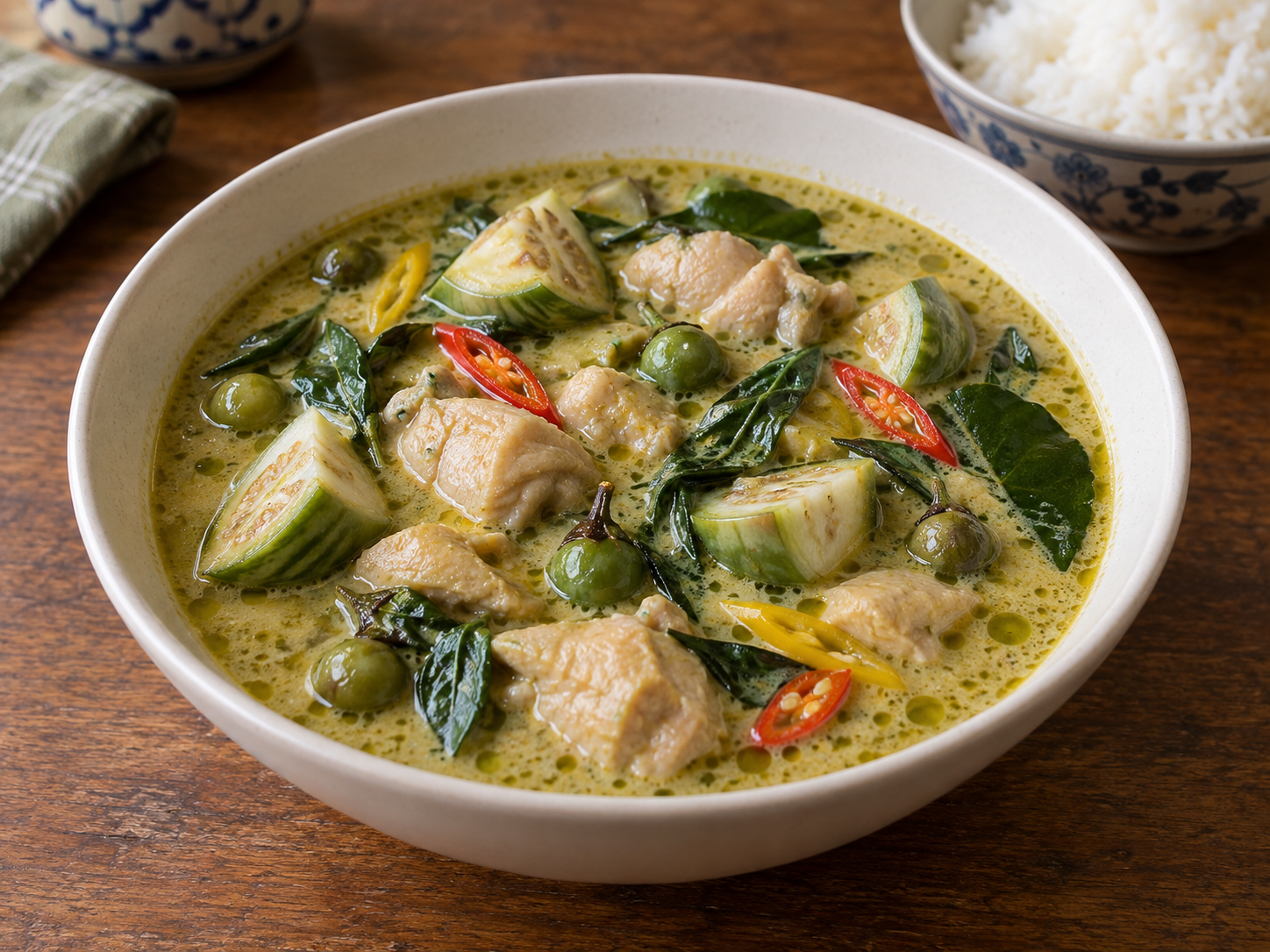
Original recipe estimate: Approx. 45 min, including blender-made paste
Chop and blend the paste ingredients, including the extra batch for storage; prepare the chicken and vegetables, gently fry the paste and simmer until properly cooked. The source does not specify the cooking duration: 60 min is expressly an editorial kitchen guideline, allowing more time than the 45-min headline. Jasmine rice is separate.
Origin & original sources
- Cuisine
- Thailand
- Origin of this version
- Thailand, Central Thai curry tradition
- Original name
- แกงเขียวหวานไก่ (Kaeng Khiao Wan Gai)
- Source languages
- Thai
See the source references for the documented version and its context.
3 original sources1 Authenticity and sources
This recipe is based on Phol Tantasathien’s Thai-language chicken version. It uses homemade blender-made paste, rice bran oil, chicken, coconut milk and two Thai aubergine varieties. Turmeric and coriander with its roots explicitly belong to this version. The paste is first fried gently in oil; separately reducing pure coconut cream until its fat separates is not added as a requirement. KRUA.CO places green curry within Central Thai cuisine. This supports the regional attribution, not a definitively established city of invention. Its own chicken version is used only for comparison; its quantities and technique are not mixed into Phol’s recipe here. Basis for the quantities: the main source’s gram and millilitre quantities are retained. Its tablespoons and teaspoons are interpreted using 15/5 ml measuring spoons: coriander ½ tbsp, cumin 2 tsp, oil 3 tbsp and fish sauce 1½ tbsp. This is a disclosed measuring convention, not a calibration established by that page. Weights for spice volumes, makrut peel and leaves, and four aubergines are approximate; red and yellow chillies, four servings, boneless meat and the overall time have been specified editorially. The paste has a calculated yield of about 490 g before blender losses, not an exactly measured yield. For the original four-person batch, use only 100 g; about 390 g remains for storage. When the serving count changes, the calculator scales both the full paste batch and the quantity used in the curry; very small batches may be harder to process, depending on the blender. Do not add the 100 g of paste in the curry to the shopping quantities for the full paste batch again. Rice is a separately prepared accompaniment and is not included.
- Phol Tantasathien – แกงเขียวหวานไก่: chicken curry with blender-made paste · Thai · accessed 10 September 2026
- KRUA.CO / ชรินรัตน์ จริงจิตร – Curries of Thailand’s four regions · Thai · accessed 10 September 2026
- KRUA.CO / สำนักพิมพ์แสงแดด – แกงเขียวหวานไก่ (comparison version) · Thai · accessed 10 September 2026
2 Ingredients
Green curry paste – full batch for storage; do not put it all in the curry
- 100 g Long green Thai chillies (พริกชี้ฟ้าเขียว / Phrik Chi Fa Khiao), stems removed
- 70 g Green Jinda chillies (พริกจินดาเขียว / Phrik Chinda Khiao), stems removed
- 7.5 ml Toasted, ground coriander seeds; approximate weight for the original batch: 3 g
- 10 ml Toasted, ground cumin; approximate weight for the original batch: 4 g
- 15 g Fresh turmeric (ขมิ้น / Khamin)
- 40 g Thai garlic (กระเทียมไทย / Krathiam Thai)
- 40 g Thai shallots (หอมแดง / Hom Daeng)
- 15 g Mature galangal (ข่าแก่ / Kha Kae)
- 20 g Tender inner part of lemongrass (ตะไคร้ / Takhrai)
- 4 g Green makrut peel (ผิวมะกรูด / Phio Makrut); original measure: peel of one fruit, without the white pith (Approximate weight.)
- 30 g Thai fermented shrimp paste (กะปิ / Kapi)
- 100 ml Water for the blender
- 50 g Fresh coriander, including stems and thoroughly cleaned roots (ผักชีทั้งต้นทั้งราก / Phak Chi)
Curry – quantities for the selected serving count
- 500 g Chicken thigh meat (สะโพกไก่ / Saphok Kai), boneless here, with skin if desired
- 100 g Homemade green curry paste taken from the full batch (Already included in the first group; add only this portion of the paste to the curry. Not an additional ingredient to buy.)
- 45 ml Rice oil / Rice bran oil (น้ำมันรำข้าว / Namman Ram Khao)
- 400 ml Unsweetened coconut milk (กะทิ / Kathi), not coconut drinking milk
- 160 g Round green-and-white Thai aubergines (มะเขือเปราะ / Makhuea Pro); original measure: 4 fruits (Approximate weight.)
- 100 g Pea aubergines (มะเขือพวง / Makhuea Phuang), removed from their clusters
- 22.5 ml Thai fish sauce (น้ำปลา / Nam Pla)
- 30 g Horapha basil leaves (ใบโหระพา / Bai Horapha)
- 20 g Soft palm sugar (น้ำตาลปี๊บ / Nam Tan Pip)
- 2 g Makrut leaves (ใบมะกรูด / Bai Makrut); original measure: 4 leaves (Approximate weight.)
- 10 g Long red Thai chilli (พริกชี้ฟ้าแดง / Phrik Chi Fa Daeng) (Approximate weight.)
- 10 g Long yellow Thai chilli (พริกชี้ฟ้าเหลือง / Phrik Chi Fa Lueang) (Approximate weight.)
Use your specialist ingredients again
Documented ingredient connections, including optional variations and side dishes. Check each recipe for its full ingredients and quantities.
Nam pla · Thai fish sauce
- Curry – quantities for the selected serving count: Thai fish sauce (น้ำปลา / Nam Pla)
More recipes using this ingredient:
- Pad Kra Pao – Stir-fried pork with holy basil
- Tom Kha Gai – Chicken soup with galangal and coconut
- Hakata tonkotsu ramen
- Phat Thai Kung Sot – Stir-fried rice noodles with prawns
- Khao Soi Gai – Chiang Mai egg noodles in coconut curry with chicken
- Tom Yam Kung Nam Sai – Clear Thai prawn soup
- Massaman Nuea – Beef Massaman curry with sweet potatoes
3 Method
- Prepare the paste ingredients: Clean the herbs and roots thoroughly. Finely chop the galangal, lemongrass, turmeric, shallots and garlic; thinly peel the makrut fruit. Have the spices toasted and ground ready to use. Avoid touching your eyes or mucous membranes while cutting the chillies, then clean your hands and work surface.
- Blend and weigh the paste: Blend all the paste ingredients finely with the amount of water specified for the chosen serving count. Switch off the blender periodically and scrape down the sides until no coarse fibres remain. Weigh the portion of paste specified in the curry ingredient group into a small bowl (100 g for four servings). Before the remaining paste comes into contact with raw chicken, divide it into small, clean portions and freeze promptly; heat it thoroughly when used later. The full batch is deliberately larger so that the blender can work reliably.
- Prepare the chicken and vegetables: Cut the chicken into bite-sized pieces that are not too thick. Use a clean chopping board for the vegetables and herbs. Quarter the round Thai aubergines just before cooking and remove the pea aubergines from their clusters. Remove the tough central ribs from the makrut leaves and tear the leaves. Slice the red and yellow chillies diagonally and pick the horapha leaves.
- Fry the paste: Warm the rice bran oil in a deep frying pan or wide pot over medium heat. Gently fry the weighed portion of paste for the curry, stirring until the raw smell fades and it becomes fragrant. The water-rich paste may spit; adjust the heat as needed and do not let it brown deeply. Add the chicken and turn it in the paste until the outside begins to cook.
- Finish cooking the curry: Briefly turn the round aubergines in the paste, then pour in the coconut milk. Add the pea aubergines, makrut leaves, fish sauce and palm sugar. Simmer gently until the aubergines are tender but still hold their shape and the chicken is fully cooked; the initially pale exterior alone does not establish doneness. Reduce the heat if the curry threatens to catch on the bottom. The source gives no fixed cooking time; piece size and actual doneness are decisive.
- Add horapha and chillies last: Fold in the red and yellow chillies and horapha, briefly press them into the hot sauce and switch off the heat. Serve immediately in bowls. The sauce should surround the pieces and be suitable for eating with separately served jasmine rice; do not reduce it to a dry paste.
Archivist’s notes
- At Thai grocery shops, ask specifically for makhuea pro, makhuea phuang, horapha, kapi and whole makrut fruits. Makrut leaves and peel are different ingredients. The paste needs the green fruit peel, not merely an extra leaf. Galangal is not ginger; pea aubergines are not green peas. Use whole coriander plants with roots, not just leaves.
- The colour comes from green chillies, herbs, coconut milk and the turmeric specified in the source. A natural green to yellow-green is appropriate. Do not add spinach colouring, green bell pepper or lime juice to supposedly “correct” it. Horapha is the anise-scented Thai basil, not the kaphrao used in Pad Kra Pao.
- Kapi is pungent, salty and fermented. Do not confuse it with sweet shrimp chilli sauce or fried shrimp paste in oil. Check the product label; the kapi and fish sauce mean this curry contains crustaceans and fish. Some commercial products also contain sugar and flavour enhancers. Ready-made green curry paste has a different concentration and salt content from this water-rich blender paste: there is no blanket 100-g substitution.
- The quantity derivation, storage handling, piece sizes, freezing and overall timing are editorial cooking notes. No in-house cooking test or nutritional calculation has been carried out.
Alternatives usable in Europe
- Alternatives usable in Europe: imported frozen Thai aubergines, makrut peel and herbs offer a sourcing alternative to fresh originals; texture and cooking time may differ. Refined neutral vegetable oil is a functional alternative to rice bran oil. European garlic and small shallots can be used in the same quantities, with a slightly different aroma. Hard-to-find Thai ingredients are explicitly retained in the main recipe.
Nutrition
No nutritional calculation has been carried out; only part of the larger paste batch is used.
| Nutrient | per 100 g | per serving, excluding separately served rice |
|---|---|---|
| Energy | not calculated | not calculated |
| Fat | not calculated | not calculated |
| Carbohydrate | not calculated | not calculated |
| Protein | not calculated | not calculated |
| Salt | not calculated | not calculated |
Image: our own AI-generated illustration of the dish.