
Original recipe estimate: Approx. 90 min
Rice-cooker programme and any required soaking/resting stages depend on the appliance; do not count them twice. Prepare five fillings in parallel, then weigh the rice, shape safely and chill promptly if needed. The historical 90-min heading is not a reliable total time.
Origin & original sources
- Cuisine
- Japan
- Origin of this version
- Japan, nationwide
- Original name
- おにぎり 五種
- Source languages
- Japanese, German
See the source references for the documented version and its context.
4 original sourcesWhat goes with it
Basic technique
Japanese rice in a rice cooker
The onigiri instructions refer to JAP-004 for the basic rice-cooker method. Rice is already included, so use this only as a technique reference.
1 Authenticity and sources
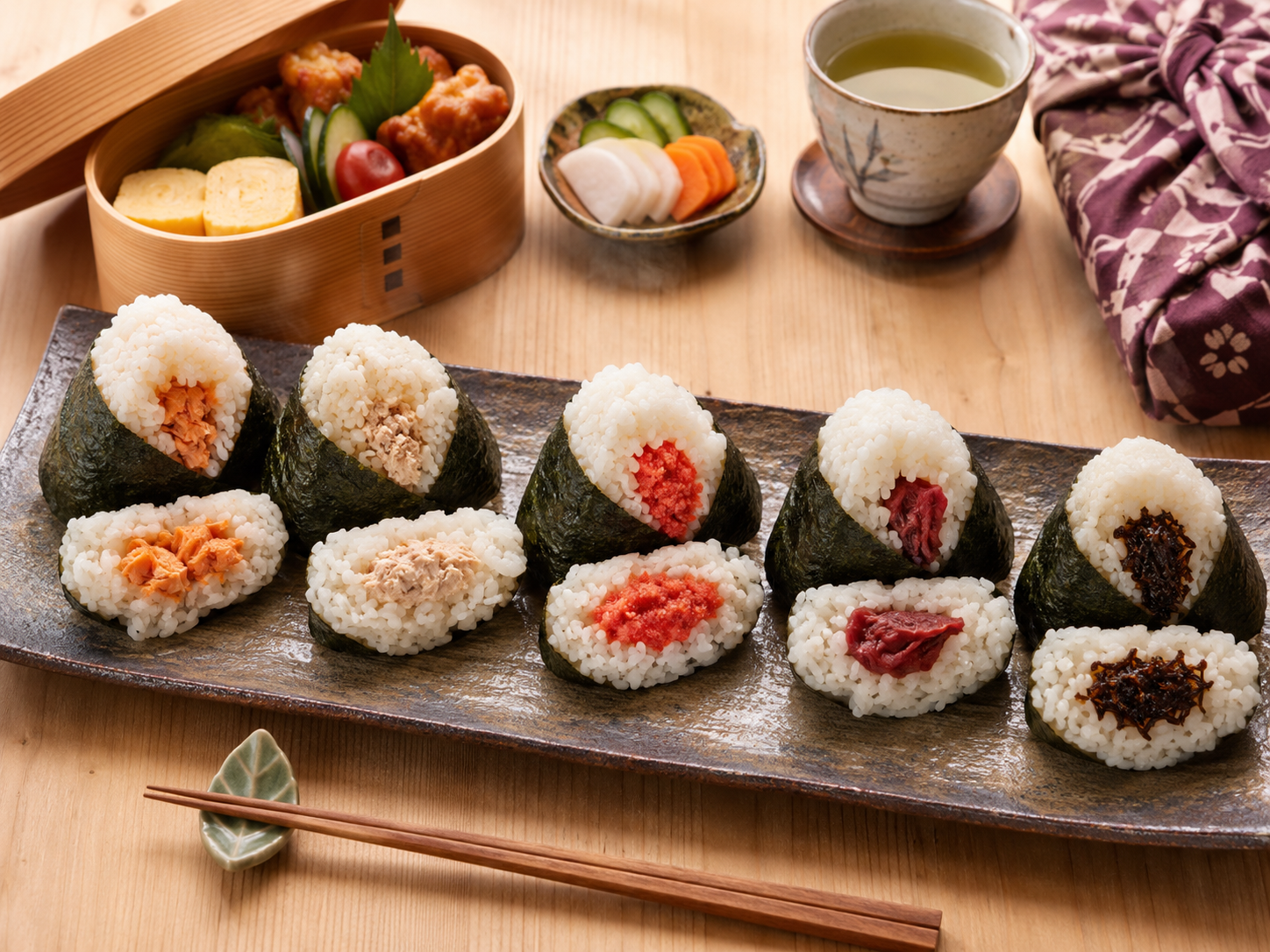
Salmon, tuna mayonnaise, karashi mentaiko, umeboshi and kombu were the five favourite fillings in Cross Marketing’s May 2025 Japanese online survey of 1,100 adults across all 47 prefectures. The survey explains the selection, not our ingredient quantities. These ten onigiri are an editorial home-kitchen version. Tiger’s Japanese interview with specialist Onigiri Ryū provides a concrete technique comparison: shape warm Japonica rice with a few gentle movements. The roughly 80 g of rice shown there is an example, not a universal standard. We weigh the actual cooked rice yield and add only enough filling to enclose it loosely. This version uses unseasoned gohan without sushi vinegar.
- クロス・マーケティング – おにぎりに関する調査(2025年) · Japanese · accessed 22 July 2026
- Tiger – Onigiri Ryū: shaping technique · Japanese · accessed 19 October 2026
- MAFF – safe bento preparation · Japanese · accessed 19 October 2026
- BfR – supplementary cooking and cooling guidance · German · accessed 19 October 2026
2 Ingredients
Editorial quantities: weigh cooked rice and divide by the planned piece count. Fillings are allowances; use surplus separately. Salt sparingly. For bento, plan fully cooked fish fillings and continuous refrigeration.
Rice, salt & nori
- 450 g Japanese short-grain rice (白米, hakumai; dry weight, about 3 gō using 150 g per gō as a working assumption)
- 660 ml Soft cold water (Guide before soaking; alternatively use the rice-cooker water line, not both)
- 150 ml Cold water (手水, temizu · for the hands)
- 6 g Fine sea salt (Shaping allowance; use sparingly according to the filling, not necessarily all of it)
- 5 sheets Roasted nori (焼き海苔, halved crosswise)
① 鮭 · Salmon (2 pieces)
- 80 g Lightly salted Japanese salmon (甘塩鮭, ama-shiozake; raw weight before cooking and removing skin and bones)
② ツナマヨネーズ · Tuna mayo (2 pieces)
- 70 g Tuna in oil, drained (ツナ缶)
- 20 g Japanese mayonnaise (Egg-yolk mayonnaise)
- 3 ml Japanese soy sauce (濃口醤油)
③ 辛子明太子 · Mentaiko (2 pieces)
- 70 g Karashi mentaiko (Seasoned Alaska pollock roe; follow the package storage and use instructions)
④ 梅干し · Umeboshi (2 pieces)
- 2 pieces Traditional umeboshi (With stones; roughly 17.5 g each is only a size guide; use the flesh after pitting)
⑤ 昆布 · Kombu (2 pieces)
- 60 g Kombu tsukudani (昆布の佃煮, simmered down in shōyu and mirin)
Use your specialist ingredients again
Documented ingredient connections, including optional variations and side dishes. Check each recipe for its full ingredients and quantities.
Koikuchi shōyu
- ② ツナマヨネーズ · Tuna mayo (2 pieces): Japanese soy sauce · 濃口醤油
More recipes using this ingredient:
Roasted nori
- Rice, salt & nori: Roasted nori · 焼き海苔, halved crosswise
More recipes using this ingredient:
3 Method
- Rinse the rice and set the water: Weigh the rice, rinse briefly with cold water, discard the first water immediately and rinse gently another 2–3 times. Drain. For the base batch, add 660 ml cooking water before soaking; alternatively use the cooker’s white-rice water line appropriate to the rice amount. Do not add both quantities. If the programme has no soaking stage, soak for about 30 min. For the detailed rice-cooker method, see JAP-004.
- Cook and loosen the rice: Use the white-rice programme according to the appliance instructions. Do not add soaking or steaming time again if the programme already includes it; otherwise observe the required rest. Loosen with a clean, lightly dampened shamoji. Briefly release steam in a clean wide bowl until the rice can be shaped safely using utensils or wrap. Do not treat any fixed temperature as safe to touch, and avoid prolonged warm holding.
- Cook the salmon thoroughly: Cook ama-shiozake in a grill pan or under an overhead grill. Reach at least 70 °C for 2 min at the thickest point; browning alone is not sufficient. Remove skin and every bone, flake the cooked flesh and cool promptly in a clean shallow container. Keep refrigerated until filling; the 80 g raw fish is not a promised weight of finished filling.
- Mix the tuna mayo: Drain the tuna thoroughly, then weigh the listed amount. Mix with mayonnaise and shōyu, cover and refrigerate until filling. This mixture is an allowance for the variety; do not force all of it into the two rice balls. Use clean utensils.
- Prepare the mentaiko appropriately: For an unheated filling, use only a product labelled by its manufacturer as ready to eat without further heating; maintain refrigeration and observe its use-by instructions. Seasoned or frozen roe is not automatically suitable for eating raw. For bento and people at increased risk, use fully cooked mentaiko: heat a thin sac or smaller pieces thoroughly, measure at least 70 °C for 2 min inside, then cool promptly in a shallow container and refrigerate. Do not rely on a blanket 3–5 min cooking time or the outside colour alone.
- Prepare umeboshi and kombu: Pit the umeboshi and roughly divide the flesh. The approximate listed weight includes the stones; do not count it as filling weight. Cut long kombu-tsukudani strands to 2–3 cm and drain excess liquid. Keep both fillings covered, using only as much as can be enclosed completely.
- Weigh and divide the cooked rice: Halve the nori crosswise and keep dry. Weigh the actual cooked rice without the bowl and divide the base batch into ten equal portions, two per variety. About 100 g rice is only a guide, not a guaranteed yield from 450 g dry rice. Adjust the planned piece count for other recipe sizes. The final piece weight also depends on its filling.
- Work cleanly and salt sparingly: Clean hands and tools. Use food-safe wrap suitable for warm food or a clean mould, especially for bento. Use the water only to lightly dampen the mould or utensils; avoid a wet rice surface. Spread a little salt from the allowance, less for salty fillings. The full allowance need not be used.
- Fill and allow for leftovers: Make a hollow in each rice portion. As an editorial starting guide, add about 10–15 g filling, less for very salty varieties; carefully enclose more only if there is enough rice. Cover completely with rice without compressing it firmly. Refrigerate fillings between small working batches. Keep surplus filling refrigerated separately or serve alongside; it is not part of the ten planned pieces.
- Shape gently: Shape into a triangle, ball or short cylinder with a few gentle movements. Apply only enough pressure to hold the rice together. If the shell tears or filling spills out, use less filling instead of pressing harder. Allocate the same share of rice portions to each variety and use clean utensils when changing fillings.
- Add nori and pack bento: For immediate eating, wrap each piece with half a nori sheet. For bento, cool the rice and cooked fillings promptly and pack them into a clean dry container only when cold; carry nori separately and dry. Use an ice pack and insulated bag and keep cool until eating. Salt, umeboshi and nori do not replace refrigeration.
- Eat fresh and chill safely: Best eaten freshly made. For later use, cool the onigiri promptly in a shallow arrangement without prolonged standing; bring below 7 °C within a few hours and refrigerate. As a conservative home-kitchen plan, eat within 24 hours; stricter package limits take precedence. Do not deliberately bring them to room temperature. Refrigeration can firm the rice; discard food with an uncertain cold chain rather than promising that reheating will make it safe.
Archivist’s notes
- Japanese japonica short-grain rice is essential. Long-grain, parboiled and risotto rice do not have the right adhesion and grain texture.
- Ama-shio means lightly salted, not sweet. Smoked salmon is not an authentic substitute because of its smoky flavour.
- Japanese mayonnaise is made with egg yolk and rice or apple vinegar, defining the typical tuna mayo flavour.
- Karashi mentaiko is seasoned Alaska pollock roe. Do not confuse it with tobiko, masago or caviar.
- Traditional umeboshi contain ume, salt and often red shiso; honey umeboshi have a milder, modern flavour profile.
- Kombu no tsukudani is kombu simmered down until soft and dark, not dried seaweed.
- No sushi vinegar: onigiri uses plain, warm gohan.
- Quantity status: rice water, salt and filling allowances are editorial home-kitchen quantities. The technique reference supports gentle shaping, not the full gram formulation. Always weigh rice after cooking; filling leftovers are expected. Identical final weights for all five varieties are not promised.
Alternatives usable in Europe
- Ama-shiozake → as an editorial approximation, salt fresh salmon with 1.2% of its weight for 30 min in the refrigerator, pat dry and cook thoroughly. This is not a documented universal Japanese salting method; do not use smoked salmon.
- Japanese mayonnaise → egg-yolk mayonnaise with a few drops of rice vinegar and a tiny pinch of sugar; no salad cream.
- Karashi mentaiko → Japanese frozen mentaiko; as a last approximation, tarako with a little ichimi tōgarashi. No caviar.
- Umeboshi → choose Japanese umeboshi to taste and follow the package instructions. Salt content does not prove that a finished onigiri is safe; Western pickled plums give a different flavour.
- Kombu no tsukudani → homemade Japanese tsukudani; dried kombu must not be used directly as a filling.
Nutrition
Nutrition not calculated: No reproducible calculation is documented for the five onigiri varieties. The former total weight of 105–115 g per piece does not fit every filling: about 100 g rice plus 35 g mentaiko already amounts to about 135 g before nori and salt. Rice yield, cooked salmon weight, pitted umeboshi, drained fillings and salt actually retained are not fully established. Each variety needs its own calculation; an unsupported average cannot replace it. A serving remains one onigiri. Previous estimates have been archived.
Nutrition not calculated: No reproducible calculation is documented for the five onigiri varieties. The former total weight of 105–115 g per piece does not fit every filling: about 100 g rice plus 35 g mentaiko already amounts to about 135 g before nori and salt. Rice yield, cooked salmon weight, pitted umeboshi, drained fillings and salt actually retained are not fully established. Each variety needs its own calculation; an unsupported average cannot replace it. A serving remains one onigiri. Previous estimates have been archived.
| Nutrient | per 100 g | per serving |
|---|---|---|
| Energy | not calculated | not calculated |
| Protein | not calculated | not calculated |
| Fat | not calculated | not calculated |
| Carbohydrate | not calculated | not calculated |
| Salt | not calculated | not calculated |
Image: our own AI-generated illustration of the dish.