
Original recipe estimate: Approx. 20 min
Japanese short-grain rice is already cooked and available warm.
The dashi required by the recipe is ready and at the appropriate temperature.
About 20 minutes from cooked rice, prepared dashi and thawed paper-thin beef is an editorial planning estimate. Allow additional time for cooking rice, preparing dashi, thawing and a separately prepared egg garnish. Onion and beef doneness determine completion, not the clock alone.
Origin & original sources
- Cuisine
- Japan
- Origin of this version
- Japan, Tokyo
- Original name
- 牛丼
- Source languages
- Japanese
See the source references for the documented version and its context.
3 original sourcesWhat goes with it
Rice accompaniment
Japanese rice in a rice cooker
For the two rice bowls, cook the rice yourself. The shopping plan replaces the two servings of cooked rice with two small bowls from the base recipe.
1 Authenticity and sources
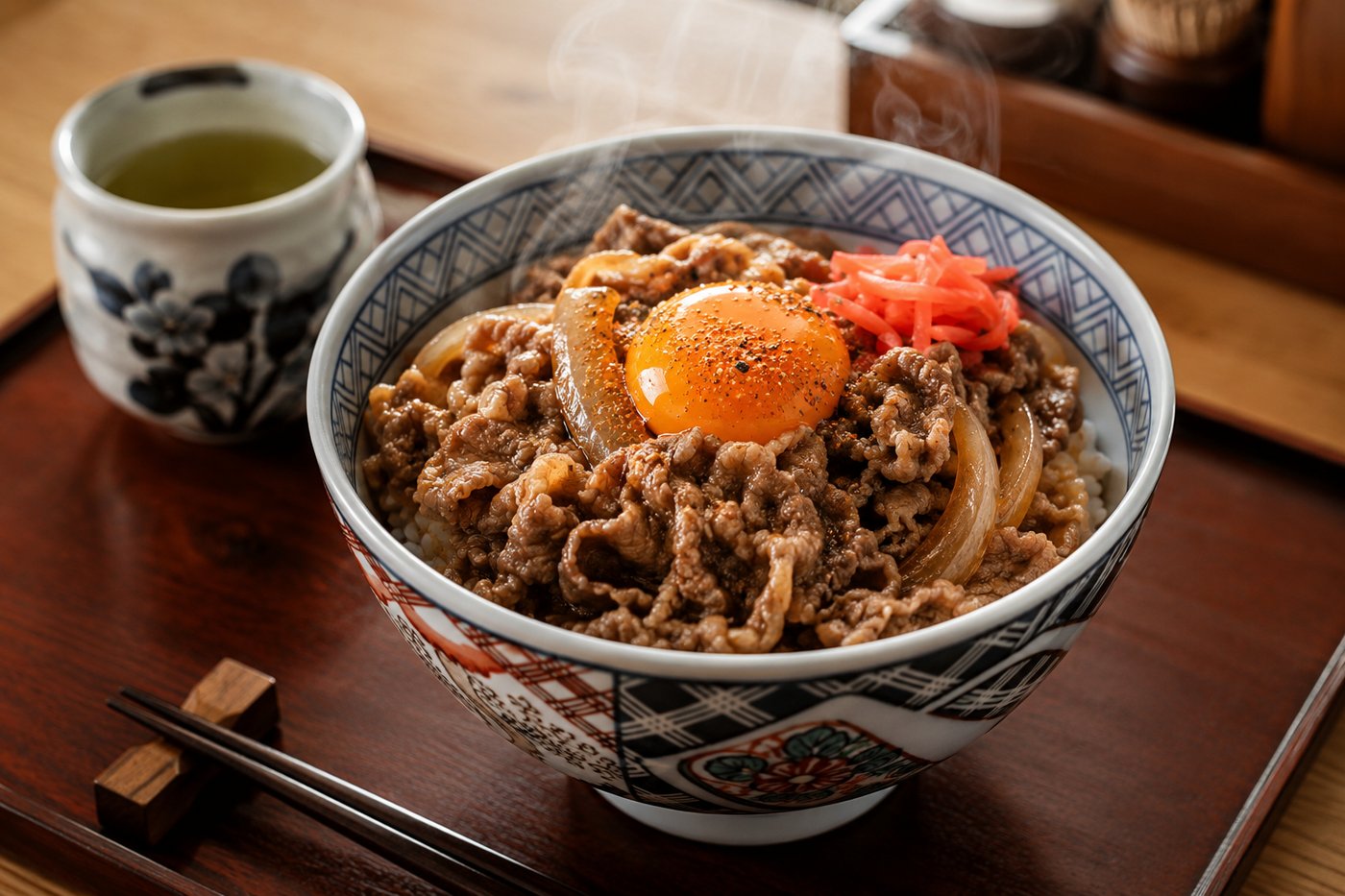
Gyūdon is a Japanese rice bowl topped with thin beef and onions in a sweet-savoury broth. Our sequence follows Kikkoman: onions first, then beef. Yamaki uses a different onion cut and cooking sequence. Both manufacturers use mentsuyu; our separate amounts of dashi, koikuchi shōyu, mirin, sake and sugar are an editorial home-kitchen formula, not an exact reconstruction of their products. These quantities are retained but have not been confirmed in our own cooking trial.
- キッコーマン – コクうま牛丼 · Japanese · accessed 22 July 2026
- Yamaki – mentsuyu beef bowl (different manufacturer recipe) · Japanese · accessed 18 October 2026
- Food Safety Commission Japan – egg garnish and vulnerable groups · Japanese · accessed 19 October 2026
2 Ingredients
Amounts are an editorial home-kitchen formula. Rice is required already cooked; its weight and the optional garnishes are unspecified. Do not add mentsuyu to the separately prepared seasoning. Weigh the sugar; the old spoon equivalence has been removed.
Main ingredients
- 250 g Paper-thin beef slices (shabu-shabu cut) (牛薄切り肉 — belly or neck)
- 200 g Onion (玉ねぎ, approx. 1 medium onion)
- 10 g Fresh ginger (生姜, cut into fine strips)
Simmering broth (warishita)
- 200 ml Dashi (だし — made with kombu and katsuobushi; dashi powder as an alternative)
- 45 ml Japanese soy sauce (koikuchi shōyu) (醤油, 大さじ3)
- 30 ml Mirin (みりん, 大さじ2)
- 30 ml Sake (酒, 大さじ2)
- 15 g Sugar (砂糖; weigh 15 g; no validated tablespoon conversion)
To serve
- 2 portions Steamed Japanese short-grain rice (ご飯 → recipe JAP-004)
- Beni shōga (pickled red ginger) (紅生姜)
- Egg yolk or onsen egg (optional; for a soft egg garnish use a suitable pasteurised ready-to-eat product; otherwise cook fully or omit)
Use your specialist ingredients again
Documented ingredient connections, including optional variations and side dishes. Check each recipe for its full ingredients and quantities.
Koikuchi shōyu
- Simmering broth (warishita): Japanese soy sauce (koikuchi shōyu) · 醤油, 大さじ3
More recipes using this ingredient:
Sake
- Simmering broth (warishita): Sake · 酒, 大さじ2
More recipes using this ingredient:
3 Method
- Prepare: Have cooked rice and prepared dashi ready. Halve the onion and slice about 5 mm thick along the grain. Cut the ginger into fine strips. Cut fully thawed, paper-thin beef into bite-sized pieces and keep chilled until cooking.
- Make the broth: Mix the dashi, koikuchi shōyu, mirin, sake and weighed sugar in a wide pan. Add the ginger and bring to the boil. This is the complete seasoning mixture; do not add mentsuyu as well.
- Cook the onions first: Simmer the onions gently in the broth for about 5 minutes. They should become flexible and translucent. If still firm, cook them a little longer before adding the beef.
- Add the beef: Lower the beef into the gently simmering broth a slice at a time and carefully separate the pieces. Do not add a frozen or tightly packed clump. Skim foam if needed; use clean utensils after handling raw meat.
- Finish gently: Simmer gently for about 5 minutes more, until the separated slices are fully cooked through and the onions are soft. Open any thicker or folded pieces and cook them through too; elapsed time alone is not a doneness check. Avoid boiling hard or reducing the liquid to a glaze: leave spoonable broth for the rice.
- Serve: Divide hot rice between two bowls, add the beef and onions and spoon over some broth. Add beni shōga as desired. Egg is optional: for a soft garnish, use only a suitable pasteurised ready-to-eat egg product according to its instructions. Otherwise cook the egg fully or omit it. Serve immediately.
Archivist’s notes
- Quantity status: All existing ingredient amounts remain an editorial home-kitchen formula. Kikkoman and Yamaki document versions of the dish, not our complete seasoning formula. Their mentsuyu concentrations are not interchangeable.
- Onion cut: This version follows Kikkoman with slices about 5 mm thick along the grain. Yamaki cuts across the grain and cooks longer. This does not make cross-cutting wrong; the earlier claim that it inevitably produces onion mush is unsupported.
- Beef: Obtain paper-thin slices from a butcher or Asian grocer. Thaw frozen meat in the refrigerator. A different cut or folded pieces need their own doneness check; there is no universal seconds-only cooking guarantee.
- Egg garnish: Raw yolk and a softly cooked onsen egg are not automatically free from pathogens. The product choice above is a supplementary precaution for this home-kitchen version, not a direction from the two gyūdon sources. For young children, pregnant people, older adults and immunocompromised people, use only fully cooked egg or omit it.
Alternatives usable in Europe
- Dashi: make it fresh from kombu and katsuobushi; Hondashi powder is an alternative. Do not use a stock cube.
- Mirin: use real hon-mirin; sake with a pinch of sugar is a fallback.
- Sake: use cooking sake; dry sherry is an alternative, or omit it if necessary.
- Koikuchi shōyu: Japanese soy sauce, such as Kikkoman.
- Beni shōga: pickled red ginger from an Asian food shop provides an essential contrast.
Nutrition
Not calculated. No reproducible nutrition calculation is available for our version with a separately prepared dashi-based broth. The beef cut, broth actually eaten, rice weight and optional garnishes are not sufficiently specified. Kikkoman and Yamaki give values for their different mentsuyu-based recipes; these do not validate our estimate. Earlier topping, portion and bowl estimates are preserved in the audit archive; missing values do not mean zero.
Not calculated. No reproducible nutrition calculation is available for our version with a separately prepared dashi-based broth. The beef cut, broth actually eaten, rice weight and optional garnishes are not sufficiently specified. Kikkoman and Yamaki give values for their different mentsuyu-based recipes; these do not validate our estimate. Earlier topping, portion and bowl estimates are preserved in the audit archive; missing values do not mean zero.
| Nutrient | per 100 g | per portion |
|---|---|---|
| Energy | not calculated | not calculated |
| Protein | not calculated | not calculated |
| Fat | not calculated | not calculated |
| Carbohydrate | not calculated | not calculated |
| Salt | not calculated | not calculated |
Image: our own AI-generated illustration of the dish.