
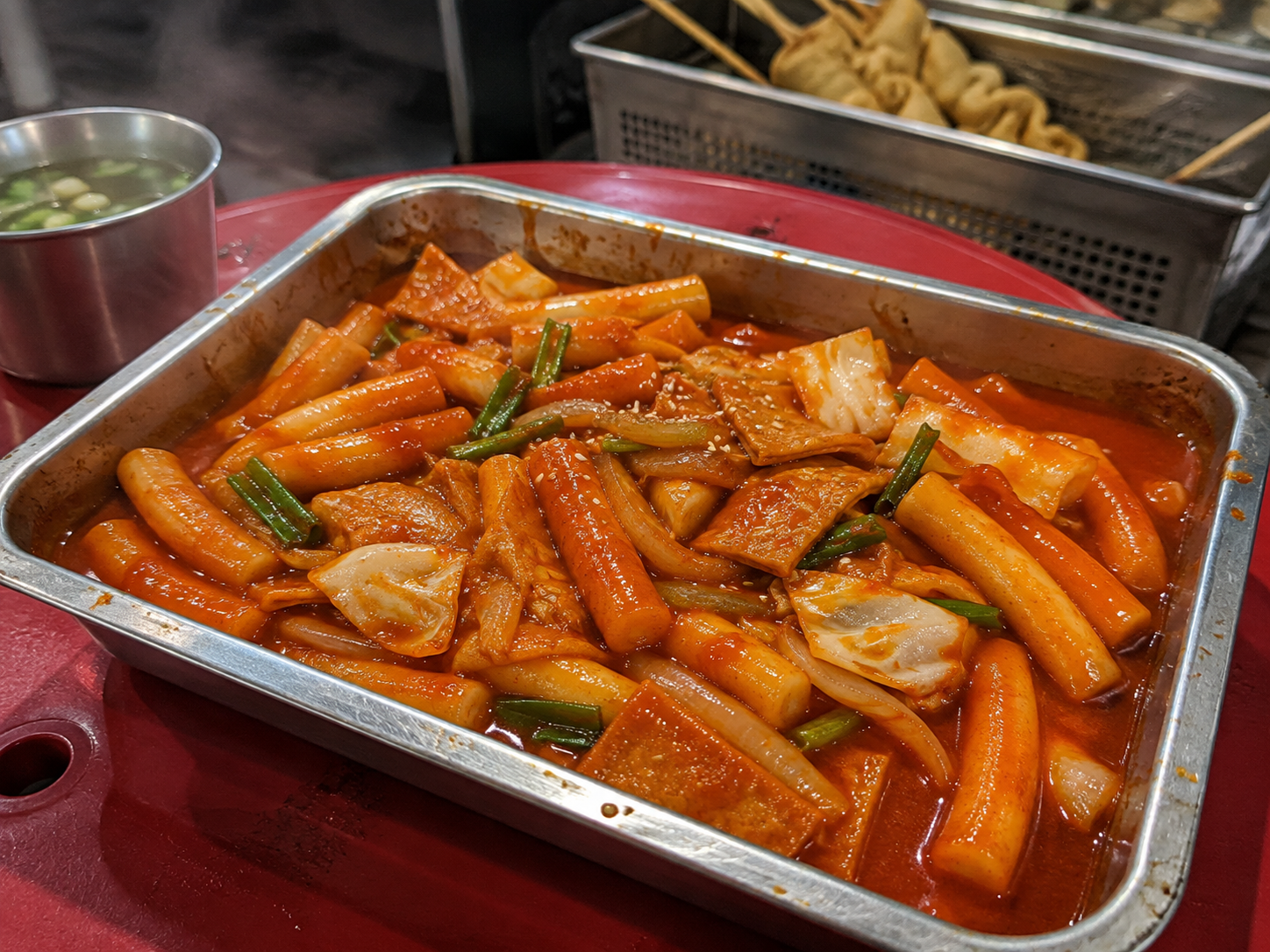
Original recipe estimate: Approx. 35 min
The rice cakes are soft or thawed and have already been soaked sufficiently.
35 min is a conditional working estimate for broth, sauce, brief cooling, pre-cooking and reduction with soft, thawed rice cakes. Hard or frozen products need additional preparation according to the pack. No timed cooking test.
Origin & original sources
- Cuisine
- Korea
- Origin of this version
- Republic of Korea · modern street-food version, particularly Seoul and Sindang-dong
- Original name
- 떡볶이
- Source languages
- Korean
See the source references for the documented version and its context.
4 original sourcesWhat goes with it
In this recipe: Tteokbokki gochujang sauce – 떡볶이 양념장
1 Authenticity and sources
Tteokbokki (떡볶이) is Korean street food featuring chewy rice cakes in red sauce. This version follows the formulation documented by Lampcook and attributed to the Korean agricultural administration and Hansik Foundation. It combines 300 g rice cakes, eomuk and vegetables with about 300 g prepared sauce. The notably large gochugaru quantity is present in that source; heat and saltiness still depend strongly on the products.
- 램프쿡 – 떡볶이양념장 & 떡볶이 요리 · Korean · accessed 4 September 2026
- 식품안전나라 – 떡볶이 · Korean · accessed 4 September 2026
- 한식진흥원 – 궁중떡볶이 · Korean · accessed 4 September 2026
- 한국관광공사 – 신당동 떡볶이타운 · Korean · accessed 4 September 2026
2 Ingredients
Four snack servings: weigh tteok before soaking/pre-cooking and vegetables after trimming. Weigh all sauce ingredients in grams, including liquids. Keep broth water and additional pre-cooking water separate; 800 ml is starting water, not finished yield. Use the whole listed sauce batch.
Broth and main ingredients – 육수와 재료
- 800 ml Water (starting water for the broth; source: 800 g, shown here as approximately 800 ml for kitchen use. Not the finished broth yield)
- 10 g Small dried anchovies (멸치 / myeolchi)
- 5 g Dried kombu (다시마 / dashima)
- 300 g Korean cylindrical rice cakes for tteokbokki (떡볶이떡 / tteokbokki-tteok – weigh the packaged rice cakes before soaking and pre-cooking, not rice flour)
- 100 g Korean fish cake (어묵 / eomuk – unpackaged weight before cutting)
- 150 g White cabbage (weigh trimmed without the core, cut into bite-sized pieces)
- 75 g Onion (weigh peeled, cut into broad strips)
- 40 g Spring onion (대파 / daepa – weigh trimmed without roots; the full allowance is for the dish, not an extra amount for the sauce)
Tteokbokki gochujang sauce – 떡볶이 양념장
- 50 g Gochujang (고추장)
- 58 g Korean chilli flakes (고춧가루 / gochugaru; the source allows a mixture of fine and coarse flakes if needed)
- 30 g Korean soy sauce (간장 / ganjang)
- 35 g Sugar
- 44 g Garlic (weigh peeled, finely chop)
- 22 g Ginger (weigh trimmed, finely chop)
- 41 g Korean rice wine (청주 / cheongju)
- 11 g Toasted sesame oil (참기름 / chamgireum)
- 6 g Toasted sesame seeds
- 0.8 g Black pepper
Use your specialist ingredients again
Documented ingredient connections, including optional variations and side dishes. Check each recipe for its full ingredients and quantities.
Gochujang
- Tteokbokki gochujang sauce – 떡볶이 양념장: Gochujang · 고추장
More recipes using this ingredient:
Dried kombu
- Broth and main ingredients – 육수와 재료: Dried kombu · 다시마 / dashima
More recipes using this ingredient:
3 Method
- Prepare the broth: Remove heads and guts from larger anchovies. Heat with the measured water and kombu, infuse until flavourful and strain. This is the starting liquid before evaporation, not a guaranteed finished volume. Cut the vegetables and eomuk into bite-sized pieces.
- Mix the sauce: Stir sugar into ganjang and cheongju, then add gochujang and gochugaru. Add garlic, ginger, sesame oil, sesame seeds and pepper. Warm over low heat, stirring until evenly combined without catching on the pan.
- Cool the sauce briefly: Cool briefly as described in the source while preparing the rice cakes, then continue cooking immediately. The listed ingredients total 297.8 g before heating. The source uses 300 g sauce in the finished dish; use the entire listed batch here without inventing an extra quantity.
- Prepare the rice cakes: Use soft, thawed tteok. Soak or thaw hard or frozen products according to their pack instructions; this adds to the working time. Pre-cook rice cakes in a separate pan of boiling water until pliable, then drain. This cooking water is process water, not part of the broth.
- Simmer together: Bring broth, sauce, tteok, cabbage, onion and eomuk to the boil together. Simmer, stirring gently, until the vegetables are cooked and the sauce thickens. The rice cakes should be soft and elastic all the way through. Do not judge doneness only by a fixed number of minutes.
- Add daepa and serve: Add the measured daepa towards the end and cook it through. The sauce should coat the tteok; it thickens further as it stands. Serve hot as four snack portions. Do not assume an extra spring onion quantity for the sauce.
Archivist’s notes
- Source comparison: all ten sauce quantities match the Lampcook table and total 297.8 g. The four-person recipe below requires 300 g sauce. The 2.2 g difference is recorded as a rounding discrepancy rather than filled with an invented ingredient. Comparisons apply to the original batch and do not scale with the portion selector.
- The source method mentions chopped spring onion in the sauce without quantifying it in the sauce table. This unresolved source detail is not silently added. The listed 40 g daepa belongs to the finished dish.
- The source nutrition table describes 75 g sauce, not a complete serving of tteokbokki. It must not be used as nutrition for the whole dish. The previous contradictory archive figures have been withdrawn.
- Tteok are unsweetened Korean rice cakes, not mochi. Eomuk contains fish and anchovy broth is not vegetarian. Gochujang and gochugaru have different roles. This is the red street-food version, not gungjung tteokbokki.
- 35 minutes is only a conditional working estimate with soft, thawed tteok and ingredients ready. The source sequence, sauce cooling and pre-cooking are described but have not been timed in a cooking test. Finished weight and actual evaporation are unknown.
- Quantity basis: Weigh all ten sauce ingredients, including ganjang, cheongju and sesame oil; their gram amounts are not millilitre values. The calculated 297.8 g is the sum before heating, not a measured sauce yield. Four snack servings do not imply fixed serving weights. Provide soaking and pre-cooking water separately; water absorption, straining losses, evaporation and finished weight have not been measured.
Alternatives usable in Europe
- Tteokbokki-tteok → cylindrical Korean rice cakes. Alternative usable in Europe: none; if unavailable, postpone making the dish rather than substitute mochi, gnocchi or rice paper.
- Eomuk → Korean fish cake. Alternative usable in Europe: none that reliably preserves the flavour and texture; do not use Thai fish cakes, surimi snacks or prawn crackers.
- Gochujang and gochugaru → distinct Korean staple ingredients. Do not replace them with Sriracha, sweet chilli sauce, pepper paste or ketchup.
Nutrition
Not calculated: product data, quantities actually eaten and measured finished weight are missing. The complete recipe yield is undetermined.
Not calculated. Earlier unverified archive estimates are preserved in the audit archive and no longer displayed as nutrition values. Missing values do not mean zero.
| Nutrient | per 100 g | per portion |
|---|---|---|
| Energy | not calculated | not calculated |
| Protein | not calculated | not calculated |
| Fat | not calculated | not calculated |
| Carbohydrate | not calculated | not calculated |
| Salt | not calculated | not calculated |
Image: our own AI-generated illustration of the dish.