
Original recipe estimate: Approx. 150 min; longer for tougher meat
Up to 90 min for the initial braise, about 30 min for the final cooking, plus 45 min for preparation, the coconut milk and paste stage, and transitions. Tougher meat takes longer; this is not a guaranteed maximum cooking time. Ready-made Massaman paste is the specified ingredient; rice is separate.
Origin & original sources
- Cuisine
- Thailand
- Origin of this version
- Thailand, Muslim-influenced curry tradition; Pim’s home-style version
- Original name
- มัสมั่นเนื้อ (Massaman Nuea)
- Source languages
- Thai
See the source references for the documented version and its context.
4 original sources1 Authenticity and sources
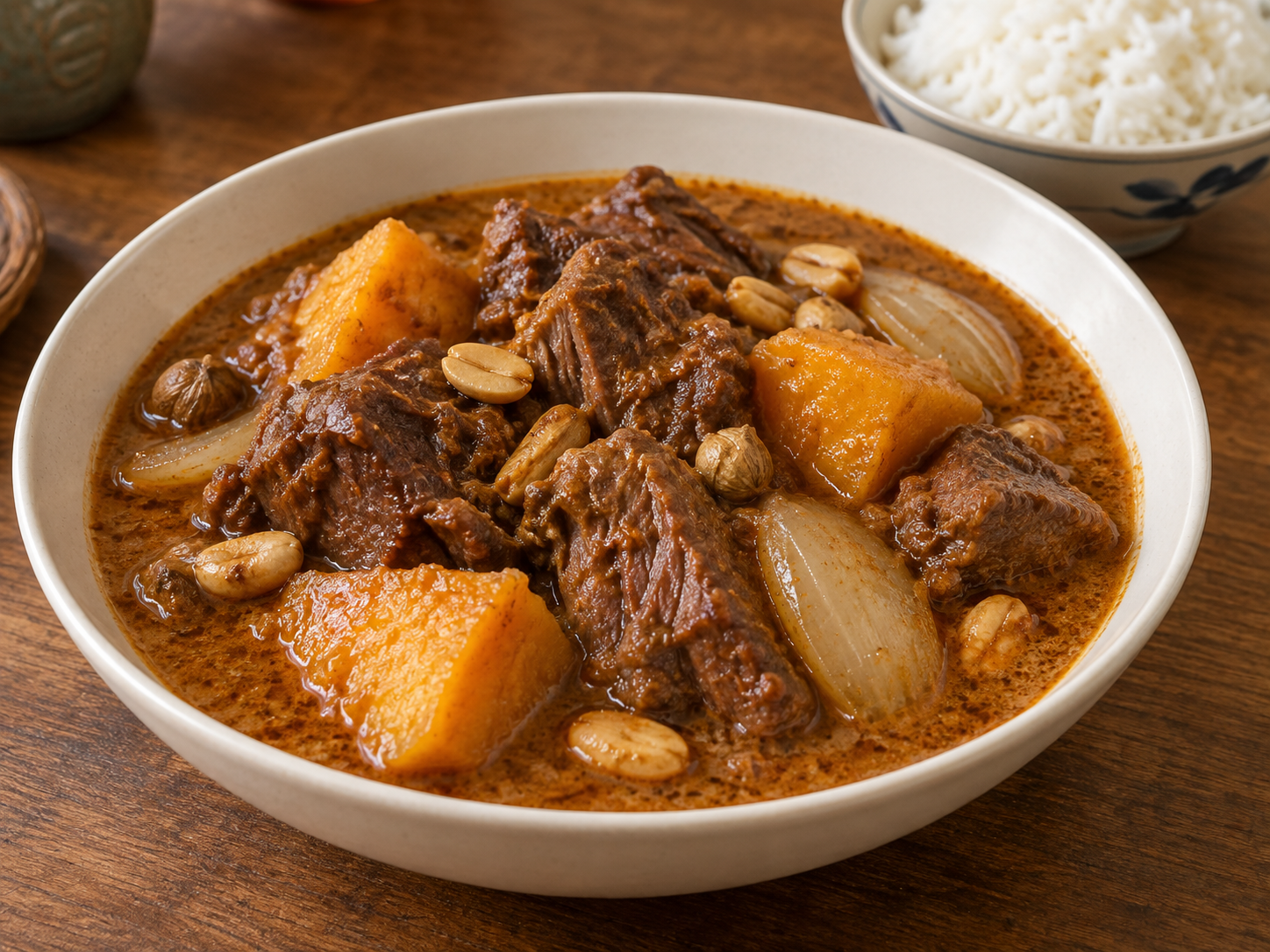
This recipe is based on Pim’s Thai-language beef Massaman recipe of 26 August 2021. She uses beef plate, sweet potatoes, onions and roasted peanuts. Sweet potatoes explicitly belong to this source version. The beef is first braised until tender in thin coconut milk; the Massaman paste is fried separately in the thick coconut fraction. Pim’s finished sauce is concentrated and just surrounds the solid ingredients. Her instructions call for shop-bought Massaman paste without specifying a required brand; no other paste recipe is mixed in. The quantities and method were independently described for the German archive, without reproducing Pim’s photographs or personal narrative. For the historical background, KRUA.CO explains the Muslim influences and the dish’s early presence in Thai court cuisine. The exact date of its arrival in Thailand is not clearly established. The culinary discussion of its Malay connections reveals further cultural links. Thailand is therefore named as the recipe country, without claiming a single proven city of invention or a definitively established Persian inventor. Pim’s present-day home-style version is not an unchanged historical court recipe. Basis for the quantities: the gram quantities follow Pim’s batch. She explicitly describes measuring cups and spoons but does not state their capacities in millilitres. The convention documented by KRUA.CO is used here: 1 cup = 240 ml, 1 tbsp = 15 ml and 1 tsp = 5 ml. This gives 1½ cups of thick coconut milk = 360 ml and 5 cups of thin coconut milk = 1200 ml. Half a tablespoon of salt is 7.5 ml; about 9 g is only a density-dependent guide. The weight of the six cardamom pods is also estimated. Six servings, a total time of about 150 minutes and beef pieces of about 4–5 cm are editorial working estimates. The source specifies 70–90 minutes for the initial braise, followed by about 30 minutes with the remaining ingredients; actual doneness takes priority. Rice is a separate accompaniment and is not included.
- Pim / ครัวบ้านพิม – มัสมั่นเนื้อ (beef with sweet potatoes) · Thai · accessed 10 September 2026
- KRUA.CO – แกงมัสมั่นเนื้อ: cultural context · Thai · accessed 10 September 2026
- KRUA.CO – แกงไทย อาหารที่เป็นดั่งงานศิลป์: Thai curries · Thai · accessed 10 September 2026
- KRUA.CO / ณวรา เปลี่ยนบุญเลิศ – Thai measuring conventions · Thai · accessed 10 September 2026
2 Ingredients
Massaman curry – quantities for the selected serving count
- 1000 g Boneless beef plate / belly (เนื้อวัวส่วนพื้นท้อง / Nuea Wua Suan Phuen Thong), for braising
- 200 g Thai Massaman curry paste (พริกแกงมัสมั่น / Phrik Kaeng Massaman), source quantity; take the saltiness and heat of the chosen paste into account
- 2 g Whole Thai cardamom pods (ลูกกระวาน / Luk Krawan); original batch: 6 pods, dry-toasted (Approximate weight.)
- 600 g Sweet potatoes (มันเทศ / Man Thet), weighed after peeling, cut into large pieces
- 200 g Onions (หอมใหญ่ / Hom Yai), weighed after peeling, quartered
- 80 g Roasted unsalted peanuts, with the red skins removed
- 360 ml Thick coconut milk / first pressing (หัวกะทิ / Hua Kathi), two thirds for frying the paste, one third to finish
- 1200 ml Thin coconut milk / second pressing (หางกะทิ / Hang Kathi), four fifths for the initial braise, one fifth later
- 100 g Extracted, strained tamarind juice (น้ำมะขามเปียก / Nam Makham Piak), not undiluted concentrate
- 200 g Coconut palm sugar (น้ำตาลมะพร้าว / Nam Tan Maphrao), source quantity
- 15 ml Thai fish sauce (น้ำปลา / Nam Pla)
- 7.5 ml Fine salt; the original batch uses about 9 g as a weight guide, divided between the initial braise and final seasoning
Use your specialist ingredients again
Documented ingredient connections, including optional variations and side dishes. Check each recipe for its full ingredients and quantities.
Nam pla · Thai fish sauce
- Massaman curry – quantities for the selected serving count: Thai fish sauce (น้ำปลา / Nam Pla)
More recipes using this ingredient:
- Pad Kra Pao – Stir-fried pork with holy basil
- Tom Kha Gai – Chicken soup with galangal and coconut
- Hakata tonkotsu ramen
- Phat Thai Kung Sot – Stir-fried rice noodles with prawns
- Khao Soi Gai – Chiang Mai egg noodles in coconut curry with chicken
- Tom Yam Kung Nam Sai – Clear Thai prawn soup
- Kaeng Khiao Wan Gai – Thai green curry with chicken
Massaman curry paste
- Massaman curry – quantities for the selected serving count: Thai Massaman curry paste (พริกแกงมัสมั่น / Phrik Kaeng Massaman), source quantity; take the saltiness and heat of the chosen paste into account
No other verified connection in the archive yet.
3 Method
- Prepare the ingredients: Cut the beef plate into pieces about 4–5 cm across. Peel the sweet potatoes and cut into similarly sized pieces; quarter the onions. Briefly toast the cardamom pods in a dry frying pan over gentle heat until fragrant, without blackening them. Measure the thick and thin coconut milk separately into the specified portions.
- Braise the beef first: Bring four fifths of the thin coconut milk specified for the selected serving count to the boil in a heavy pot. Add the beef and half the salt. Once it returns to the boil, reduce the heat sharply. Braise gently for about 70–90 minutes, occasionally stirring along the bottom of the pot. The beef should already be mostly tender before the sweet potatoes are added. Cook tougher meat for longer and add a little hot water if the pot is in danger of boiling dry; this adjustment is an editorial cooking note.
- Fry the curry paste: In a second wide pot, heat two thirds of the thick coconut milk specified for the selected serving count over medium heat until the first droplets of fat appear. Stir in the Massaman paste and fry, adjusting the heat as needed, until strongly fragrant. Stir regularly; do not let the paste burn dark on the bottom. Transfer the pre-braised beef with a slotted spoon and coat it in the paste.
- Combine the remaining ingredients and liquid: Add the sweet potatoes, onions, peanuts and cardamom. Pour in the coconut braising liquid left in the first pot and the reserved fifth of the thin coconut milk. Pim’s original six-serving batch has about 360 ml of braising liquid left after the initial braise, giving around 600 ml in total; this is an approximate reduction guideline, not a guaranteed yield. The curry sauce should just surround the solid ingredients. If considerably more liquid remains, reduce it a little before combining.
- Season and finish braising: Stir in the tamarind juice, coconut palm sugar and fish sauce. The source quantities remain documented above; because pastes vary in saltiness, tamarind in acidity and sugar products in sweetness, add them gradually and reserve the remainder for adjusting the seasoning. Add the remaining salt only after tasting. Simmer gently for about 30 minutes until the sweet potatoes, onions and beef are tender; the pieces should hold their shape. Pim describes a slightly leading sour note, followed by rounded sweetness and a salty finish.
- Finish with coconut milk: Stir in the reserved third of the thick coconut milk and briefly bring the curry back to a bubble. Remove from the heat immediately and serve in bowls. Set aside the whole cardamom pods before eating. Serve jasmine rice separately; this serving suggestion is an editorial addition.
Archivist’s notes
- Ask your butcher specifically for beef plate or a well-marbled piece of beef belly suitable for braising. The Australian origin of Pim’s beef is not a purchasing requirement. The cut, ageing and animal affect cooking time; a fixed number of minutes does not guarantee tenderness.
- At Thai grocery shops, ask for Massaman paste, coconut palm sugar and whole luk krawan pods. Ready-made red, yellow or green curry paste is not an equivalent replacement. Massaman paste already provides the warm spices; extra decorative cinnamon sticks, star anise or bay leaves do not automatically belong in this version.
- Tamarind juice is extracted from sour tamarind pulp and water, then strained to remove fibres and seeds. Pim’s page does not specify the ratio. The 100 g in the original batch refers to ready-to-use juice, not 100 g of block tamarind or strong concentrate. Follow the dilution instructions for the particular commercial product. Lime or lemon juice is not substituted without basis.
- Pim documents 200 g of curry paste and 200 g of sugar for the original batch, not a universally suitable dose for every brand. With salty imported paste in particular, hold back the extra salt and season the finished sauce gradually. Mae Ploy paste is one possible sourcing option, not a brand verified as the one Pim used. The paste may contain shrimp; peanuts and fish sauce are also ingredients in this dish. Do not label it vegetarian or make a blanket halal claim.
- No in-house cooking test or nutritional calculation has been carried out.
Alternatives usable in Europe
- First- and second-pressing coconut milk have different concentrations. Do not use coconut drinking milk or sweetened cocktail coconut cream. Alternatives usable in Europe: unsweetened thick coconut cream for hua kathi; for hang kathi, a practical approximation is equal parts unsweetened full-fat coconut milk and water (600 ml of each in the original batch). This dilution is an editorial sourcing alternative, not a fat concentration specified by Pim. Emulsifiers can make visible fat separation harder to achieve; do not burn the paste by using excessive heat.
Nutrition
No nutritional calculation has been carried out.
| Nutrient | per 100 g | per serving, excluding separately served rice |
|---|---|---|
| Energy | not calculated | not calculated |
| Fat | not calculated | not calculated |
| Carbohydrate | not calculated | not calculated |
| Protein | not calculated | not calculated |
| Salt | not calculated | not calculated |
Image: our own AI-generated illustration of the dish.