
Original recipe estimate: Approx. 55 min
Editorial plan: up to 45 min soaking plus at least 10 min draining; prepare tamarind, sauce, cooked sprouts and other ingredients in parallel. Allow about 25 min for two individually fried portions, longer if thorough cooking requires it. 80 min is a planning figure, not a cooking trial.
Origin & original sources
- Cuisine
- Thailand
- Origin of this version
- Thailand · Central Thailand / Bangkok
- Original name
- ผัดไทยกุ้งสด
- Source languages
- Thai, German
See the source references for the documented version and its context.
3 original sourcesWhat goes with it
In this recipe: Phat Thai sauce
1 Authenticity and sources
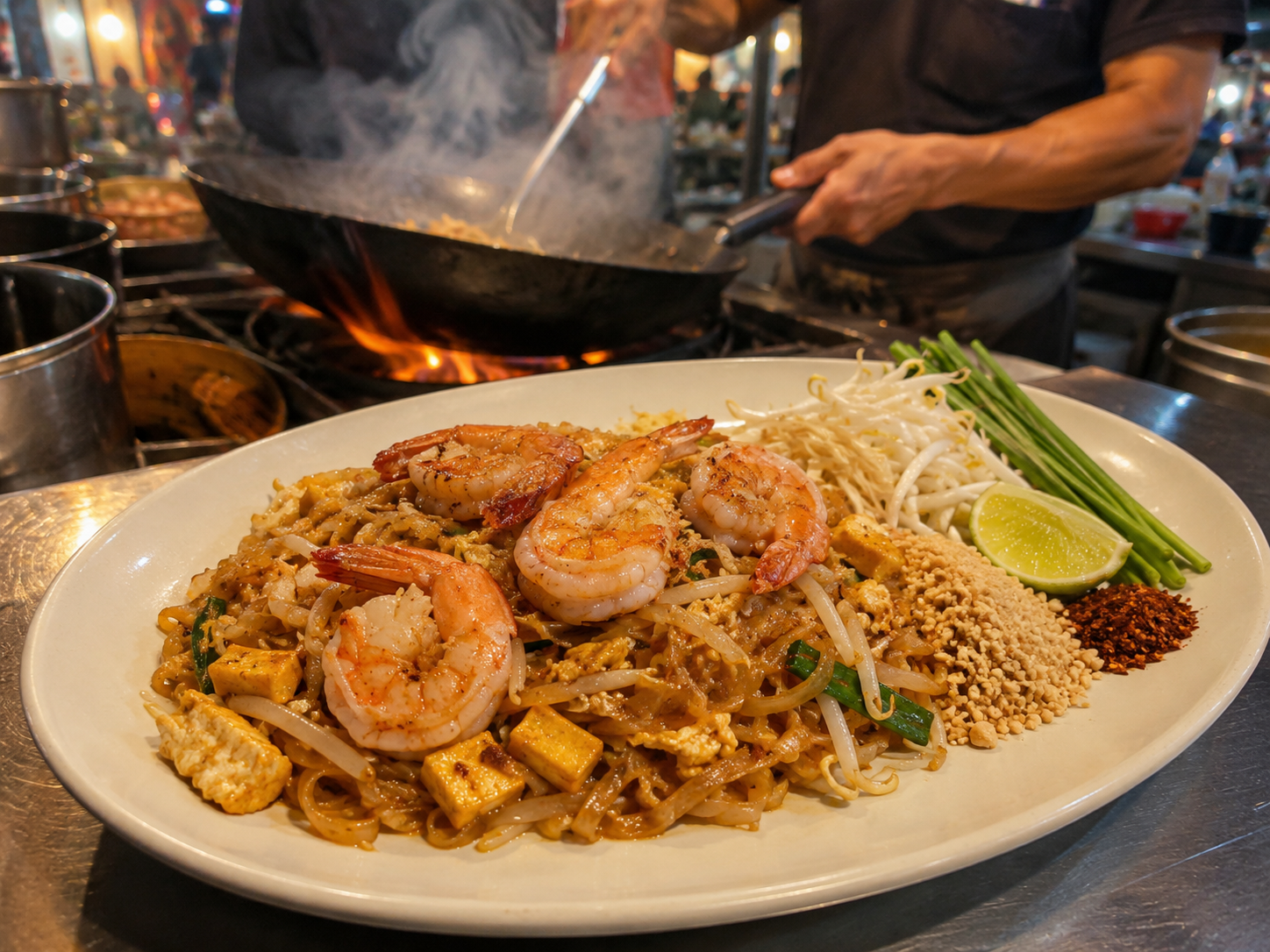
Phat Thai Kung Sot combines rice noodles, fresh shrimp and a sweet, sour and salty tamarind seasoning. Thailand’s Ministry of Culture documents the defining ingredients and cultural context, but provides no weighed recipe formula. The quantities and wok sequence here are our editorial home-kitchen version for two separately fried portions. Thai PBS presents Phat Thai with Sen Chan as regional cooking; the linked programme description does not establish gram quantities. This version contains no ketchup.
- กระทรวงวัฒนธรรม – ผัดไทย · Thai · accessed 22 July 2026
- Thai PBS Foodwork – ผัดไทยเส้นจันท์ · Thai · accessed 19 October 2026
- BfR – Lebensmittelinfektionen im Privathaushalt · German · accessed 19 October 2026
2 Ingredients
Phat Thai sauce
- 35 g Thick tamarind water (น้ำมะขามเปียก – nam makham piak; strained tamarind-pulp water, not undiluted concentrate)
- 35 g Coconut palm sugar or palm sugar (น้ำตาลมะพร้าว / น้ำตาลปี๊บ; finely chopped)
- 30 ml Genuine Thai fish sauce (น้ำปลาแท้ – nam pla)
- 30 ml Water
Noodles and wok ingredients
- 160 g Dried flat rice noodles (เส้นจันท์ – sen chan; 3–5 mm wide)
- 180 g Raw medium-sized prawns (Peeled and deveined, tail segment left on)
- 60 g Firm yellow Thai tofu (เต้าหู้เหลือง; cut into 5 mm-wide sticks)
- 20 g Small dried shrimp (Briefly rinsed, dried and roughly chopped)
- 30 g Sweet preserved radish (หัวไชโป๊หวาน; very finely chopped)
- 30 g Thai shallots (Not sliced too thinly)
- 40 ml Rice bran oil or groundnut oil (Total allowance for both portions including the egg; no additional oil required)
- 110 g Hen’s egg, without shell (2 medium eggs)
- 100 g Mung bean sprouts (Heat thoroughly beforehand and drain; raw weight)
- 30 g Garlic chives (Cut into 3 cm lengths)
- 45 ml Water (30–60 ml, only as needed)
To serve
- 35 g Unsalted peanuts (Dry-roasted and coarsely crushed)
- 80 g Mung bean sprouts for serving (Raw weight; heat thoroughly before serving in this home-kitchen version)
- 20 g Garlic chives (Long pieces)
- 1 pieces Small lime (Cut into wedges)
- 100 g Banana blossom (หัวปลี; finely sliced, optional but traditional)
- 2 g Roasted Thai chilli powder (Serve separately)
Use your specialist ingredients again
Documented ingredient connections, including optional variations and side dishes. Check each recipe for its full ingredients and quantities.
Nam pla · Thai fish sauce
- Phat Thai sauce: Genuine Thai fish sauce · น้ำปลาแท้ – nam pla
More recipes using this ingredient:
- Pad Kra Pao – Stir-fried pork with holy basil
- Tom Kha Gai – Chicken soup with galangal and coconut
- Hakata tonkotsu ramen
- Khao Soi Gai – Chiang Mai egg noodles in coconut curry with chicken
- Tom Yam Kung Nam Sai – Clear Thai prawn soup
- Kaeng Khiao Wan Gai – Thai green curry with chicken
- Massaman Nuea – Beef Massaman curry with sweet potatoes
3 Method
- Soak the noodles in cold water: Completely submerge the Sen Chan noodles in cold water for 30–45 min. They must become pliable while remaining firm in the centre and clearly undercooked. Drain thoroughly for at least 10 min; do not blanch.
- Cook the three-flavour sauce: Gently heat the tamarind water, palm sugar, fish sauce and 30 ml water just until the sugar dissolves. Reduce lightly for 1–2 min and leave to cool completely.
- Prepare the ingredients: Cut the additions, beat the eggs and divide the ingredients into two equal portions. Heat both portions of sprouts thoroughly in boiling water beforehand: at least 70 °C for 2 min throughout, then drain. Keep wok and garnish portions separate and continue immediately. Refrigerate raw shrimp until frying and use separate utensils.
- Cook the shrimp thoroughly: For each portion, spread 10 ml oil in the hot wok. Turn the shrimp until fully cooked, reaching at least 70 °C for 2 min at the thickest point. The former short frying time is not a reliable doneness guarantee. Transfer to a clean plate and immediately continue with the same portion; do not reuse the raw-shrimp plate.
- Fry the tofu and aromatics: Reserve a few drops for the egg from the remaining 10 ml oil per portion. Add the rest to the wok. Stir-fry the tofu, dried shrimp, shallots and sweet radish for 30–45 sec until fragrant; do not burn the dried shrimp.
- Cook the noodles in the wok: Add half the drained noodles, increase the heat and loosen them with two wok spatulas. Start by pouring 15 ml water around the edge; add more by the tablespoon only if the noodles are still brittle.
- Let the sauce absorb: Add half the sauce around the edge of the wok, then keep lifting and turning the noodles for 60–90 sec. They should absorb the sauce completely, look glossy and copper-brown, and retain a springy bite.
- Set the egg: Push the noodles aside, add the reserved drops of oil to the clear area and pour in half the egg. Let it start setting for about 15–20 sec, then fold through the noodles and continue frying until no liquid egg remains. The initial setting time is not the full cooking time.
- Add the sprouts and chives: Add half the already heated wok sprouts and short garlic chives. Toss until hot; this step does not rely on cooking raw sprouts in a few seconds.
- Return the shrimp: Fold in the fully cooked shrimp and heat through again. Check the noodles: springy, neither hard nor mushy. If needed, add a little hot water from the planned allowance. Plate immediately.
- Serve: Scatter over the peanuts. Serve with the heated garnish sprouts, long garlic chives, lime wedges, optional banana blossom and chilli powder. Eat immediately and fry the second portion just as freshly.
Archivist’s notes
- Phat Thai combines Chinese rice-noodle and wok techniques with Thai three-flavour seasoning.
- The ministry text describes the dish’s spread during Plaek Phibunsongkhram’s rule. It gives no registration year, so the former 2011 claim is not repeated here as established. Origin and state promotion are separate questions.
- Sen Chan names a Thai rice-noodle type associated with Chanthaburi; the name alone establishes neither the manufacturing location nor the historical place of invention. Check the package and soaking instructions.
- Never precook the noodles: they should absorb water and sauce only in the wok, becoming springy rather than mushy.
- Wash dried shrimp first and fry them over moderate heat; their low moisture content means they burn very quickly.
- Hua chai po wan is sweet preserved radish, not a European dill pickle and not Korean yellow danmuji.
- Garlic chives have flat leaves; large amounts of spring onion do not provide an equivalent flavour.
- The copper-brown colour comes from tamarind, palm sugar, fish sauce and wok heat, not red tomato sauce.
- Working tamarind preparation: soften 30 g unsweetened tamarind pulp in 90 ml warm water for about 15 min, work it thoroughly and press through a sieve. Weigh out 35 g for the sauce and use the remainder separately. This is an editorial concentration guide, not a ministry formula. Dilute commercial concentrate according to its manufacturer; do not substitute the same weight of concentrate.
- Raw sprouts are a traditional accompaniment. Thorough heating here is an explicitly identified hygiene adjustment for home cooking; washing alone is insufficient. The ingredients remain the same.
Alternatives usable in Europe
- Sen Chan → high-quality Thai flat rice noodles of the same width; adjust the soaking time and never precook.
- Thai palm sugar → pure Indonesian coconut palm sugar; brown beet sugar has a different aroma.
- Yellow Thai tofu → very firm pressed plain tofu; do not use smoked tofu.
- Banana blossom may be omitted. Tamarind, fish sauce, palm sugar, preserved radish, dried shrimp and garlic chives are much more important to the dish’s character.
Nutrition
Nutrition not calculated: No reproducible nutrition calculation is documented for this version of phat Thai. The former serving weight of about 460 g is not supported by a recorded final yield. Water absorbed by the noodles, oil and accompaniments actually consumed, tamarind concentration, and the fish sauce, tofu and preserved radish products used affect the result. The recipe still makes two servings. Previous estimates have been archived.
Nutrition not calculated: No reproducible nutrition calculation is documented for this version of phat Thai. The former serving weight of about 460 g is not supported by a recorded final yield. Water absorbed by the noodles, oil and accompaniments actually consumed, tamarind concentration, and the fish sauce, tofu and preserved radish products used affect the result. The recipe still makes two servings. Previous estimates have been archived.
| Nutrient | per 100 g | per serving |
|---|---|---|
| Energy | not calculated | not calculated |
| Protein | not calculated | not calculated |
| Fat | not calculated | not calculated |
| Carbohydrate | not calculated | not calculated |
| Salt | not calculated | not calculated |
Image: our own AI-generated illustration of the dish.