
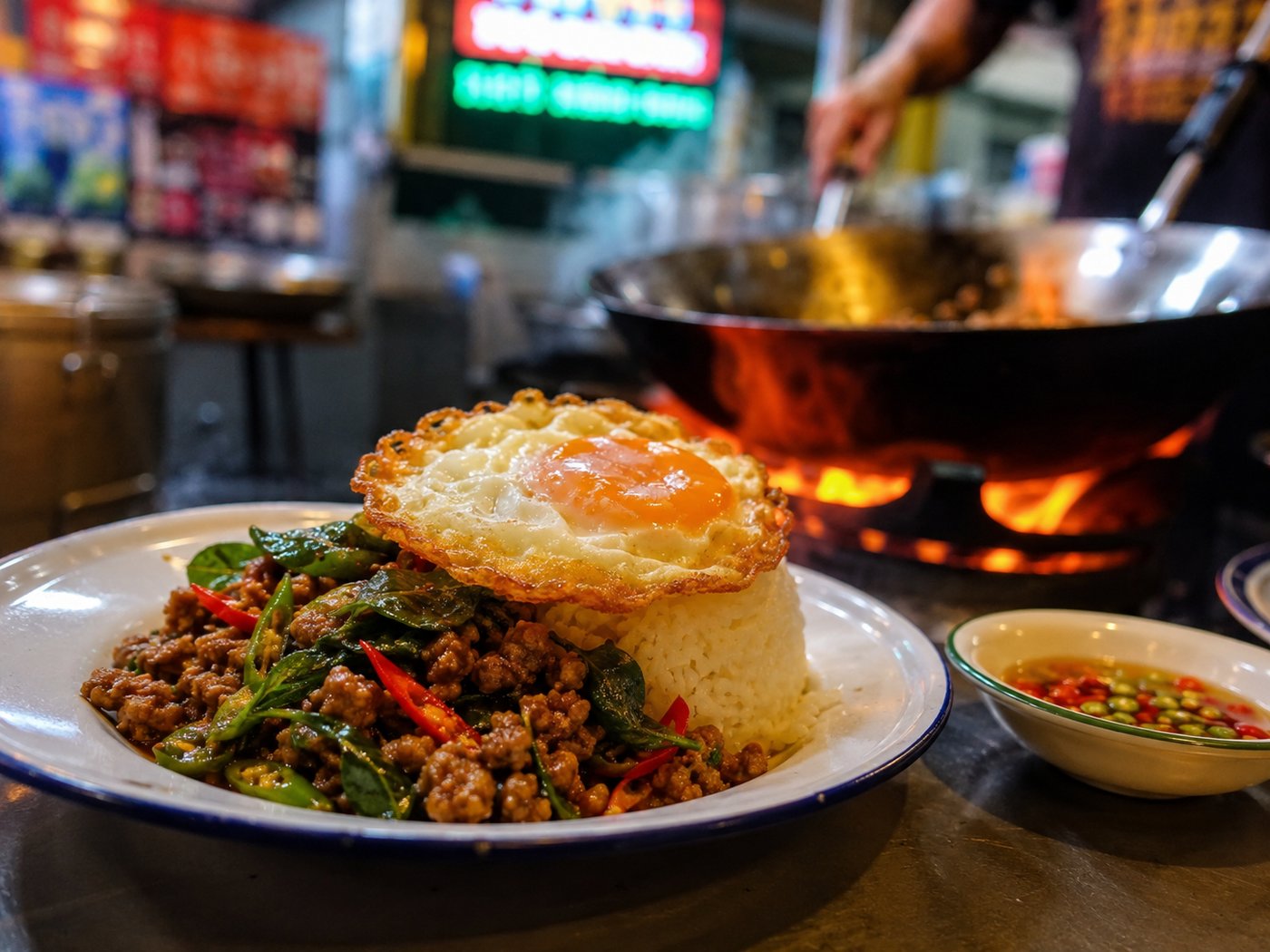
Original recipe estimate: Approx. 15 min
Jasmine rice is already cooked and available warm.
Editorial 25-minute plan for preparation, fried eggs and the stir-fry when jasmine rice is already available. Cooking rice, thawing and larger batches are additional.
Origin & original sources
- Cuisine
- Thailand
- Origin of this version
- Thailand, Bangkok
- Original name
- ผัดกะเพราหมู
- Source languages
- Thai, Thai · republished feature, English · supplementary food safety
See the source references for the documented version and its context.
6 original sources1 Authenticity and sources
Pad kra pao mu (ผัดกะเพราหมู) is Thai cooked-to-order food. Its defining herb is holy basil (kaphrao), not sweet Thai basil (horapha). The historical Thairath reference describes a coarsely pounded seasoning paste with optional galangal. TrueID documents a more strongly seasoned version by the cooking channel กินได้อร่อยด้วย. Our main batch is an editorial archive formulation; its gram amounts are not exact conversions of either source.
- ไทยรัฐ – เปิดสูตรลับ ‘ผัดกะเพราแท้’ · Thai · accessed 22 July 2026
- TrueID – Pad Kaphrao, Vorlage กินได้อร่อยด้วย · Thai · accessed 16 October 2026
- Kasetsart Agricultural Library – Chilli names · Thai · republished feature · accessed 16 October 2026
- Wongnai – Crisp fried eggs (technique only) · Thai · accessed 16 October 2026
- FDA – What You Need to Know About Egg Safety · English · supplementary food safety · accessed 16 October 2026
- FoodSafety.gov – Safe Minimum Internal Temperatures · English · supplementary food safety · accessed 16 October 2026
2 Ingredients
Base recipe for two diners: weigh raw meat, picked dry basil leaves and peeled garlic. Gram weights take precedence over approximate clove, slice and spoon references in the text. Have cooked rice and separate egg-frying oil ready. Optional sauces stay within the listed allowances; do not add the separate TrueID variation to the main batch.
Main ingredients
- 300 g Coarsely minced pork (หมูสับ – raw boneless meat weight, ideally pork neck)
- 40 g Holy basil (kaphrao) leaves (ใบกะเพรา – preferably red; weigh picked, washed and well-dried leaves, excluding coarse stalks)
- 20 g Thai garlic (กระเทียมไทย – peeled weight; 6–8 cloves is only a rough guide for the base recipe; use the gram weight)
- 6 pieces Red Jinda chillies (พริกจินดา – not interchangeable terminology for spur chillies; heat varies)
- 8 pieces Green bird’s-eye chillies (พริกขี้หนูสวน – size and heat vary; use fewer if needed)
- 5 g Galangal, 2 thin slices (ข่า – optional variation; trimmed weight. Two thin slices is only a guide for the base recipe, not a universal requirement)
- 30 ml Neutral vegetable oil (น้ำมันพืช – for the stir-fry only; egg-frying oil is separate)
Seasoning (use sparingly!)
- 15 ml Fish sauce (น้ำปลา – good quality)
- 2.5 g Sugar (weigh it; ½ tsp is only a rough guide for the base recipe; add gradually to balance the flavour)
- 5 ml Oyster sauce (น้ำมันหอย, optional)
- 3 ml Sweet dark soy sauce (ซีอิ๊วดำหวาน – just for colour, optional)
- 30 ml Stock or water (measured liquid for the wok, not rice cooking water; account for the salt in stock)
To serve
- 2 portions Steamed jasmine rice (ข้าวหอมมะลิ – already cooked accompaniment; the serving count is neither a gram weight nor a dry rice amount. Plan rice separately to appetite)
- 2 pieces Eggs (for crisp fried eggs (ไข่ดาว); use pasteurised eggs for soft yolks)
- Neutral oil for frying the eggs (plan separately according to pan size, not included in the wok oil; oil used is not the same as oil absorbed)
Use your specialist ingredients again
Documented ingredient connections, including optional variations and side dishes. Check each recipe for its full ingredients and quantities.
Si-io dam wan
- Seasoning (use sparingly!): Sweet dark soy sauce · ซีอิ๊วดำหวาน – just for colour, optional
No other verified connection in the archive yet.
Nam pla · Thai fish sauce
- Seasoning (use sparingly!): Fish sauce · น้ำปลา – good quality
More recipes using this ingredient:
- Tom Kha Gai – Chicken soup with galangal and coconut
- Hakata tonkotsu ramen
- Phat Thai Kung Sot – Stir-fried rice noodles with prawns
- Khao Soi Gai – Chiang Mai egg noodles in coconut curry with chicken
- Tom Yam Kung Nam Sai – Clear Thai prawn soup
- Kaeng Khiao Wan Gai – Thai green curry with chicken
- Massaman Nuea – Beef Massaman curry with sweet potatoes
3 Method
- Prepare: Have cooked rice ready. Coarsely chop pork neck or use coarse mince. Wash and thoroughly dry the basil. Measure all sauces and liquid before frying.
- Pound the paste (โขลก): Coarsely pound the garlic and both chilli types, with the galangal if wanted, in a mortar. Do not purée for this version; other Thai recipes also use finer pastes.
- Fry the eggs: Heat the separate egg-frying oil in a small pan without letting it smoke. Crack each egg into a cup and carefully slide it into the hot oil. Fry over medium heat until the edges turn crisp; turn carefully if needed. For unpasteurised eggs, cook both white and yolk until firm. Use pasteurised eggs only if serving soft yolks. Drain and cook the stir-fry immediately afterwards.
- Fry the paste: Heat the measured stir-fry oil. Stir-fry the paste until fragrant without letting the garlic darken. Reduce the heat as needed.
- Cook and season the pork: Add and break up the mince. Work in fish sauce and sugar gradually, using the optional sauces only if wanted. Add the measured stock or water and continue cooking until the pork is fully cooked. Use a thin thermometer probe in a sufficiently thick gathered portion of meat to check at least 71 °C, without touching the pan. Colour alone is not sufficient.
- Adjust the consistency: Briefly reduce the liquid until the meat is juicy but not soupy. Do not add sauces beyond the measured allowance; salt content varies between products.
- Add the basil: Add the basil leaves only to the fully cooked meat and toss briefly until wilted. Remove from the heat.
- Serve: Serve immediately with the prepared jasmine rice and fried eggs. Rice weight and the amount of egg-frying oil absorbed are undetermined; servings are a working division.
Archivist’s notes
- Source scope: direct access to Thairath was blocked; the search text read supports the coarse paste, galangal and a fried egg, but not every archive quantity. TrueID explicitly credits the cooking channel กินได้อร่อยด้วย.
- Jinda (พริกจินดา) and spur chilli (พริกชี้ฟ้า) are different names. The Thai Kasetsart agricultural library lists them separately. Jinda is not invariably mild; counts do not reliably predict heat.
- Galangal is optional here. Finer pastes and other vegetable additions also occur; the former claim of a universal ban is withdrawn. This version contains no additional vegetables.
- Separate TrueID version for 400 g meat: 3 tbsp oyster sauce, 1½ tbsp seasoning sauce, 1 tbsp fish sauce, ½ tbsp sweet soy sauce and ½ tbsp sugar. This is a separate sauce formulation, not an addition to the main recipe. The version also uses different chilli and herb amounts. Do not scale it automatically with the portion selector.
- The editorial 25-min kitchen plan includes preparation, eggs and the stir-fry when rice is already cooked. The historical 15-min figure remains documented but is not an approved total time. Cooking rice, thawing and larger batches take extra time.
- Quantity basis: This home version is set for two diners. The 300 g meat and seasoning quantities are editorial working amounts, not an exact conversion of the Thairath or TrueID recipe. Use the weighed amounts for garlic, sugar and galangal; clove, spoon and slice references are approximate guides for the base recipe. Do not add the separate 400 g TrueID variation. Rice weight, egg-frying oil absorption and finished yield have not been measured.
Alternatives usable in Europe
- Look for fresh or frozen holy basil in an Asian grocery. Horapha or European basil with ground cloves is not an equivalent substitute.
- Jinda and bird’s-eye chillies: other fresh chillies of known heat can be used as a fallback. The flavour changes.
- Buy fresh or frozen galangal; this optional ingredient can be omitted. Ginger does not provide the same aroma.
- Choose fish sauce by ingredients and salt content. Soy sauce produces different seasoning.
- Use Thai sweet dark soy sauce. Indonesian kecap manis has a different formulation; as a fallback, use sparingly to taste rather than assuming equal quantities.
Nutrition
Not calculated: product data, quantities actually eaten and measured finished weight are missing. Side dishes are excluded.
Not calculated. Earlier unverified archive estimates are preserved in the audit archive and no longer displayed as nutrition values. Missing values do not mean zero.
| Nutrient | per 100 g | per portion |
|---|---|---|
| Energy | not calculated | not calculated |
| Protein | not calculated | not calculated |
| Fat | not calculated | not calculated |
| Carbohydrate | not calculated | not calculated |
| Salt | not calculated | not calculated |
Image: our own AI-generated illustration of the dish.