
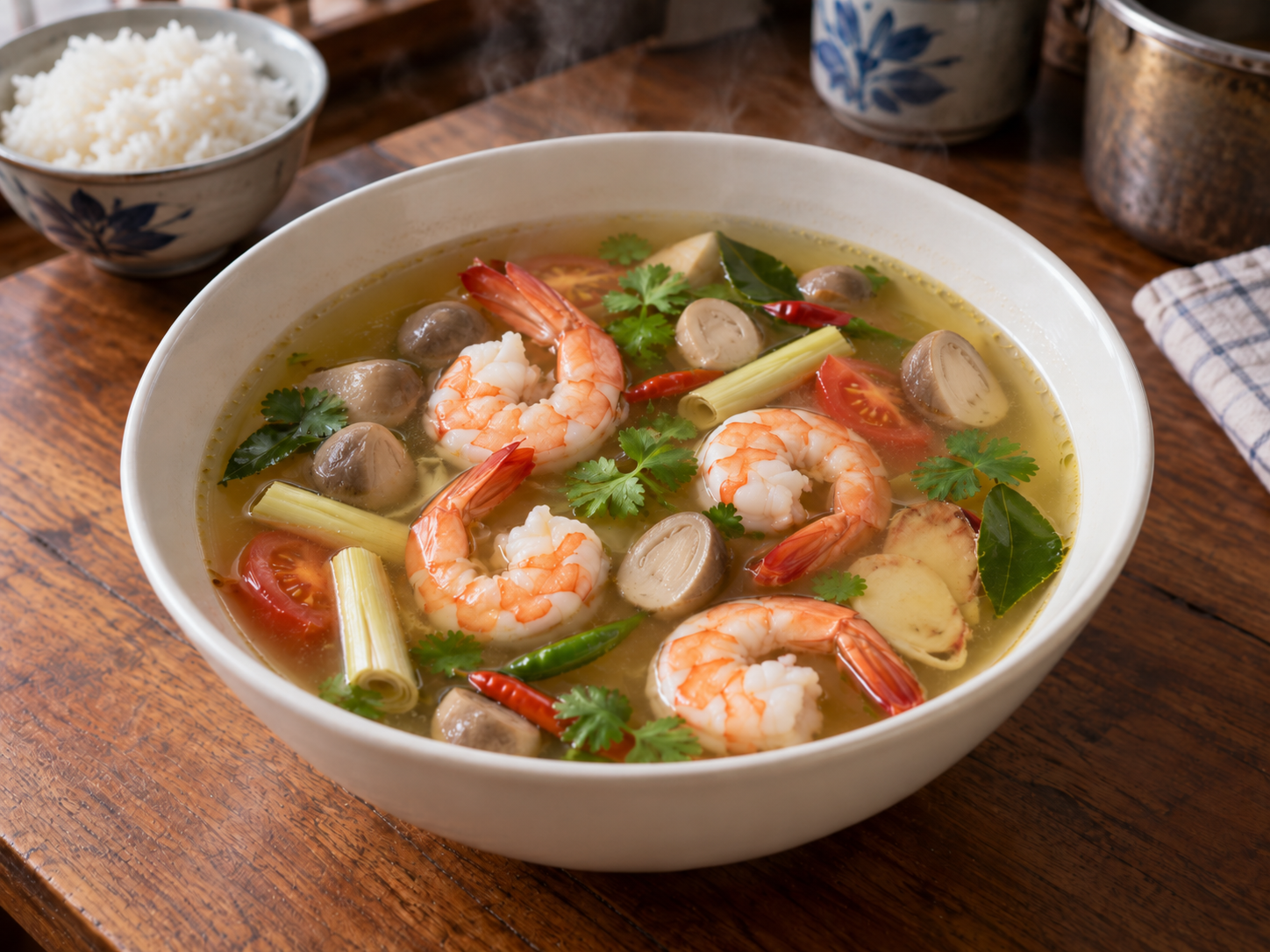
Original recipe estimate: Approx. 40 min
10 min for the stock, 5 min for the aromatics, 3 min for the mushrooms and up to 4 min for the prawns; about 23 min for peeling and trimming, chopping, bringing to the boil, straining and seasoning. No stock needs to be prepared beforehand: it is made from the shells as part of this recipe.
Origin & original sources
- Cuisine
- Thailand
- Origin of this version
- Thailand · Central Thailand / Chao Phraya basin
- Original name
- ต้มยำกุ้งน้ำใส (Tom Yam Kung Nam Sai)
- Source languages
- Thai
See the source references for the documented version and its context.
4 original sources1 Authenticity and sources
Tom Yam Kung is rooted in the river and farming communities of Central Thailand; Thailand’s Ministry of Culture particularly identifies the Chao Phraya basin. This does not establish a single city of invention or an unchanged original version. This archive version combines Krua Baan Pim’s clear home-style soup with a homemade prawn stock: lemongrass, galangal and makrut lime leaves perfume the broth; lime, fish sauce and crushed fresh chillies provide the final seasoning. A little tomato follows Pim’s version and is not a universal requirement. The version chosen here contains neither milk nor coconut milk nor nam phrik phao; this is a specific recipe tradition, not a prohibition on chilli paste in every Thai nam sai variation. The quantities are an editorial metric synthesis for four soup servings as part of a Thai meal, not an exact conversion of a single source. Phol’s reduced-salt fish sauce is not replaced with the same quantity of regular fish sauce. The archive underwent source and plausibility checks, but no cooking test.
- กรมส่งเสริมวัฒนธรรม – ต้มยำกุ้ง / Origins and culture · Thai · accessed 7 September 2026
- ครัวบ้านพิม – ต้มยำกุ้งน้ำใส · Thai · accessed 7 September 2026
- Phol Foodmafia – ต้มยำกุ้ง / Prawn stock · Thai · accessed 7 September 2026
- Cultural Fund – ศิลปินสาร, volume 5 no. 26, pages 8–9 · Thai · accessed 7 September 2026
2 Ingredients
Prawn stock and soup ingredients · weigh aromatics after trimming
- 600 g Raw whole prawns (Including heads and shells; this is not the weight of peeled prawn meat)
- 1200 ml Water (After straining, top up the stock to this volume)
- 100 g Fresh straw mushrooms (เห็ดฟาง – het fang)
- 40 g Lemongrass (ตะไคร้ – takhrai)
- 30 g Galangal (ข่า – kha)
- 4 g Makrut lime leaves (ใบมะกรูด – bai makrut; central ribs removed)
- 6 g Coriander roots (รากผักชี – rak phak chi)
- 60 g Tomato (Cut into small wedges)
- 10 g Coriander leaves (ผักชี – phak chi)
Fresh seasoning · start with the base quantities, then adjust to taste
- 10 g Small fresh Thai chillies (พริกขี้หนูสวน; increase to up to 1.5 times the amount for more heat)
- 40 ml Thai fish sauce (น้ำปลา – nam pla; regular salt strength, increase to up to 1.5 times the amount to taste)
- 60 ml Freshly squeezed lime juice (น้ำมะนาว – nam manao; increase to up to 1⅓ times the amount to taste)
- as needed Salt (Only after tasting; 0–2 g for four servings)
Use your specialist ingredients again
Documented ingredient connections, including optional variations and side dishes. Check each recipe for its full ingredients and quantities.
Nam pla · Thai fish sauce
- Fresh seasoning · start with the base quantities, then adjust to taste: Thai fish sauce · น้ำปลา – nam pla; regular salt strength, increase to up to 1.5 times the amount to taste
More recipes using this ingredient:
- Pad Kra Pao – Stir-fried pork with holy basil
- Tom Kha Gai – Chicken soup with galangal and coconut
- Hakata tonkotsu ramen
- Phat Thai Kung Sot – Stir-fried rice noodles with prawns
- Khao Soi Gai – Chiang Mai egg noodles in coconut curry with chicken
- Kaeng Khiao Wan Gai – Thai green curry with chicken
- Massaman Nuea – Beef Massaman curry with sweet potatoes
3 Method
- Prepare the prawns: Remove the heads and shells and reserve them for the stock. Slit the backs and remove the intestinal tract; the tail fans may be left on. Refrigerate the prawn meat until ready to cook.
- Prepare the aromatics: Bruise the lemongrass and coriander roots; cut the lemongrass into short lengths and the galangal into thin slices. Set aside about half the lemongrass and galangal for the stock. Halve the straw mushrooms, tear the makrut leaves and roughly crush the chillies.
- Make the stock: Bring the heads, shells, reserved aromatics and coriander roots to the boil with the amount of water stated in the ingredient list, then simmer gently for about 10 minutes. Skim off the foam, strain through a fine sieve and discard the solids. If necessary, top the stock back up to the stated water volume.
- Build the soup: Let the remaining lemongrass and galangal infuse gently in the stock for about 5 minutes. Add the fresh straw mushrooms and cook for about 3 minutes before adding the prawns.
- Cook the prawns: Add the prawns and makrut leaves; cook gently for approximately 2–4 minutes, depending on size. Add the tomato in the final minute. The prawns should be opaque through to the centre and fully cooked; time alone does not establish doneness.
- Season outside the pot: Put the chillies and initially the base quantities of fish sauce and lime juice stated in the ingredient list into a large preheated serving bowl. Ladle the hot soup over them, mix gently and taste. Add more fish sauce and lime only as needed within the stated ranges; check whether salt is needed only afterwards. Garnish with coriander leaves and serve immediately. Set aside the tough pieces of galangal, lemongrass and leaves while eating.
Archivist’s notes
- The 10-minute shell-stock cooking time is documented by Phol; the other timings are editorial guidelines. The technique of straining the stock, adding fresh aromatics and seasoning outside the pot is also supported by the Cultural Fund source.
- Raw whole prawns provide both meat and stock. River prawns are characteristic of the region; white prawns are also documented by Pim. Peeled prawns do not supply the heads and shells needed for this method.
- Look for fresh or frozen galangal, makrut leaves and coriander roots in Thai or Asian grocery shops. Ginger does not replace galangal, nor does lime juice replace makrut leaves.
- Use genuine Thai nam pla; salt content varies between products. Light soy sauce creates a different flavour profile.
- Serve as a soup within a Thai meal. If desired, serve jasmine rice separately rather than cooking it in the soup. The tough pieces of aromatics are not eaten.
Alternatives usable in Europe
- Canned straw mushrooms can replace fresh ones. Drain them; they are already cooked and only need to be heated through.
- Fresh enoki are an alternative documented by Pim; cook them fully.
- If coriander roots are unavailable, lightly bruised coriander stems can provide a milder aromatic alternative.
Nutrition
No nutritional values have been calculated for this archive version. The edible yield of the prawns, the proportion of stock and the fish sauce used to adjust the seasoning affect the values.
| Nutrient | per 100 g | per soup serving |
|---|---|---|
| Energy | not calculated | not calculated |
| Protein | not calculated | not calculated |
| Fat | not calculated | not calculated |
| Carbohydrate | not calculated | not calculated |
| Salt | not calculated | not calculated |
Image: our own AI-generated illustration of the dish.