
Original recipe estimate: Approx. 80 min
For all three fillings and all the dumplings in this entry: allow about 70 min for preparation, test-cooking and folding, plus three batches of frying and steaming at up to about 9 min each, and plating. 80 min is tight for all varieties; ready-made gyōza wrappers are the specified ingredient.
Origin & original sources
- Cuisine
- Japan
- Origin of this version
- Japan, nationwide
- Original name
- 焼き餃子 三種
- Source languages
- Japanese, German
See the source references for the documented version and its context.
5 original sourcesWhat goes with it
In this recipe: Classic tare
1 Authenticity and sources
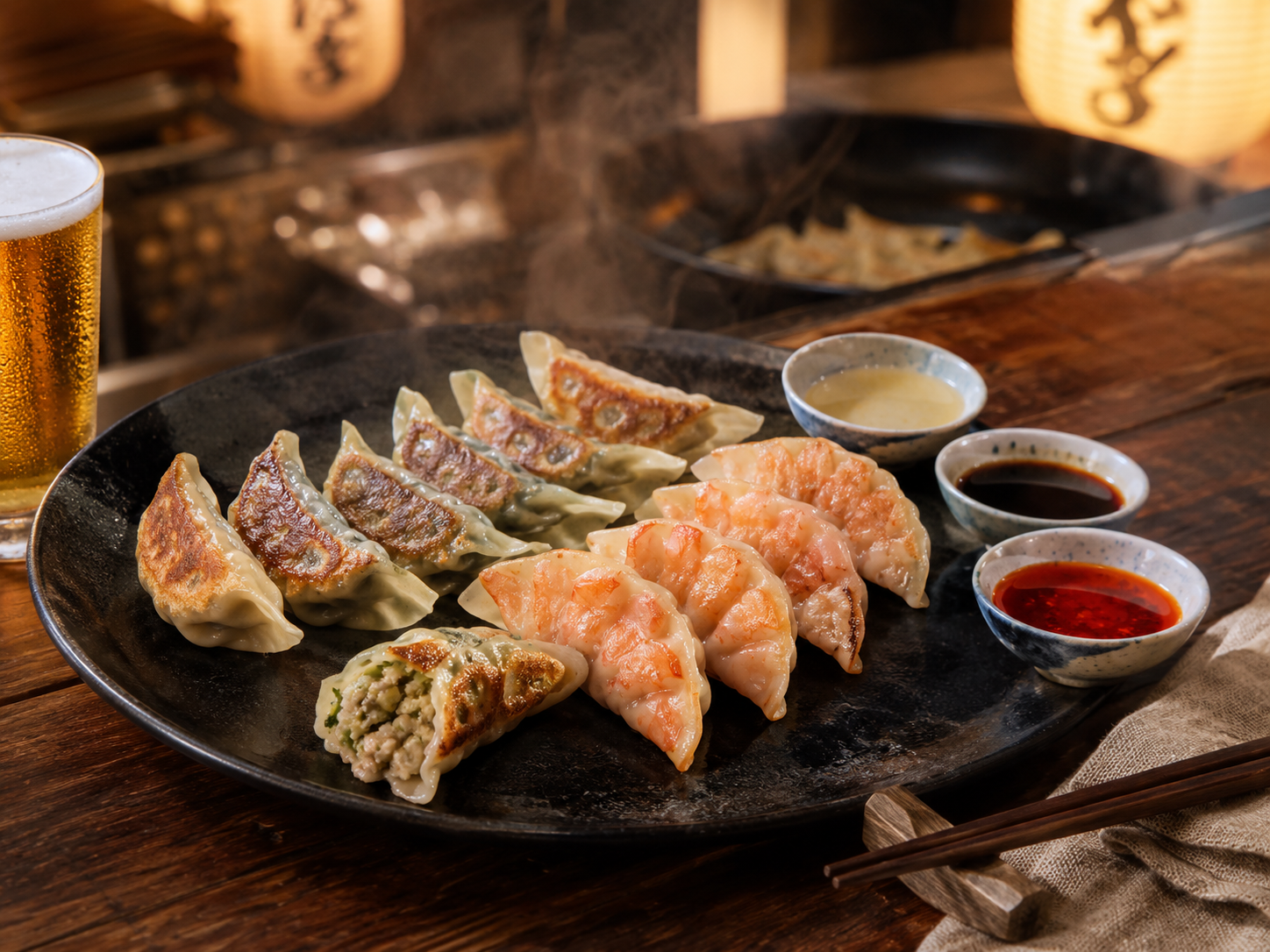
This editorial selection combines three Japanese gyōza profiles: pork with cabbage and nira, pork with shiso, and prawn. The macaroni poll from 2023 places cabbage gyōza at rank 1, shiso at rank 4 and steamed prawn gyōza at rank 5; it is neither a representative national statistic nor evidence for these exact fillings. Kikkoman documents the fry-and-steam method and its own cabbage and prawn variants, while S&B provides a shiso variant. Our complete quantities and combination are not exact translations of these different recipes. The aim is thin, tightly sealed wrappers, fully cooked fillings and crisp bases.
- キッコーマン – 焼き餃子 · Japanese · accessed 22 July 2026
- S&B – 青じそ餃子 (comparison variant) · Japanese · accessed 19 October 2026
- Kikkoman – 包まないえびにら餃子 (different prawn variant) · Japanese · accessed 19 October 2026
- macaroni – gyōza poll 2023, selection context only · Japanese · accessed 19 October 2026
- BfR – supplementary cooking and cooling guidance · German · accessed 19 October 2026
2 Ingredients
Editorial combination. Cabbage amounts apply after blanching and squeezing. Three varieties for a total of 36 wrappers; cook surplus filling separately. Add steaming water according to pan and evaporation. Times are guides; measure the centre of the filling.
Wrappers & frying
- 36 pieces Thin Japanese gyōza wrappers (餃子の皮, 8–9 cm diameter)
- 30 ml Neutral vegetable oil (For three batches)
- 240 ml Boiling water (Starting amount for three batches; extra hot water as needed, depending on pan and evaporation)
- 15 ml Toasted sesame oil (ごま油, for the final frying)
- 30 ml Water (For sealing)
① Classic: pork · cabbage · nira (12 pieces)
- 80 g Minced pork, not too lean (豚ひき肉)
- 75 g White cabbage (Working weight after blanching, cooling and firm squeezing; no fixed conversion to raw weight)
- 25 g Japanese long onion or spring onion (長ねぎ)
- 15 g Garlic chives (ニラ, nira)
- 3 g Garlic (Finely grated)
- 3 g Ginger (Finely grated)
- 8 ml Japanese soy sauce (濃口醤油)
- 8 ml Sake (酒)
- 8 ml Oyster sauce (オイスターソース)
- 8 ml Toasted sesame oil (ごま油)
- 5 g Potato starch (片栗粉, katakuriko)
- 1 g Salt (For this filling; pepper separately to taste)
- White pepper (To taste; separated from the previous salt note)
② Shiso: pork · ōba (12 pieces)
- 90 g Minced pork, not too lean (豚ひき肉)
- 60 g White cabbage (Working weight after blanching, cooling and firm squeezing; no fixed conversion to raw weight)
- 20 g Japanese long onion or spring onion (Finely chopped)
- 12 pieces Large shiso leaves (青じそ / 大葉)
- 4 g Ginger (Finely grated)
- 8 ml Japanese soy sauce (濃口醤油)
- 8 ml Sake (酒)
- 5 ml Toasted sesame oil (ごま油)
- 5 g Potato starch (片栗粉)
- 1 g Salt (For this filling; pepper separately to taste)
- White pepper (To taste; separated from the previous salt note)
③ Prawn (12 pieces)
- 120 g Raw peeled prawns (むきえび, deveined)
- 75 g White cabbage (Working weight after blanching, cooling and firm squeezing; no fixed conversion to raw weight)
- 25 g Japanese long onion or spring onion (Finely chopped)
- 3 g Garlic (Finely grated)
- 3 g Ginger (Finely grated)
- 8 ml Oyster sauce (オイスターソース)
- 8 ml Sake (酒)
- 5 ml Japanese soy sauce (濃口醤油)
- 5 ml Toasted sesame oil (ごま油)
- 5 g Potato starch (片栗粉)
- White pepper (To taste)
Classic tare
- 45 ml Rice vinegar (米酢, komezu)
- 30 ml Japanese soy sauce (濃口醤油)
- Japanese chilli oil (ラー油, rāyu)
Use your specialist ingredients again
Documented ingredient connections, including optional variations and side dishes. Check each recipe for its full ingredients and quantities.
Koikuchi shōyu
- ① Classic: pork · cabbage · nira (12 pieces): Japanese soy sauce · 濃口醤油
- ② Shiso: pork · ōba (12 pieces): Japanese soy sauce · 濃口醤油
- ③ Prawn (12 pieces): Japanese soy sauce · 濃口醤油
- Classic tare: Japanese soy sauce · 濃口醤油
More recipes using this ingredient:
Sake
- ① Classic: pork · cabbage · nira (12 pieces): Sake · 酒
- ② Shiso: pork · ōba (12 pieces): Sake · 酒
- ③ Prawn (12 pieces): Sake · 酒
More recipes using this ingredient:
Japanese rice vinegar · Komezu
- Classic tare: Rice vinegar · 米酢, komezu
More recipes using this ingredient:
3 Method
- Prepare and weigh the cabbage: Have more trimmed raw cabbage ready than the required prepared weight. Chop finely, blanch in batches for about 30–45 seconds, cool in cold water and squeeze firmly in a clean cloth. Only then weigh the listed cabbage amount for each filling. Variable water loss prevents an exact back-calculation of raw weight; use cooled cabbage.
- Knead the classic filling: Mix the minced pork with the quantities of soy sauce, sake, oyster sauce, sesame oil, salt and pepper listed for this group until sticky. Work in the cabbage, long onion, nira, garlic, ginger and katakuriko. Cover and refrigerate; clean hands and tools after contact with raw pork.
- Prepare the shiso filling: Mix the minced pork with its allotted soy sauce, sake, sesame oil, salt and pepper until sticky. Work in the cabbage, long onion, ginger and katakuriko. Finely slice half the dry shiso leaves and mix them in; halve the other half lengthwise and reserve for the wrappers. Refrigerate the filling.
- Give the prawn filling texture: Chop two thirds of the prepared, patted-dry prawns into a sticky paste and cut one third into 5–7 mm pieces. Mix with this group’s oyster sauce, sake, soy sauce, sesame oil and pepper, then work in the cabbage, long onion, garlic, ginger and katakuriko. Cover and refrigerate.
- Test-cook and plan the filling: Fry a small, flat sample of each mixture until fully cooked before tasting for seasoning. Never taste raw filling. The following gram amounts per wrapper are editorial folding guides, not a measured yield. Allocate one third of the wrappers to each variety. Cook surplus filling thoroughly and separately rather than forcing it all into the wrappers.
- Fold the classic gyōza: Start with about 15–17 g filling per wrapper, using only as much as allows it to close without stretching. Lightly moisten the edge, fold over, make 5–6 pleats at the front, press out air and seal tightly. Shape a flat base.
- Enclose the shiso: Place half a reserved shiso leaf on each allotted wrapper. Start with about 14–16 g filling and seal as above. Reduce the filling for smaller wrappers; visible shiso is no reason to leave the seam open.
- Shape the ebi-gyōza: Start with about 16–18 g prawn filling per wrapper and seal just as tightly. Keep only the small batch being worked on outside the refrigerator; refrigerate finished dumplings and remaining raw fillings, covered, until frying immediately afterwards. Do not lay a wet cloth directly on the dumplings.
- Brown the bases: For the base recipe, plan three batches in a non-stick pan about 24–26 cm across with a tight-fitting lid. Spread 10 ml neutral oil per batch over medium heat and arrange up to 12 dumplings without crowding. Lightly brown for about 60–90 seconds, longer if needed. Cook larger recipe quantities in additional batches of the same size; distribute oil and water according to the pan and batch count.
- Steam and check doneness: Briefly take the pan off the heat, carefully pour about 80 ml hot water in at the side and cover immediately, avoiding splashes. Return to medium heat and steam actively for an initial 4–5 min. Before frying dry, use a clean thin probe in the filling centres of several thick dumplings per batch: at least 70 °C for 2 minutes. Add a little hot water and continue covered cooking if necessary. Translucent wrappers or browned bases alone do not prove that the filling is cooked.
- Finish until crisp: Only after adequate cooking, remove the lid and evaporate the remaining water. For the base batch, pour 5 ml sesame oil around the edge and fry for about 1–2 min until golden and crisp. Adjust the heat to prevent burning. Repeat with the other chilled varieties; timing also depends on wrappers, filling and hob.
- Serve immediately: Mix the rice vinegar and soy sauce for the tare, adding rāyu to taste. Serve the gyōza in batches with crisp bases facing up. Cook surplus filling thoroughly and separately and serve alongside; it is not part of the planned dumpling count. Cool cooked leftovers promptly in shallow containers and refrigerate.
Archivist’s notes
- Japanese gyōza wrappers are thinner and usually smaller than Chinese jiaozi wrappers. Thaw slowly in the refrigerator and always keep covered.
- Nira is garlic chives, not ordinary chives; its aroma is part of the classic filling.
- Shiso / ōba tastes cool, citrusy and anise-like. Korean perilla is related but larger and more strongly flavoured.
- Combining prawn paste with small pieces gives both binding and bite. Do not purée in a blender until rubbery.
- These cooking times are guides for freshly filled, chilled gyōza. Frozen dumplings need an adjusted steaming process and the same doneness check; do not simply apply the short fresh timings unchanged. Do not store raw fillings at room temperature.
- Source status: the poll also compares cooking styles and different fillings, rather than providing a reliable ranking of our three recipes. The complete quantities remain editorial. Cabbage is now explicitly defined as prepared weight: a working definition, not a retrospectively verified original conversion. The planned 36 wrappers give 6 servings of 6 pieces, but may leave surplus filling.
Alternatives usable in Europe
- Gyōza no kawa → thin Chinese dumpling wrappers; thick wonton wrappers only as a last resort.
- Nira → garlic chives; if necessary, 10 g chives plus ½ small garlic clove.
- Aojiso / ōba → Korean perilla leaves; basil or mint are not equivalent substitutes.
- Katakuriko → potato starch; cornflour binds with a slightly different texture.
- Rāyu → Japanese chilli oil; alternatively, neutral chilli oil without Sichuan pepper.
Nutrition
Nutrition not calculated: No reproducible calculation is documented for the mixed plate with three fillings. Wrapper weight and composition, pork fat content, squeezed cabbage weight, filling actually used and absorbed frying oil are not sufficiently documented. A serving remains 6 pieces, 2 of each filling; the former serving weight of about 170 g is unconfirmed. The tare is separate. Nutrition values in the linked Kikkoman source belong to its own recipe and cannot be transferred to this combination. Previous estimates have been archived.
Nutrition not calculated: No reproducible calculation is documented for the mixed plate with three fillings. Wrapper weight and composition, pork fat content, squeezed cabbage weight, filling actually used and absorbed frying oil are not sufficiently documented. A serving remains 6 pieces, 2 of each filling; the former serving weight of about 170 g is unconfirmed. The tare is separate. Nutrition values in the linked Kikkoman source belong to its own recipe and cannot be transferred to this combination. Previous estimates have been archived.
| Nutrient | per 100 g | per serving |
|---|---|---|
| Energy | not calculated | not calculated |
| Protein | not calculated | not calculated |
| Fat | not calculated | not calculated |
| Carbohydrate | not calculated | not calculated |
| Salt | not calculated | not calculated |
Image: our own AI-generated illustration of the dish.