
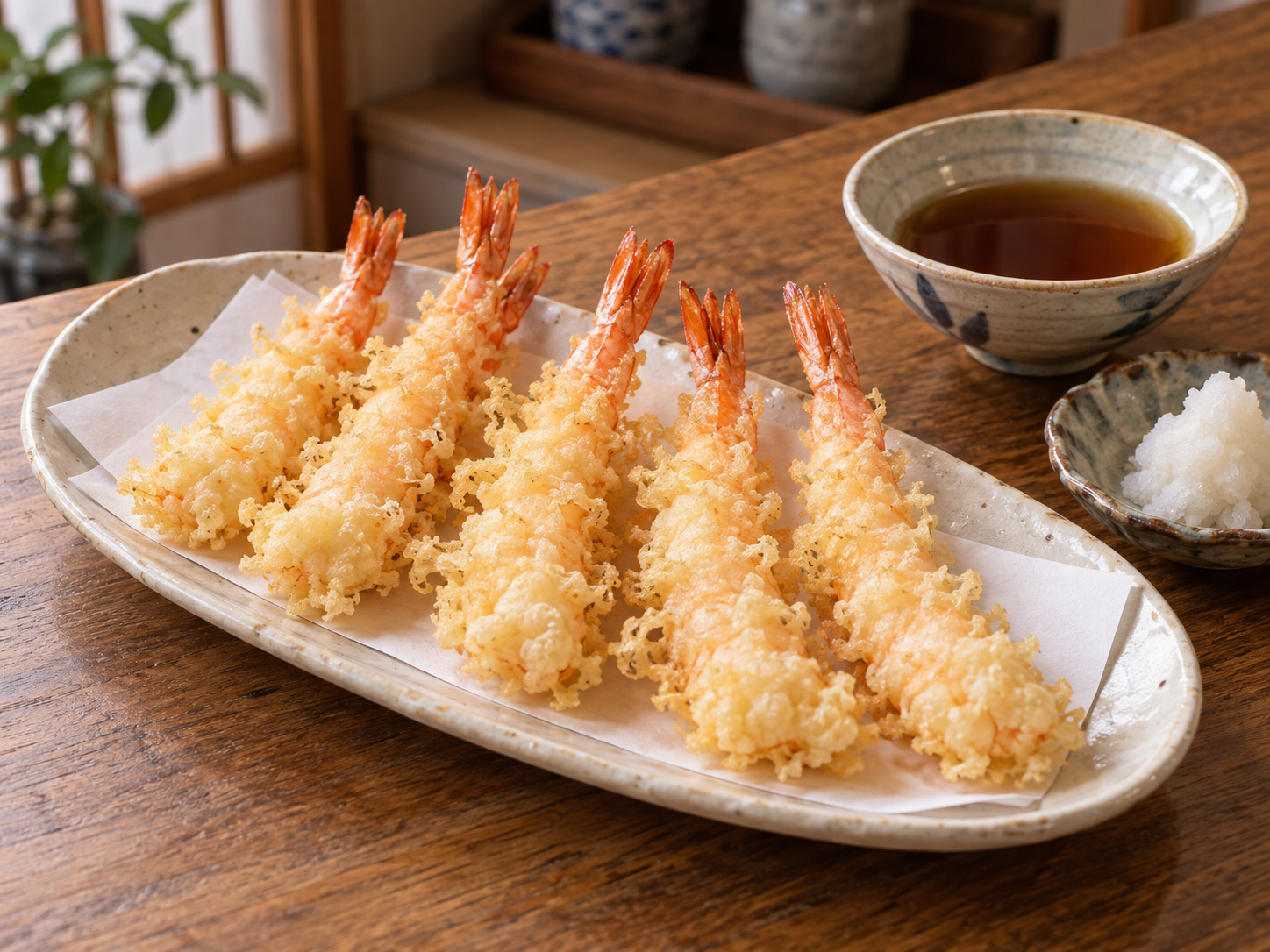
Original recipe estimate: Approx. 30 min
Tentsuyu, prawn preparation, batter and frying in batches are included in the method; the batter does not rest. Planning estimate for the original yield.
Origin & original sources
- Cuisine
- Japan
- Origin of this version
- Japan · Home-cooking version, linked to Edo’s tempura tradition
- Original name
- 海老の天ぷら (Ebi Tempura)
- Source languages
- Japanese
See the source references for the documented version and its context.
4 original sourcesWhat goes with it
In this recipe: Tentsuyu and radish
1 Authenticity and sources
The prawns and batter follow Kikkoman Japan’s 基本のえび天ぷら. The separately added tentsuyu comes from the tempura recipe of Japan’s Hattori cookery school. Cold water, brief mixing and hot oil produce the light coating. The prawns are straightened beforehand. Japan’s Ministry of Agriculture, Forestry and Fisheries (MAFF) describes Portuguese influences on tempura’s development and its popularity as Edo street food. Its historic seafood platter cooked in sesame oil is a different version; this archive specifically documents ebi tempura for home cooking, without claiming it is the only valid original form. Kikkoman specifies six prawns, half an egg, 150 ml water, one cup of flour and one teaspoon of flour for dusting. Its own measurement guide defines a cup as 200 ml and a teaspoon as 5 ml. Flour weights are approximations, not exact volume-to-weight conversions; the original volume is retained. The 25 g of egg assumes an egg with 50 g of contents. Prawn weight and oil quantity are shopping and working estimates. Hattori’s sauce for four people is halved, including the kombu area; kombu weight and radish quantity are editorial estimates. The source specifies mirin and shōyu in general; hon-mirin and koikuchi are the particular ingredients chosen here. Total time including the sauce is an editorial estimate; Kikkoman gives 15 minutes for the prawns alone. Some batter and almost all the frying oil will be left over.
- Kikkoman – Basic prawn tempura · Japanese · accessed 10 September 2026
- Hattori cookery school – Vegetable tempura (tentsuyu) · Japanese · accessed 10 September 2026
- MAFF – Tempura (Tokyo) · Japanese · accessed 10 September 2026
- Kikkoman – Home Cooking measurement conventions · Japanese · accessed 10 September 2026
2 Ingredients
Prawns and batter
- 180 g Raw black tiger prawns, headless and shell-on (Approx.; base quantity of 2 portions: 6 medium prawns; follow the piece count)
- 3 g Hakurikiko (薄力粉), for dusting (Approx.; Japanese low-protein wheat flour)
- 25 g Beaten whole egg, without shell
- 150 ml Very cold water, for the batter
- 200 ml Hakurikiko (薄力粉), for the batter (Fill loosely and level off; approximate weight for the base quantity of 2 portions: 110 g)
- 1000 ml Refined rapeseed oil, for deep-frying (Approx.; actual quantity depends on pot size and oil depth, not the amount consumed)
Tentsuyu and radish
- 150 ml Water, for tentsuyu
- 25 ml Hon-mirin (本みりん)
- 25 ml Japanese koikuchi shōyu (濃口醤油)
- 5 g Katsuobushi (かつお節), thin bonito flakes
- 1 g Dried kombu (昆布) (Approx.; base quantity of 2 portions: roughly 2 × 4 cm)
- 60 g Peeled daikon (大根), for finely grating
Use your specialist ingredients again
Documented ingredient connections, including optional variations and side dishes. Check each recipe for its full ingredients and quantities.
Koikuchi shōyu
- Tentsuyu and radish: Japanese koikuchi shōyu (濃口醤油)
More recipes using this ingredient:
Hon-mirin
- Tentsuyu and radish: Hon-mirin (本みりん)
More recipes using this ingredient:
Dried kombu
- Tentsuyu and radish: Dried kombu (昆布) · Approx.; base quantity of 2 portions: roughly 2 × 4 cm
More recipes using this ingredient:
Katsuobushi · bonito flakes
- Tentsuyu and radish: Katsuobushi (かつお節), thin bonito flakes
More recipes using this ingredient:
3 Method
- Make the tentsuyu: Heat the sauce water, mirin, shōyu, kombu and katsuobushi together. Once boiling, simmer gently for 2–3 minutes, then strain through a sieve lined with filter paper. Finely grate the daikon and set aside separately.
- Prepare the prawns: Peel, leaving the tail fans attached, and devein. Trim about 5 mm from the tail tips and pat the prawns thoroughly dry. Make shallow cuts along the belly at intervals of about 5 mm. With the cut side facing down, gently press the prawns straight. Coat the bodies lightly with the dusting flour.
- Set up for frying: Heat the oil to 180 °C in a sturdy, deep pot. Aim for an oil depth of about 3–4 cm, filling the pot no more than halfway; adjust the oil quantity accordingly. Have a thermometer and draining rack ready.
- Mix the batter at the last moment: Mix the egg thoroughly with the very cold water. Briefly fold in the batter flour with chopsticks. Small lumps may remain; do not beat until smooth or leave the batter to rest.
- Fry in batches: Hold each prawn by the tail, dip the body into the batter and carefully lower it into the oil. Fry only a few at a time, turning during cooking. The source gives roughly 90 seconds at 180 °C; depending on size, cook until the coating is pale and crisp and the flesh is fully opaque. Drain on the rack.
- Serve immediately: Arrange the prawns loosely and serve the sauce and daikon separately. Add radish to the tentsuyu to taste and briefly dip the tempura only as you eat.
Archivist’s notes
- Hakurikiko is Japanese low-protein wheat flour. A ready-made tempura mix may contain starch, egg or raising agents, so it is not a like-for-like substitute in the quantities used here.
- Look for hon-mirin, koikuchi shōyu, unseasoned kombu and katsuobushi at Japanese food shops. Mirin is not rice vinegar; kombu is not nori. The neutral refined oil is an editorial choice where the main source specifies frying oil without naming a type.
- The batter contains egg and wheat; the tentsuyu contains fish and usually soy/wheat. This is not a vegetarian or gluten-free version. Nutrition has not been calculated; no in-house cooking test has been carried out.
Alternatives usable in Europe
- Alternatives usable in Europe: low-protein white wheat flour, ideally around 8–9 % protein, if hakurikiko is unavailable. The flour type number alone does not guarantee the same protein content. Vannamei prawns are already expressly permitted by the Japanese main source.
Nutrition
Nutrition has not been calculated; leftover batter and unabsorbed frying oil are not fully consumed.
| Nutrient | per 100 g | Per small portion |
|---|---|---|
| Energy | not calculated | not calculated |
| Protein | not calculated | not calculated |
| Fat | not calculated | not calculated |
| Carbohydrate | not calculated | not calculated |
| Salt | not calculated | not calculated |
Image: our own AI-generated illustration of the dish.