
Original recipe estimate: Approx. 50 min with prepared dashi and cooked octopus
The dashi required by the recipe is ready and at the appropriate temperature.
The octopus is fully cooked and drained.
Starting with prepared, cooled dashi and cooked octopus: prepare the batter and filling, allow about 10 min for hydration, preheat the pan and cook the original quantity in batches of 8–12 min. Making the dashi and cooking the octopus are not included.
Origin & original sources
- Cuisine
- Japan
- Origin of this version
- Japan, Osaka
- Original name
- たこ焼き (Takoyaki)
- Source languages
- Japanese
See the source references for the documented version and its context.
3 original sources1 Authenticity and sources
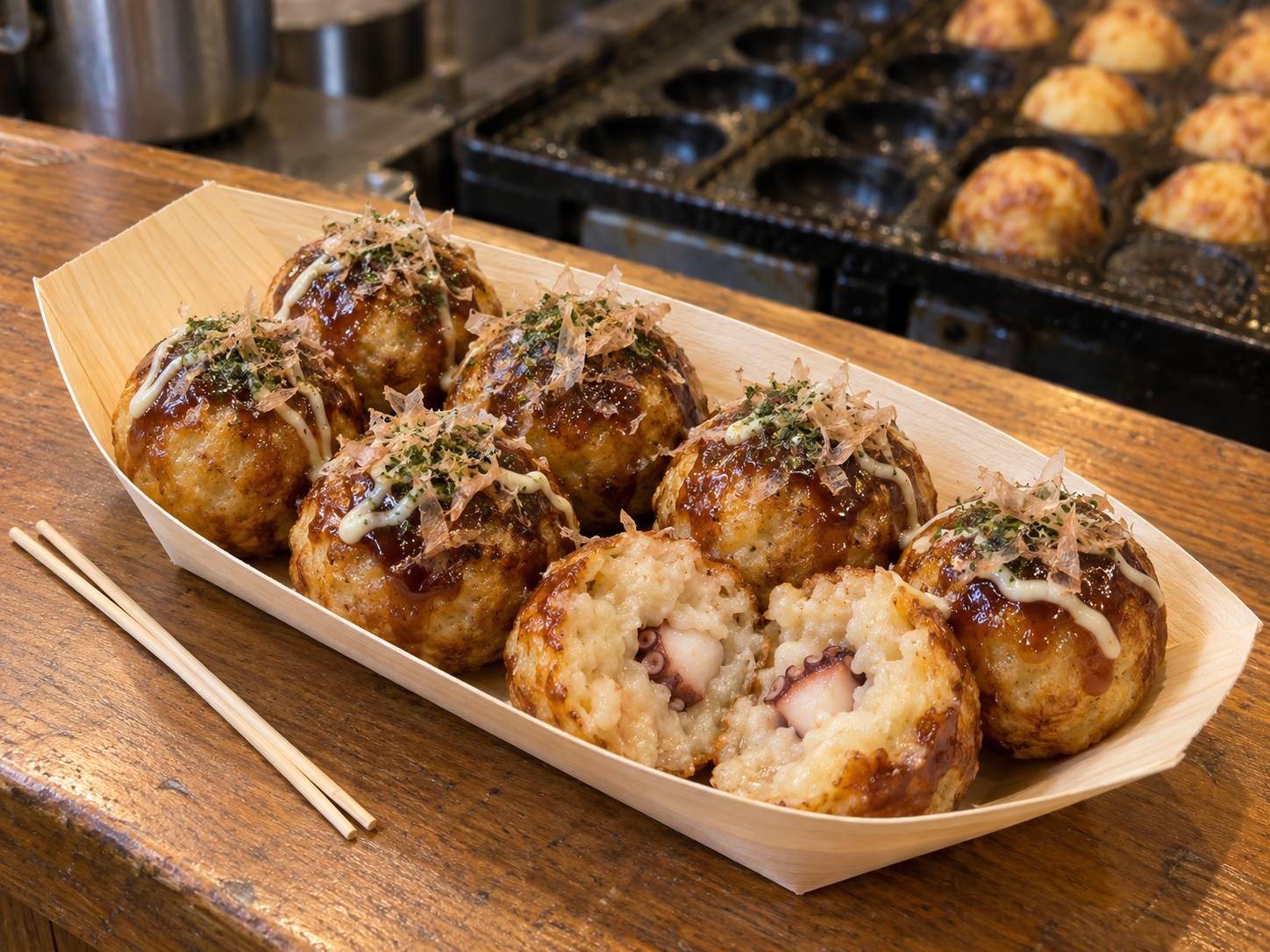
A thin browned shell surrounds soft, dashi-flavoured batter and a piece of octopus: this version follows the Japan Konamon Association’s Osaka recipe, published in the Ministry of Agriculture, Forestry and Fisheries (MAFF) collection of Japanese regional dishes. Tenkasu add extra flavour to the batter. Early quarter-turns shape the balls while their centres are still soft. Japanese-language sources from Japan, read on 10 September 2026: * MAFF / 日本コナモン協会: たこ焼き 大阪府: the main source for quantities, method and regional context. The batch below uses half the source quantities. The ministry describes the development from Osaka radio-yaki in the early Shōwa period and the later spread of sauce toppings. * 会津屋: 会津屋について: the long-established Osaka business dates its development of takoyaki to 1935 and names founder Endō Tomekichi. This is explicitly the company’s own history. Aizuya still serves its seasoned balls without sauce; our present-day topping style does not reconstruct that early house recipe. * 日清製粉ウェルナ: たこ焼き: supplementary technique guidance on thin batter, stirring it again, two successive quarter-turns and lightly oiling the surface. The soy sauce additionally used there is not transferred into the MAFF batter. Conversion: the main source gives 300 g flour, 1100 cc dashi, three eggs, 2–3 g salt, 200 g cooked octopus and 60 g tenkasu for approximately 80 small balls. Each quantity is halved here; 1 cc equals exactly 1 ml. The midpoint of the halved salt range is chosen: 1.25 g. The 75 g egg is a practical approximation for one and a half eggs with about 50 g contents each; weigh the egg without its shell. Here the dashi is specified as unsalted kombu-katsuo dashi; the main source does not specify its composition. Oil, topping quantities and total time are editorial guidelines. No cooking test or nutritional calculation has been carried out.
- MAFF / Japan Konamon Association – Osaka takoyaki · Japanese · accessed 10 September 2026
- Aizuya – the company’s own history · Japanese · accessed 10 September 2026
- Nisshin Seifun Welna – takoyaki technique · Japanese · accessed 10 September 2026
2 Ingredients
Batter
- 150 g Japanese low-protein wheat flour (hakurikiko / 薄力粉)
- 550 ml Cooled, unsalted kombu-katsuo dashi (だし), prepared and measured
- 75 g Beaten egg, without shell (Weigh beaten egg without its shell. In the original batch: 75 g, approximately 1.5 eggs with 50 g contents each.)
- 1.25 g Fine salt
Filling and cooking
- 100 g Cooked, well-drained octopus (yude-dako / ゆでだこ)
- 30 g Tenkasu, unsweetened fried tempura batter crumbs (天かす)
- Neutral vegetable oil for light greasing (As needed for the pan; approximately 20 ml in the original batch, not automatically all to be added.)
Toppings to taste
- 80 g Thick Japanese takoyaki sauce (濃厚ソース / たこ焼ソース) (Approximate kitchen guideline.)
- 30 g Japanese mayonnaise (Approximate kitchen guideline.)
- 1 g Finely crumbled aonori (青のり) (Approximate kitchen guideline.)
- 4 g Finely shaved or crumbled bonito (katsuobushi / かつお節) (Approximate kitchen guideline.)
Use your specialist ingredients again
Documented ingredient connections, including optional variations and side dishes. Check each recipe for its full ingredients and quantities.
Katsuobushi · bonito flakes
- Toppings to taste: Finely shaved or crumbled bonito (katsuobushi / かつお節) · Approximate kitchen guideline.
More recipes using this ingredient:
Aonori
- Toppings to taste: Finely crumbled aonori (青のり) · Approximate kitchen guideline.
More recipes using this ingredient:
3 Method
- Prepare the filling: Pat the already cooked octopus dry and cut into pieces about 15 mm across. Split thick arm sections lengthways first. Allow a suitably sized piece for each ball; the yield depends on the size of the pieces and the moulds. Have the tenkasu and toppings ready.
- Mix a thin batter: Beat the egg, add the dashi, then incorporate the flour and salt. Mix gently with a whisk, first allowing the flour to sink into the liquid. Leave any small lumps to hydrate for about ten minutes. The batter remains much thinner than pancake batter. Transfer to a pouring jug and stir from the bottom before each batch.
- Heat and fill the takoyaki pan: Preheat the electric takoyaki plate according to the appliance instructions; the main source specifies 220 °C. For a hob pan, adjust the heat accordingly. Lightly oil the moulds and the surface between them. A drop of batter should sizzle audibly. Pour batter over the moulds and onto the connecting surface, without overflowing the outer edge. Immediately put a piece of octopus in each mould and scatter over the tenkasu. Reserve a little batter to fill any gaps.
- Shape with quarter-turns: Once the edges turn pale and set after about one to two minutes, separate the batter between the moulds. First stand each piece up by turning it about 90 degrees, tucking the excess batter into the mould. Then turn it another 90 degrees. The still-soft centre flows into the empty half and closes the ball. Do not wait until all the batter has cooked into a firm hemisphere.
- Cook evenly until done: Continue turning gently, tucking in loose edges and filling any small openings with a little reserved batter. Swap balls between hotter and cooler moulds. Once the surface becomes drier, brush it very lightly with oil and cook until golden all over. Depending on the pan, allow about eight to twelve minutes total cooking time per batch as a working guideline: the centre should be soft and creamy but heated through, with no raw, floury taste.
- Add toppings and serve: Place the hot balls in a shallow dish or wooden serving boat. Brush lightly with sauce, add fine lines of mayonnaise to taste, and scatter over the aonori and bonito. Some browned surface should remain visible. Serve immediately; the soft centre is very hot.
Archivist’s notes
- Octopus: yude-dako is already cooked octopus, not squid. Look for unseasoned cooked octopus at a fishmonger or in the frozen seafood section; thaw fully and drain. Preparing raw octopus is not included in the stated total time.
- Dashi: use prepared, unsalted kombu-katsuo dashi. If using Japanese dashi granules, follow the pack’s dosage instructions; if they contain salt, use additional salt sparingly. Vegetable stock gives a different flavour profile.
- Tenkasu and aonori: tenkasu are tempura batter crumbs, not breadcrumbs or panko. Aonori are aromatic green seaweeds; dark nori sushi sheets are a different ingredient. Both are available from Japanese food shops.
- Pan: round moulds are needed to shape the balls. With imported equipment, check hob compatibility or mains voltage; a Japanese 100-V appliance is not suitable for direct connection to the Austrian mains supply. Use a suitable hob pan or an appliance rated for 230 V.
- Allergens: contains wheat, egg, molluscs and fish. Ready-made sauces, mayonnaise and tenkasu may contain further allergens; check the labels.
- The quantities make approximately 40 small balls or four snack servings. Larger moulds give fewer pieces. Add toppings to taste; the amount of oil depends on the pan.
Alternatives usable in Europe
- If hakurikiko is unavailable, try a low-protein, finely milled wheat flour such as German Type 405 or Austrian smooth W480. These flour types do not guarantee the same protein content. A thick Japanese tonkatsu sauce can replace the takoyaki sauce chosen here; do not silently substitute ketchup.
Nutrition
No nutritional calculation has been carried out.
| Nutrient | per 100 g | per takoyaki with its share of toppings |
|---|---|---|
| Energy | not calculated | not calculated |
| Fat | not calculated | not calculated |
| Carbohydrate | not calculated | not calculated |
| Protein | not calculated | not calculated |
| Salt | not calculated | not calculated |
Image: our own AI-generated illustration of the dish.