
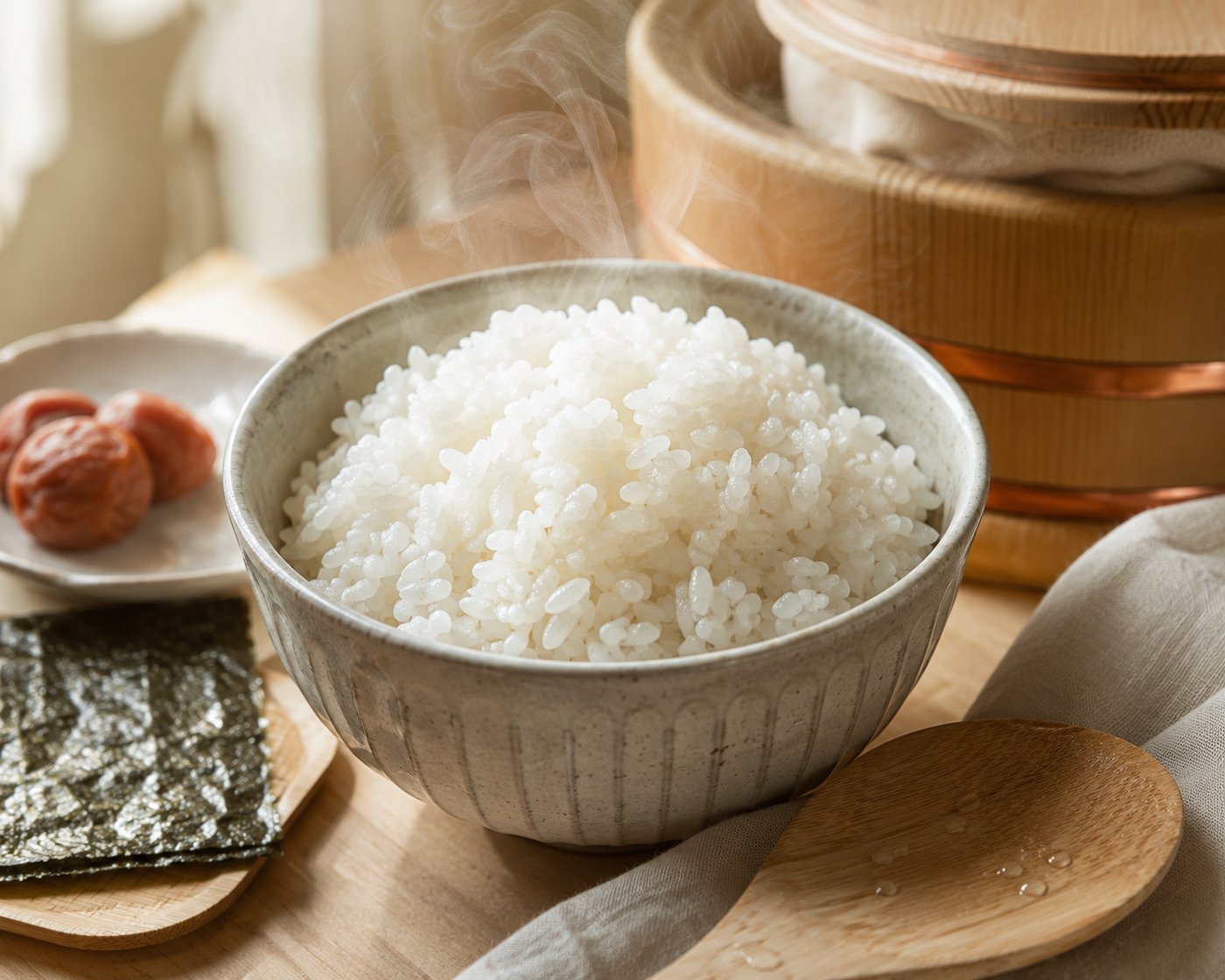
Original recipe estimate: 10 min active (+ 30–60 min soaking and cooking)
No fixed total: approximately 10 minutes of hands-on work plus the complete white-rice programme. Add separate soaking and resting only if required by the appliance instructions and not already included in the programme; neither 70 min nor any other fixed total time is supported by the archived estimates.
Origin & original sources
- Cuisine
- Japan
- Origin of this version
- Japan (nationwide)
- Original name
- 白ごはん
- Source languages
- Japanese
See the source references for the documented version and its context.
4 original sourcesWhat goes with it
Use it in
Gyūdon – Japanese beef and onion rice bowl
This recipe documents how it uses the base recipe.
Use it in
Onigiri with five popular fillings
This recipe documents how it uses the base recipe.
Use it in
Japanese chicken katsu curry
This recipe documents how it uses the base recipe.
1 Authenticity and sources
Japanese white short-grain rice is measured carefully, washed briefly and cooked on the appropriate white-rice programme. This version uses a cooker with a 180 ml rice cup and matching water markings. cotogoto supports the base quantities; Zojirushi supplements the appliance guidance. 2 gō are 360 ml of dry rice, weighing approximately 300 g. The archived 440 ml water is only a guide: follow the instructions for the specific appliance.
- cotogoto – 炊飯器で白米を炊く · Japanese · accessed 22 July 2026
- MEXT – food 01088, cooked rice (nutrition reference) · Japanese · accessed 18 October 2026
- Zojirushi – measuring, washing and water guidance · Japanese · accessed 19 October 2026
- Zojirushi – built-in soaking and resting · Japanese · accessed 19 October 2026
2 Ingredients
Two gō are 360 ml dry rice and approximately 300 g. The 440 ml water is only a guide. Put rice in the pot first, then use the matching white-rice line; never the water line plus 440 ml. When changing servings, adjust cups and markings together and respect appliance capacity. Tools are not multiplied.
Ingredients
- 300 g Japanese short-grain rice (2 gō = 360 ml dry rice, approximately 300 g; e.g. Koshihikari)
- 440 ml Water (cold, for cooking) (440 ml is only a guide; with rice in the pot, fill to the matching white-rice line; do not add another 440 ml)
Equipment
- 1 pieces Rice-cooker measuring cup (1 gō = 180 ml)
- 1 pieces Rice paddle (shamoji) (しゃもじ)
- Kitchen scales and ohitsu (Optional)
3 Method
- Measure the dry rice: For the base batch, use two level 180 ml rice-cooker cups of dry rice: 2 gō = 360 ml, approximately 300 g. 1 gō weighs about 150 g, not exactly the same for every rice. Do not use a 250 ml kitchen cup. First check appliance capacity and the white-rice programme.
- Discard the first water promptly: Cover the rice with cold drinking water in a bowl, move it briefly with your hand and immediately pour away the first cloudy water. Use additional water for washing; it is not part of the later cooking-water amount.
- Wash gently: Move the damp rice with loosely spread fingers and without strong pressure. Do not grind or crush the grains. Wash in a coated inner pot only if the appliance instructions allow it.
- Rinse and drain: Rinse two or three times with fresh water, pouring it away each time. Slight cloudiness is normal; there is no need to wash until the water is completely clear. Drain briefly and thoroughly, then transfer to the inner pot.
- Set the cooking water before soaking: Place the pot on a level surface and distribute the rice evenly. For the two rice cups, add cold water up to the 2 marking for ordinary white rice. This is the complete cooking mixture: do not add the listed 440 ml as well. If there is no suitable marking, use the amount in the appliance instructions; 440 ml is not a universal quantity for every cooker.
- Soak only as the appliance requires: If the normal white-rice programme already includes soaking or preheating, start it immediately. Only if the appliance requires separate soaking, leave the rice in its already measured cooking water for the specified time. Do not drain or refill to the line afterwards. The archived 30–60 minutes are not compulsory for every programme.
- Complete the programme: Run the normal white-rice programme to completion. Quick, sushi and porridge programmes are not equivalent choices. If resting is included, fluff the rice immediately after the completion signal. Only for an appliance without that phase, leave it closed to rest according to its instructions; do not automatically add another 10 minutes.
- Fluff and serve: Use a damp shamoji to divide the hot rice into sections, then gently lift the grains from the bottom upwards without crushing them. Serve immediately or use the approved keep-warm function according to the appliance instructions. Cool leftovers promptly in shallow portions and refrigerate; do not leave them in a switched-off cooker.
Archivist’s notes
- Reference amount: Two level 180 ml rice cups define the base batch; 300 g is the approximate weight. The water line assumes the matching cup and rice already in the pot. It is not a millilitre scale for water alone.
- Changing servings: Adjust the number of rice cups and matching water line together, respecting minimum and maximum fill. The displayed 440 ml and its arithmetic multiples do not replace the appliance instructions. Programme times do not multiply with servings.
- Rice type: Use ordinary polished Japanese short-grain rice. Brown rice, glutinous rice and musenmai require their own instructions. Do not automatically increase water for musenmai; use the specified cup, water line and programme.
- Source status: cotogoto gives the base quantities and credits Hidee Iyadomi as supervisor. The current method supplements this basis with manufacturer guidance. The water estimate does not apply universally to every appliance. No cooking trial of our own has been carried out.
Alternatives usable in Europe
- Japanese short-grain rice → ‘sushi rice’, Koshihikari or Nishiki from an Asian food shop; as a fallback, Italian round-grain rice (Originario).
- Shamoji → a flat, damp spoon.
- Ohitsu → optional, but improves the texture.
- Hard tap water → filtered or soft water.
Nutrition
General food-table reference for cooked, well-milled Japanese short-grain rice: MEXT, Standard Tables of Food Composition in Japan, 8th edition with the 2023 supplement, food 01088 (checked on 18.10.2026). This recipe batch has not been measured. The second value column multiplies the per-100 g reference by 1.5 for a weighed 150 g amount; it is not automatically one quarter of the pot. Actual yield and water absorption may differ. Carbohydrate uses the Japanese table’s total-carbohydrate definition. Salt 0 g is its rounded figure, not a claim of absolute absence of sodium.
General food-table reference for cooked, well-milled Japanese short-grain rice: MEXT, Standard Tables of Food Composition in Japan, 8th edition with the 2023 supplement, food 01088 (checked on 18.10.2026). This recipe batch has not been measured. The second value column multiplies the per-100 g reference by 1.5 for a weighed 150 g amount; it is not automatically one quarter of the pot. Actual yield and water absorption may differ. Carbohydrate uses the Japanese table’s total-carbohydrate definition. Salt 0 g is its rounded figure, not a claim of absolute absence of sodium.
| Nutrient | per 100 g | Reference for 150 g cooked |
|---|---|---|
| Energy | 156 kcal | 234 kcal |
| Protein | 2.5 g | 3.8 g |
| Fat | 0.3 g | 0.5 g |
| Carbohydrate | 37.1 g | 55.7 g |
| Salt | 0 g | 0 g |
Image: our own AI-generated illustration of the dish.