
Original recipe estimate: Approx. 55 min
Marinate for 20 min, preparing the glaze during that time. Fry the original quantity in batches (4–5 min each, 5 min resting, then a second fry of 1–2 min) and finish by glazing. Allow about 50 min of additional kitchen time to account for batches and heating the oil.
Origin & original sources
- Cuisine
- Korea
- Origin of this version
- Republic of Korea · a nationwide market dish, particularly associated with Incheon/Sinpo and Sokcho
- Original name
- 닭강정
- Source languages
- Korean
See the source references for the documented version and its context.
4 original sources1 Authenticity and sources
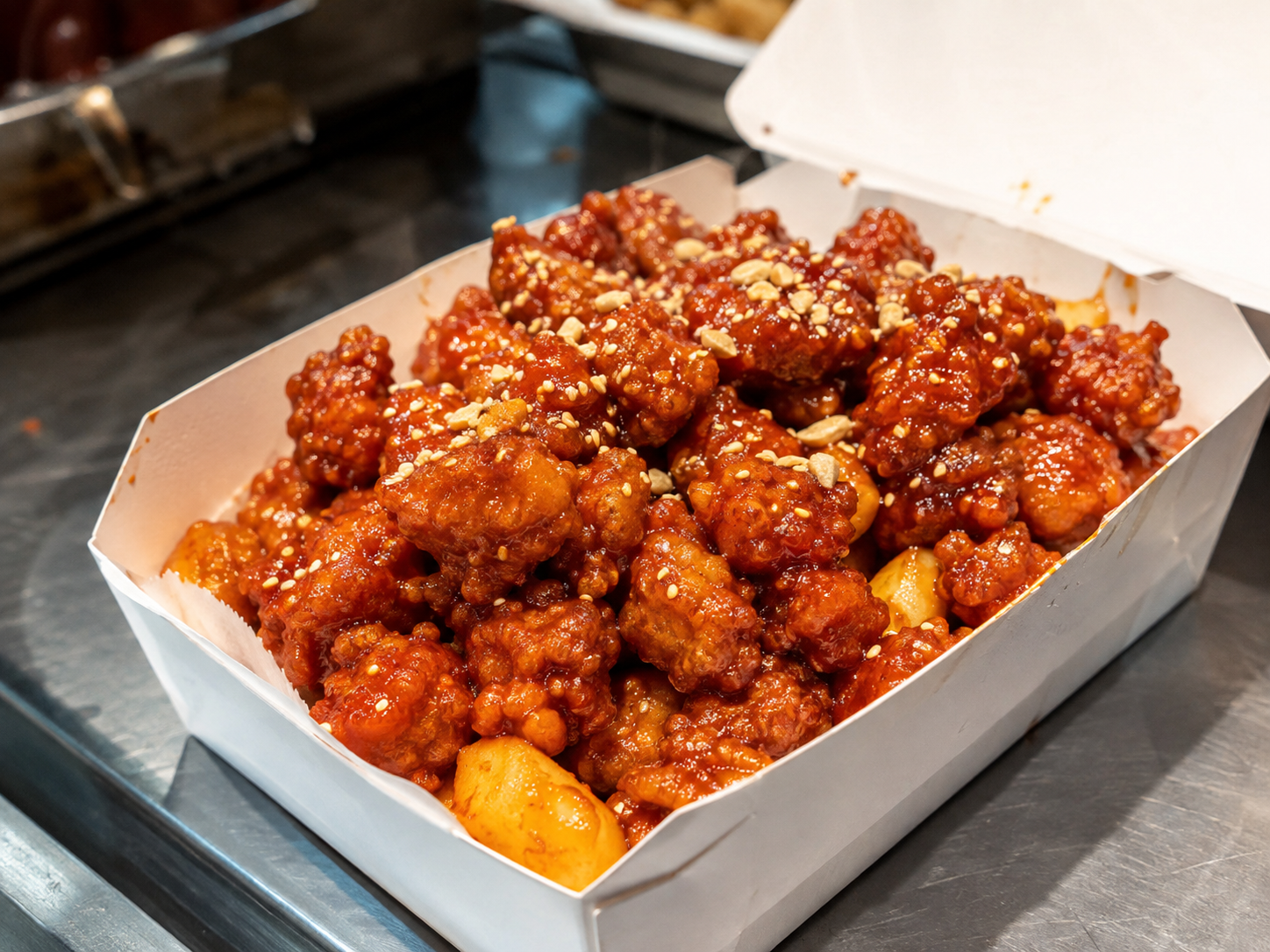
Dakgangjeong is Korean market-style chicken with a thin starch crust, fried twice and then briefly glazed with gochujang and mulyeot. The clear, viscous syrup forms a close-fitting film around the crust, keeping it crisp for longer. This documented basic version is not generic red fried chicken: cheese, rosé sauce, ramen, ketchup and sweet chilli sauce do not belong in it.
- Lampcook – Dakgangjeong · Korean · accessed 4 September 2026
- Lampcook Korean Menu Dictionary – Dakgangjeong · Korean · accessed 4 September 2026
- Korea Tourism Organization – Incheon and Sokcho dakgangjeong · Korean · accessed 4 September 2026
- Korea Tourism Organization – Shinpo Dakgangjeong · Korean · accessed 4 September 2026
2 Ingredients
Chicken and starch crust – 닭고기와 녹말
- 650 g Boneless chicken thigh (Cut into pieces about 3 cm across)
- 20 ml Korean dark soy sauce (진간장 / jin-ganjang)
- 8 g Garlic (Very finely grated or chopped)
- 0.5 g Black pepper
- 40 g Korean starch (녹말 / nokmal; potato or sweet potato starch)
- 1000 ml Neutral frying oil (Adjust the quantity to the size of the pot)
Gochujang-mulyeot glaze – 양념
- 30 g Gochujang (고추장)
- 30 g Korean corn syrup (물엿 / mulyeot)
- 15 ml Korean dark soy sauce (진간장 / jin-ganjang)
- 30 ml Korean rice wine or cooking wine (청주 / cheongju or 미림 / mirim)
- 30 ml Water
- 8 g Garlic (Very finely grated or chopped)
- 5 g Toasted sesame seeds
- 20 g Roasted peanuts (Roughly chopped; optional Shinpo market style)
Use your specialist ingredients again
Documented ingredient connections, including optional variations and side dishes. Check each recipe for its full ingredients and quantities.
Jin-ganjang
- Chicken and starch crust – 닭고기와 녹말: Korean dark soy sauce · 진간장 / jin-ganjang
- Gochujang-mulyeot glaze – 양념: Korean dark soy sauce · 진간장 / jin-ganjang
More recipes using this ingredient:
Gochujang
- Gochujang-mulyeot glaze – 양념: Gochujang · 고추장
More recipes using this ingredient:
3 Method
- Season the chicken: Mix the chicken thoroughly with jin-ganjang, garlic and pepper. Cover and leave for 20 minutes; it should be well seasoned but not swimming in marinade.
- Prepare the glaze: Stir the gochujang, mulyeot, jin-ganjang, cheongju or mirim, water and garlic together in a wide wok or pot until smooth. Do not reduce it heavily yet.
- Apply a thin starch coating: Immediately before frying, coat the chicken evenly but thinly with nokmal. Shake off excess starch; a thick Western-style batter is not wanted.
- Fry twice: Fry in batches at 170 °C for about 4–5 minutes until pale golden. Remove and rest for 5 minutes. Heat the oil to 180 °C and fry the chicken for another 1–2 minutes until the crust is dry and crisp.
- Glaze briefly: Bring the sauce to the boil. Add the hot chicken and toss quickly over high heat until the sauce clings tightly as a thin, glossy film. Do not simmer for a long time.
- Finish market-style: Immediately sprinkle with sesame seeds and, optionally, chopped peanuts. Serve hot or slightly cooled, while the crisp crust remains clearly defined beneath the glaze.
Archivist’s notes
- Mulyeot (물엿) is Korean corn syrup and forms the viscous, clear glaze. Honey, maple syrup, sweet chilli sauce and ketchup are not equivalent substitutes to use without explanation.
- Apply only a thin coating of nokmal. Look for Korean potato or sweet potato starch in an Asian grocery shop; panko, cornflakes, beer batter and a thick flour-and-egg coating produce a different dish.
- Bone-in dakgangjeong exists alongside this boneless snack version. Peanuts and Cheongyang chilli are particularly associated with Shinpo market style, but are not mandatory.
- Cheese, rosé sauce, cream and ramen versions are not included. Yangnyeom chicken is not a reliable synonym: here, double frying with starch and a briefly reduced mulyeot glaze define the dish.
Alternatives usable in Europe
- Mulyeot → Korean corn syrup. Alternatives usable in Europe: none as an identical base; jocheong or rice syrup is a deliberately maltier Korean variation, but not the same product.
- Nokmal → Korean potato or sweet potato starch. Do not replace it with panko, cornflakes, beer batter or a thick Western-style coating.
- Gochujang → fermented Korean chilli paste. Do not replace it with sriracha, sweet chilli sauce, pepper paste or ketchup.
Nutrition
Not calculated. No reproducible nutrition calculation is documented for this recipe. The previous table and serving note were inconsistent. Oil absorption, retained starch and glaze, optional peanuts and finished weight are not documented as a calculation basis. Earlier estimates are preserved in the audit archive. Missing values do not mean zero.
Not calculated. No reproducible nutrition calculation is documented for this recipe. The previous table and serving note were inconsistent. Oil absorption, retained starch and glaze, optional peanuts and finished weight are not documented as a calculation basis. Earlier estimates are preserved in the audit archive. Missing values do not mean zero.
| Nutrient | per 100 g | Per snack portion |
|---|---|---|
| Energy | not calculated | not calculated |
| Protein | not calculated | not calculated |
| Fat | not calculated | not calculated |
| Carbohydrate | not calculated | not calculated |
| Salt | not calculated | not calculated |
Image: our own AI-generated illustration of the dish.