
Original recipe estimate: Approx. 45 min
Japanese short-grain rice is already cooked and available warm.
Editorial plan: about 45 min for vegetables and curry with 5–8 min simmering, coating, frying and plating. Have rice already cooked and warm; its cooking time is not included. Batch count and doneness checks may extend the workflow. No cooking trial.
Origin & original sources
- Cuisine
- Japan
- Origin of this version
- Japan · modern yōshoku cooking
- Original name
- チキンカツカレー
- Source languages
- Japanese, English
See the source references for the documented version and its context.
5 original sourcesWhat goes with it
Basic technique
Japanese rice in a rice cooker
Read the rice-cooker method for gohan here. The curry recipe specifies cooked rice; the raw amount depends on the actual yield, so quantities are not added automatically.
In this recipe: Small side dish from the source recipe
1 Authenticity and sources
This chicken katsu version follows the Japanese S&B recipe using coconut milk and Akakan powdered roux. The amounts for rice, coating materials, salt, pepper and frying oil, together with some gram conversions, are editorial working quantities. House Foods is only a comparison with a different pork katsu curry; its quantities, cooking times and nutritional values are not transferred. The historical Tokyo Updates link was inaccessible during the new review. A cooking trial of this home-kitchen version remains outstanding.
- エスビー食品 – チキンカツカレー · Japanese · accessed 3 September 2026
- ハウス食品 – カツカレー · Japanese · accessed 3 September 2026
- TOKYO UPDATES(東京都)– 日本のカツカレー発祥を主張し合う各店、実はこの料理が愛されるだけで幸せ · Japanese · accessed 3 September 2026
- S&B – 計量のヒント (spoon and product measures) · Japanese · accessed 19 October 2026
- FoodSafety.gov – Poultry: supplementary doneness check · English · accessed 19 October 2026
2 Ingredients
The roux quantity applies to the specified powdered product. Have rice cooked; weigh egg without the shell. Coating and oil are working allowances. Weight conversions, thickness and doneness checks are editorial clarifications; no cooking trial.
Gohan - ご飯
- 360 g Cooked Japanese short-grain rice (Gohan / ご飯; cooked weight, not raw rice; have it cooked and hot before starting)
Curry - カレー
- 50 g Onion (Very finely diced)
- 30 g Carrot (Very finely diced)
- 30 ml Neutral vegetable oil (For sautéing)
- 1 g Garlic (fresh, finely grated; editorial working quantity, not an exact conversion of the source’s tube paste)
- 1 g Ginger (fresh, finely grated; editorial working quantity, not an exact conversion of the source’s tube paste)
- 300 ml Water (For the curry sauce)
- 38 g Japanese curry roux (S&B 赤缶カレーパウダールウ 中辛; powdered roux, not plain curry powder; quantity applies only to this product)
- 100 ml Coconut milk (Unsweetened)
Chicken katsu - チキンカツ
- 250 g Chicken breast fillet (skinless and boneless; raw weight)
- 1 g Fine salt (For seasoning)
- 0.5 g White pepper (ホワイトペッパー)
- 25 g Egg (beat without the shell, then weigh the stated amount)
- 27 g Wheat flour (薄力粉 / hakurikiko; editorial gram value for the spoon measure)
- 15 ml Water (For the batter)
- 60 g Japanese panko (パン粉; coating allowance, not the amount fully eaten)
- 600 ml Neutral oil (Frying bath; adjust the working amount to the vessel rather than blindly multiplying when scaling)
Small side dish from the source recipe
- 30 g Mizuna (水菜)
- 20 g Carrot (Cut into fine strips)
- 15 g Red pepper (Very thinly sliced)
3 Method
- Prepare the rice and vegetables: Have the rice already cooked and warm; plan any fresh rice cooking separately before this workflow. Finely dice the onion and carrot from the curry group, and grate the garlic and ginger. For the side dish, cut the mizuna into 3–4 cm lengths, its carrot into fine strips and the pepper very thinly. Briefly soak the vegetables in cold water and drain very thoroughly.
- Start the curry: Heat the oil from the curry group. Fry the onion and curry carrot over medium heat until softened, then briefly add the garlic and ginger. Pour in the water from the curry group, bring to the boil and simmer gently for 5–8 min until the vegetables are tender. Keep the batter water separate.
- Finish the roux sauce: Take the pan off the heat, stir in the Japanese curry roux until fully incorporated, then return to low heat. Stir until the sauce thickens. Stir in the coconut milk, bring briefly to a simmer and keep warm.
- Cut the chicken evenly: Do not wash the chicken. Halve the breast diagonally and horizontally to make evenly thin pieces. As an editorial working guide, aim for about 1 cm thickness; gently flatten thick areas between food-safe covering. Season with salt and white pepper. Keep refrigerated until coating.
- Apply the panko coating: Beat the shelled egg and weigh the required amount. Mix with the flour and water from the katsu group to make a smooth batter. Coat the chicken, cover with panko and press gently. Keep surplus egg separate before any raw-meat contact and use it fully cooked; discard batter and crumbs that have touched raw chicken.
- Fry the chicken katsu: Choose a tall, stable pot suited to the oil quantity and fill no more than one third with oil. Heat to 170–180 °C. Fry without overlapping, one piece at a time if necessary, turn once and let the oil regain temperature between batches. Golden crumbs alone do not show doneness: insert a thermometer sideways into the thickest meat and check at least 74 °C. Cook longer if needed, adjusting heat within the range to avoid burning the coating. Drain on a clean rack and cut on a clean board only just before serving.
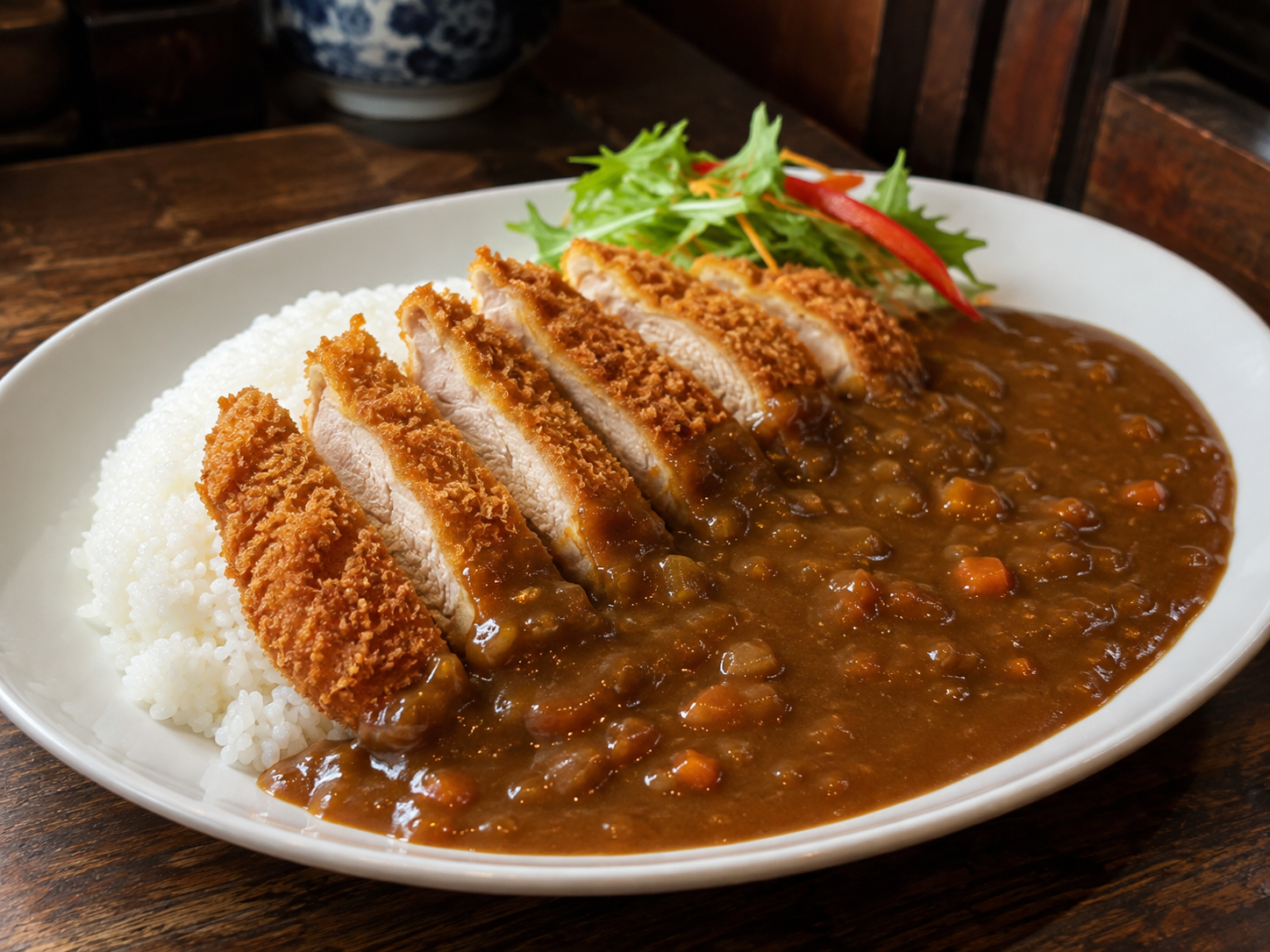
- Plate in the Japanese style: Divide the rice between two plates, place the sliced chicken katsu alongside or slightly over the rice, and pour in the curry so that some of the crisp panko coating remains visible. Put the well-drained mizuna side dish separately alongside and serve immediately.
Archivist’s notes
- Katsu-karē is Japanese yōshoku, not Indian curry. Garam masala, a yoghurt marinade, naan, basmati rice and fresh coriander do not belong in this documented version.
- Stir in the curry roux off the heat. This lets it dissolve evenly without sticking to the bottom of the pan; the sauce then thickens over low heat.
- The curry should not cover the entire panko coating. Some of the katsu remains visible and crisp while the sauce accompanies the rice.
- Slice the chicken only just before serving. This keeps its juices in the meat and the crust drier.
- Quantity status: Japanese tablespoons are treated as 15 ml here. The source specifies half an egg and spoon measures of flour; our 25 g egg and 27 g flour are working weights, not guaranteed exact conversions. Fresh garlic and ginger replace the source’s tube pastes using separate working quantities here. Panko and frying oil are allowances; absorption and leftovers have not been measured.
Alternatives usable in Europe
- Japanese curry roux → the 38 g applies to S&B Akakan powdered roux, not generally to Golden Curry or Vermont blocks. European fallback: Japanese block roux using its package dosage and liquid quantity for the planned servings. Count the coconut milk towards that liquid and plan correspondingly less water; check thickening gradually. A gram-for-gram substitution is not guaranteed.
- Panko → coarse, airy Japanese breadcrumbs. Fine European breadcrumbs make the coating denser. Alternative usable in Europe: coarse, unseasoned panko crumbs from an Asian food shop.
- Mizuna → do not equate it with lamb’s lettuce. Alternative usable in Europe: very young mustard greens; their peppery flavour and leaf texture will still differ.
Nutrition
Nutrition not calculated: No reproducible calculation is documented for this version of katsu curry. The source provides its own per-serving values but leaves rice, coating and frying oil partly unspecified. Those values cannot be transferred to our quantities. Specific product data, coating used, oil absorbed and the served yield are needed. The frying bath is not the amount of oil consumed. Previous estimates have been archived.
Nutrition not calculated: No reproducible calculation is documented for this version of katsu curry. The source provides its own per-serving values but leaves rice, coating and frying oil partly unspecified. Those values cannot be transferred to our quantities. Specific product data, coating used, oil absorbed and the served yield are needed. The frying bath is not the amount of oil consumed. Previous estimates have been archived.
| Nutrient | per 100 g | per serving |
|---|---|---|
| Energy | not calculated | not calculated |
| Protein | not calculated | not calculated |
| Fat | not calculated | not calculated |
| Carbohydrate | not calculated | not calculated |
| Salt | not calculated | not calculated |
Image: our own AI-generated illustration of the dish.