
Original recipe estimate: Approx. 30 min
The “Combine” step explicitly requires no long marinating period. This is a kitchen estimate for the original quantity; allow for the number of batches.
Origin & original sources
- Cuisine
- Korea
- Origin of this version
- Korea · South Korean home-cooking version
- Original name
- 불고기 (Bulgogi)
- Source languages
- Korean
See the source references for the documented version and its context.
3 original sources1 Authenticity and sources
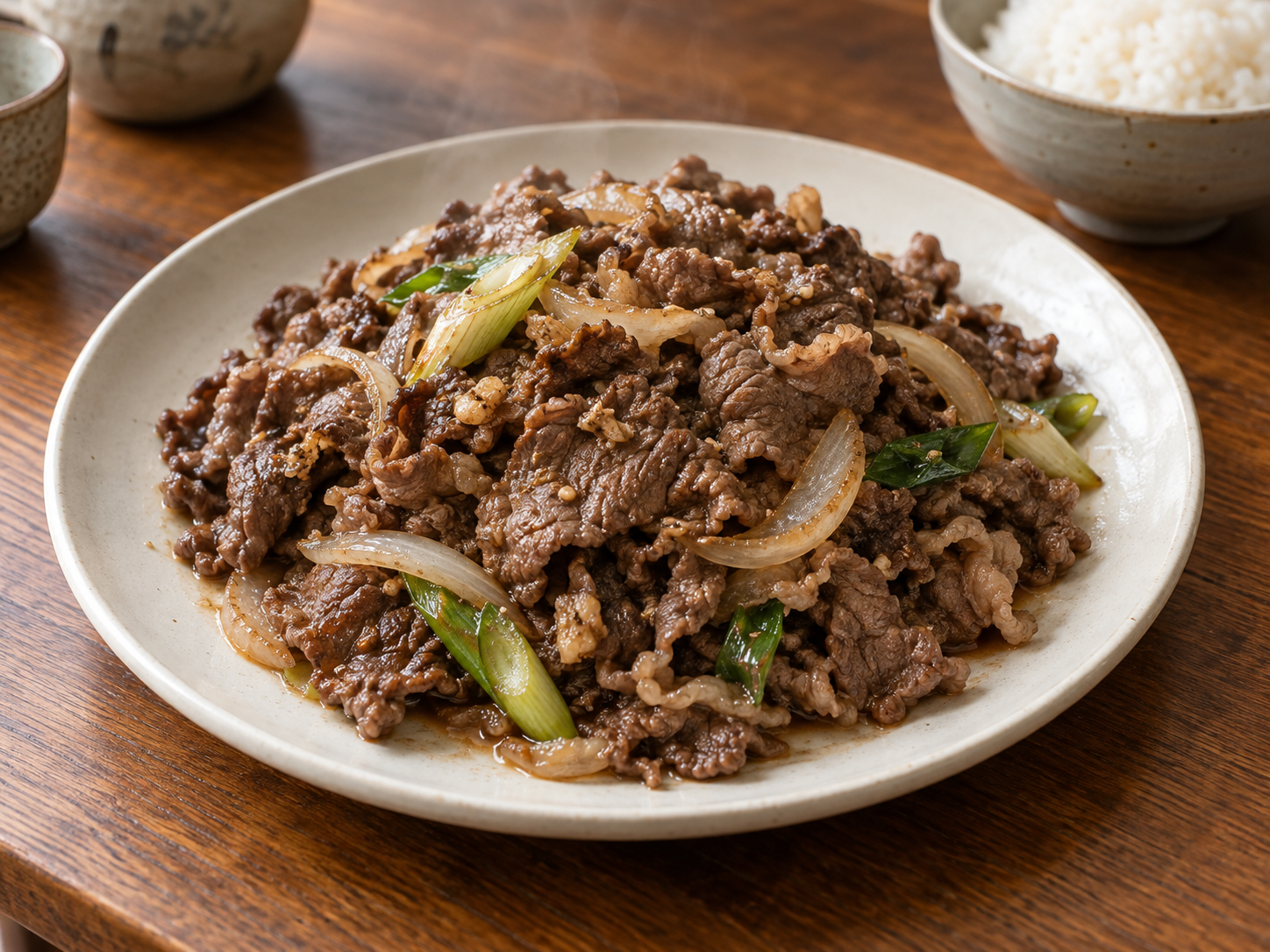
This recipe is based on the Korean text for 불고기 in the cookbook 다문화 가정을 위한 한국요리 (Korean Cooking for Multicultural Families), printed page 111. According to the imprint, the recipe work is by the Korean Food Institute at Sookmyung Women’s University; published by Daewoo Securities, January 2011 edition, and provided through the Korean Danuri portal. Only the original Korean text of the bilingual edition is used. Beef, onion and daepa are cooked in a pan with a freshly mixed soy and sesame seasoning. The source version contains no pear, mushrooms, chilli paste or glass noodles. Its character comes from thinly sliced meat, garlic, toasted sesame and the sweet-salty marinade. The 한국민족문화대백과사전 describes bulgogi as marinated, thinly sliced beef and explains its connection to neobiani in court and Seoul cooking. Its suggested derivation from maekjeok should be read as an origin theory. This pan-cooked version is not presented as the sole historical original or as a particular Gwangyang, Eonyang or Seoul broth-based variation. Quantity derivation (for four small portions): the 500-g beef batch is unchanged. The source lists half an onion, 30 g daepa, six large spoonfuls of soy sauce and two large spoonfuls each of cheongju, sugar, sesame oil, garlic and kkaesogeum; no quantity is given for pepper. Its measurements section on printed page 26 defines 1 large spoonful = 15 ml and 1 large spoonful of chopped garlic = 10 g. There, 1/12 of an onion corresponds to approximately 10 g; this is the basis for the 60-g guide weight for half an onion. The sugar and sesame weights are rounded bulk-density estimates for 30 ml each, not precisely measured weights from the source. The pepper quantity, four small portions and working times are editorial choices. Rice and other side dishes are not included.
- Sookmyung Women’s University Korean Food Institute / Daewoo Securities – Korean Cooking for Multicultural Families, Danuri PDF · Korean · accessed 9 September 2026
- Academy of Korean Studies – Bulgogi · Korean · accessed 9 September 2026
- National Institute of Korean Language, Basic Korean Dictionary – Kkaesogeum · Korean · accessed 9 September 2026
2 Ingredients
Meat and vegetables
- 500 g Beef loin (sogogi deungsim / 소고기 등심), sliced about 3 mm thick across the grain
- 60 g Peeled onion (yangpa / 양파), cut into thin strips (Approx.; rounded guide weight)
- 30 g Large Korean spring onion (daepa / 대파), sliced diagonally
Marinade
- 90 ml Korean soy sauce for frying and braising (jin-ganjang / 진간장; not soup soy sauce)
- 30 ml Clear Korean rice wine (cheongju / 청주)
- 25 g White sugar (Approx.; rounded guide weight)
- 30 ml Toasted Korean sesame oil (chamgireum / 참기름)
- 20 g Finely chopped garlic (dajin maneul / 다진 마늘)
- 18 g Toasted, freshly crushed sesame seeds (kkaesogeum / 깨소금), without added salt here (Approx.; rounded guide weight)
- 0.5 g Freshly ground black pepper (Approx.; rounded guide weight)
Use your specialist ingredients again
Documented ingredient connections, including optional variations and side dishes. Check each recipe for its full ingredients and quantities.
Jin-ganjang
- Marinade: Korean soy sauce for frying and braising (jin-ganjang / 진간장; not soup soy sauce)
More recipes using this ingredient:
3 Method
- Prepare the beef: Pat the beef dry and cut into slices about 3 mm thick across the grain. Cut large slices into manageable pieces. Gently separate any pre-sliced bulgogi beef.
- Prepare the vegetables and sesame: Cut the onion into thin strips and slice the daepa diagonally. Coarsely crush the toasted sesame seeds in a mortar; they should remain granular.
- Mix the marinade: Thoroughly mix the soy sauce, cheongju, sugar, sesame oil, garlic, sesame seeds and pepper.
- Combine: Gently mix the meat, vegetables and marinade. The source does not require an additional long marinating period. The mixture can absorb the flavours briefly while the pan heats; cover and refrigerate if preparing further ahead.
- Cook in the pan: Preheat a wide pan over medium to high heat. Add the mixture in batches, unfolding and turning the beef slices until cooked through and the onions are soft. As a working guide, allow about 4–6 minutes per batch; thickness, pan and quantity affect the cooking time. Do not let the sugar and garlic burn. A little aromatic cooking juice may remain. Serve hot.
Archivist’s notes
- Beef cut: ask a butcher for slices about 3 mm thick, cut across the grain. The source explicitly permits less expensive bulgogi beef instead of beef loin; chunky stewing cubes are unsuitable.
- Specify the soy sauce: the recipe page says ganjang in general. The cookbook’s own ingredient guide on page 17 distinguishes jin-ganjang for frying and braising from guk-ganjang for soups. Use Korean cooking soy sauce here. Do not silently substitute Chinese dark colouring soy sauce, ketjap manis or very salty soup soy sauce. The stated quantity gives a strong seasoning.
- Understand the sesame correctly: the National Institute of Korean Language’s Korean dictionary defines kkaesogeum as crushed toasted sesame seeds, sometimes with salt. This recipe specifies the unsalted version; it certainly does not mean two tablespoons of pure salt. Do not use tahini paste.
- Verification status: quantities and technique were checked against the original Korean text; no cooking test has been carried out. Nutrition has not been calculated. Recipe photographs and the source’s book design are not reproduced.
Alternatives usable in Europe
- Alternatives usable in Europe: if daepa is unavailable, use thicker spring onions. For hard-to-find cheongju, dry, unsweetened Japanese sake is an explicitly different sourcing alternative. Sweet mirin and ready-made bulgogi marinade do not replace the documented ingredients without changing the recipe.
Nutrition
Nutrition has not been calculated; rice and other side dishes are not included.
| Nutrient | per 100 g | Per small meat portion |
|---|---|---|
| Energy | not calculated | not calculated |
| Protein | not calculated | not calculated |
| Fat | not calculated | not calculated |
| Carbohydrate | not calculated | not calculated |
| Salt | not calculated | not calculated |
Image: our own AI-generated illustration of the dish.