
Original recipe estimate: Approx. 40 min
40 min is an editorial estimate for two pancakes with sufficient cooking surface. Divide ingredients per pancake and reserve binding batter; noodles and egg need free space. Work in batches in a small pan: extra batches increase the total time. No timed cooking trial.
Origin & original sources
- Cuisine
- Japan
- Origin of this version
- Japan, Hiroshima
- Original name
- 広島お好み焼き
- Source languages
- Japanese
See the source references for the documented version and its context.
3 original sources1 Authenticity and sources
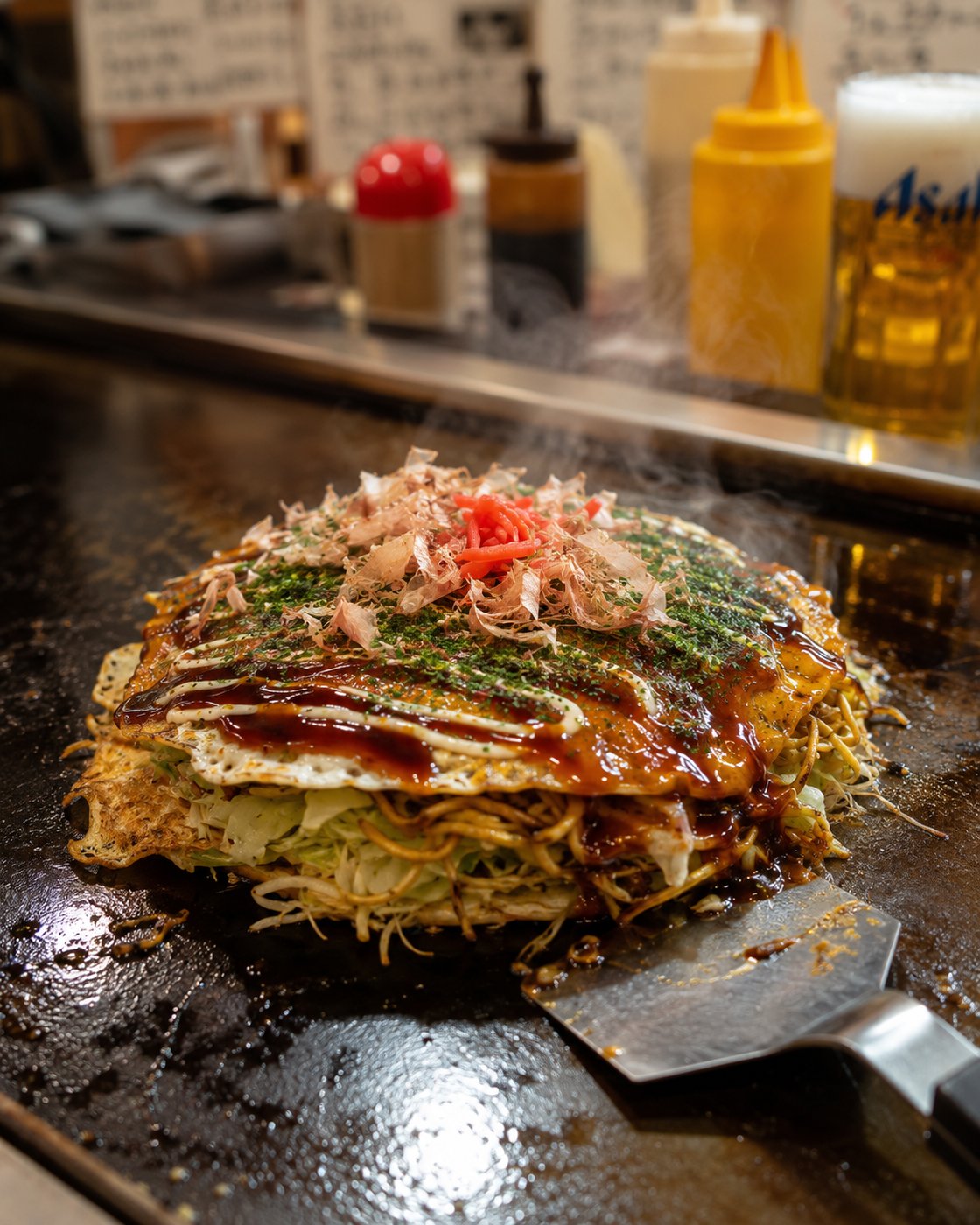
This recipe follows Otafuku Sauce’s official Hiroshima okonomiyaki instructions. Unlike Osaka-style okonomiyaki, the ingredients are layered rather than mixed into the batter. A thin crêpe carries shredded cabbage, a separate layer of yakisoba noodles and an egg. Steaming the cabbage inside the stack is central to this preparation.
- オタフクソース – 小麦粉から作る広島お好み焼 · Japanese · accessed 22 July 2026
- MHLW – hygiene, core temperature and rapid cooling · Japanese · accessed 18 October 2026
- Toyo Suisan – Maruchan yakisoba, three 150 g noodle portions · Japanese · accessed 20 October 2026
2 Ingredients
For two pancakes: 300 g precooked yakisoba noodles without sachet sauce, 150 g per pancake; not dry weight. Manufacturer reference: a 150 g Maruchan noodle portion. Use 10 g of the specified yakisoba sauce per pancake, without additional sauce powder. Weigh cabbage trimmed and sprouts drained.
Batter (kiji)
- 40 g Wheat flour, German Type 405 (薄力粉, plain flour)
- 60 ml Water
- 2.5 ml Mirin (½ tsp)
Layers
- 300 g White cabbage (キャベツ – 300 g trimmed, without the hard core; cut into 2–3 mm strips)
- 10 g Spring onion (青ねぎ, sliced into rings)
- 60 g Mung bean sprouts (もやし – weigh rinsed and well drained; this version uses mung beans, not soybeans)
- 80 g Pork belly, thinly sliced (豚バラ肉, approx. 6 slices)
- 300 g Yakisoba noodles (steamed) (焼そば麺 – 2 × 150 g precooked noodles, noodle weight only without sauce sachets; not dry weight)
- 2 pieces Eggs (たまご)
- 2 g Bonito powder (katsuo-ko) (かつお粉)
- 20 g Crisp tempura bits (tenkasu) (天かす/天華)
Seasoning and finishing
- 20 g Yakisoba sauce (オタフク焼そばソース)
- Okonomi sauce (Otafuku) (To taste)
- Aonori (green seaweed flakes) (青のり, to taste)
Use your specialist ingredients again
Documented ingredient connections, including optional variations and side dishes. Check each recipe for its full ingredients and quantities.
Aonori
- Seasoning and finishing: Aonori (green seaweed flakes) · 青のり, to taste
More recipes using this ingredient:
3 Method
- Mix and divide the batter: The complete ingredient list makes two pancakes. Mix water, mirin and flour in that order until smooth. Reserve approx. 10 g of this batter for binding each pancake later; divide the remaining batter evenly between the two crêpes. When scaling up, cook the corresponding additional pancakes individually.
- Shred the cabbage and prepare portions: Cut the cabbage into 2–3 mm strips. Divide the measured toppings, noodles and yakisoba sauce evenly among the planned pancakes, allowing one egg for each. The following steps describe one pancake at a time. Keep pork not yet needed refrigerated. For the base batch, allocate 150 g precooked noodles and 10 g yakisoba sauce to each pancake; do not add any supplied sauce powder as well.
- Spread the crêpe: Preheat a griddle or suitable pan to 160–180 °C. Spread only the crêpe batter allocated to this pancake into a very thin circle about 20 cm across. Do not use the reserved binding batter yet.
- Build the layers: Use only the prepared single-pancake portions, in this order: bonito powder, cabbage, tempura crumbs, spring onion, sprouts and pork belly. Place raw pork with a separate utensil.
- Turn over: Heat the cooking surface above 200 °C, drizzle the approx. 10 g of batter reserved for this pancake over the stack, and turn carefully with two wide spatulas. Use clean utensils for cooked surfaces afterwards.
- Steam (蒸らす): Warm the allocated noodles on a free cooking area. Cook the pork belly thoroughly, then reduce to 180 °C and steam the cabbage for approx. 5 min until partly translucent. Do not judge by colour alone: the meat and centre of the stack should reach at least 75 °C for 1 min; cook longer if necessary.
- Season the noodles: Add only the allocated yakisoba sauce to this noodle portion, fry briefly and form a circle. Place the cabbage stack on top and press gently.
- Attach the egg: Spread one egg into a circle on a free cooking area for this pancake. Place the stack on the still-soft egg and press gently. Continue cooking until the egg is completely set; then turn so that it is on top.
- Finish and cook the remaining pancakes: Add okonomi sauce and aonori to taste and serve immediately. Repeat with the reserved portions. A large griddle allows pancakes side by side; use batches in a smaller pan, with an additional pan for noodles and egg. Multiple batches increase the total time.
Archivist’s notes
- Layered, not mixed: keep the cabbage and toppings separate from the crêpe batter.
- Divide the listed cabbage among the pancakes. The mound collapses during steaming; do not accidentally put the entire quantity on one pancake.
- The source lists ingredients for two pancakes and approx. 10 g of binding batter on an individual stack. Explicit division and reservation are editorial clarifications; take the reserve from the existing batter rather than mixing extra.
- Equipment: A large griddle needs room for the stack, noodles and egg. With pans, work in batches and have an additional pan ready. Larger quantities mean more individual pancakes, not an ever-larger stack.
- Noodle weight: Otafuku lists two noodle portions without a gram weight. As a specific product reference, Toyo Suisan lists “マルちゃん焼そば 3人前” with three noodle packs of 150 g; the 480 g total pack also includes sauce. Our 300 g means two such noodle portions without the sachet sauce. Weigh other precooked yakisoba noodles and use 150 g per pancake, not two arbitrary packs or 300 g dry noodles. Omit the sachet sauce because this recipe already allows 20 g yakisoba sauce for both pancakes. No cooking trial.
Alternatives usable in Europe
- Otafuku okonomi sauce → find the original in an Asian food shop; as a fallback, reduce Worcestershire sauce, ketchup, oyster sauce and sugar together.
- Yakisoba noodles → precooked Japanese chuka noodles; egg is not a required ingredient. European fallback: cook suitable ramen or mie noodles according to the packet, drain well, then weigh 300 g for two pancakes; the texture may differ.
- Katsuo-ko → bonito powder or finely crushed katsuobushi flakes.
- Tenkasu → agedama (fried tempura batter droplets) from an Asian food shop.
- Aonori → green aonori flakes; do not confuse them with nori sheets.
Nutrition
Not calculated for our recipe version. Otafuku lists 799 kcal and 4.8 g salt per portion on its Japanese original page (checked on 18.10.2026). These are the manufacturer’s figures for its recipe, not our own calculation. The source gives no finished portion weight; noodles are listed as two portions rather than 300 g, with okonomi sauce and aonori as needed. Their application to specific products, sauce consumption and finished yield is not documented. Earlier macronutrient estimates, the assumed 430 g portion and derived per-100 g figures have been archived. Missing values do not mean zero.
Not calculated for our recipe version. Otafuku lists 799 kcal and 4.8 g salt per portion on its Japanese original page (checked on 18.10.2026). These are the manufacturer’s figures for its recipe, not our own calculation. The source gives no finished portion weight; noodles are listed as two portions rather than 300 g, with okonomi sauce and aonori as needed. Their application to specific products, sauce consumption and finished yield is not documented. Earlier macronutrient estimates, the assumed 430 g portion and derived per-100 g figures have been archived. Missing values do not mean zero.
| Nutrient | per 100 g | per pancake |
|---|---|---|
| Energy | not calculated | not calculated |
| Protein | not calculated | not calculated |
| Fat | not calculated | not calculated |
| Carbohydrate | not calculated | not calculated |
| Salt | not calculated | not calculated |
Image: our own AI-generated illustration of the dish.