
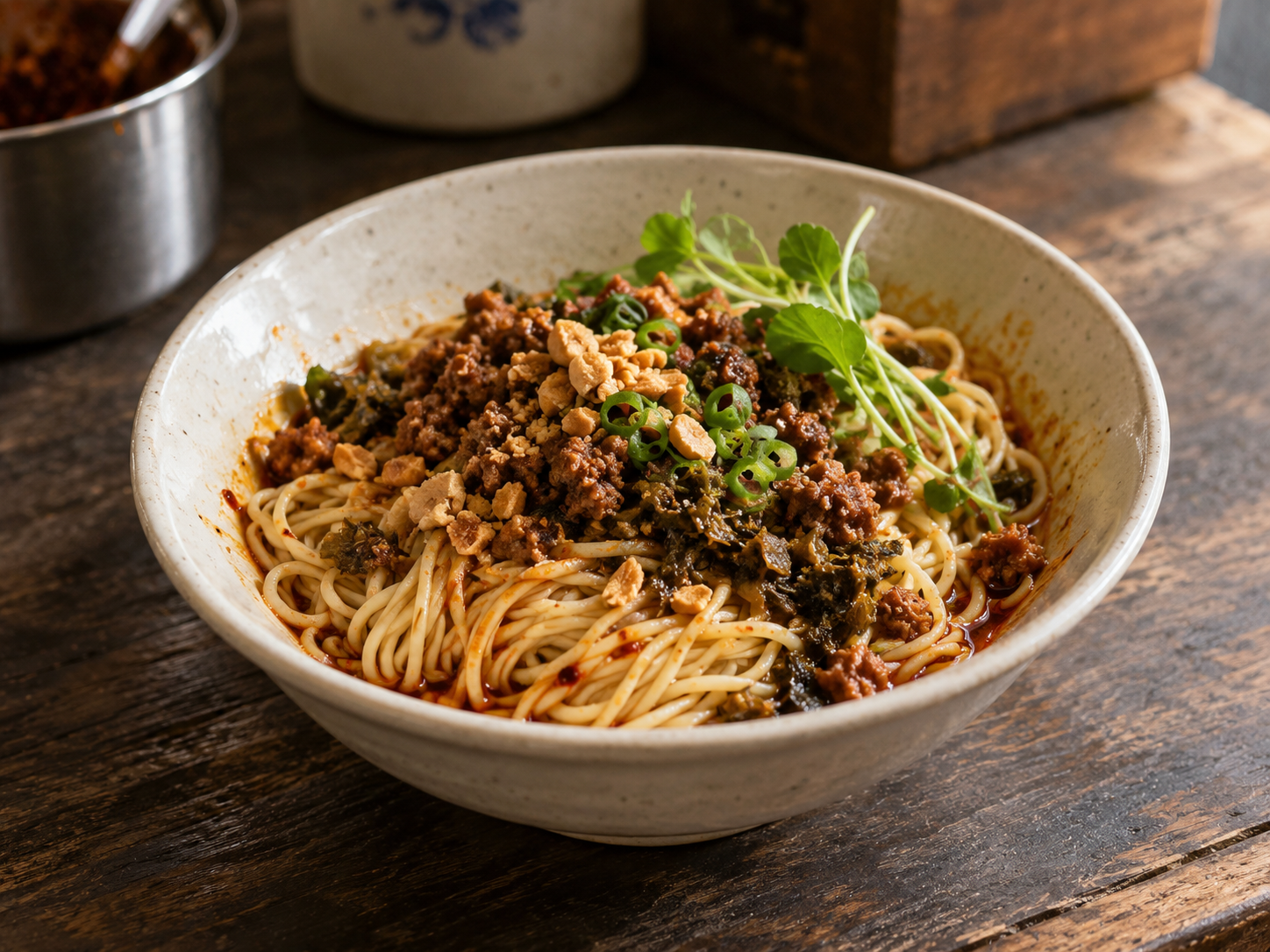
Original recipe estimate: Approx. 1 hour 15 min
The required Chinese red chilli oil is ready.
The required seasoned hóng jiàngyóu is ready.
The bowl seasoning requires ready-made red chilli oil and hóng jiàngyóu; the method does not make either component. Allow 75 min from prepared components for the pepper, sàozi, sauce, noodles and serving. Do not replace them with unseasoned standard soy sauce.
Origin & original sources
- Cuisine
- China
- Origin of this version
- China · Sichuan · Chengdu and Zigong
- Original name
- 担担面 (Dàndànmiàn)
- Source languages
- Chinese
See the source references for the documented version and its context.
6 original sources1 Authenticity and sources
Dàndànmiàn combines fine noodles, crisp pork sàozi and a boldly seasoned bowl. This archive formulation brings together Yíbīn suìmǐ yácài, Chuān dōngcài, red chilli oil, hóng jiàngyóu, black vinegar, sesame paste and ground red huājiāo. China Weather Sichuan describes a Chengdu version with Deyang soy sauce and a little stock; Sichuan Online mentions yácài and dōngcài in a culinary memoir. The gram and millilitre quantities here are an editorial compilation, not a fully documented conversion of one source. Neither Chengdu nor Zigong is claimed as the sole birthplace.
- Ministry of Commerce digital museum of time-honoured brands – Tidu Dan Dan Noodles · Chinese · accessed 5 September 2026
- China Weather, Sichuan – Chengdu dan dan noodles · Chinese · accessed 5 September 2026
- CCTV Agriculture – Dan dan noodles · Chinese · accessed 5 September 2026
- Sichuan Online – Yácài and dōngcài in dan dan noodles · Chinese · accessed 5 September 2026
- Chongqing Municipal Government – Local culinary memories of dan dan noodles · Chinese · accessed 5 September 2026
- 尾巴的厨房 / Douguo – 复制酱油 (terminology comparison) · Chinese · accessed 20 October 2026
2 Ingredients
Editorial amounts for four small bowls. Weigh fresh noodles uncooked, meat raw and vegetables trimmed. Here hóng jiàngyóu means brewed Deyang soy sauce, not a sweet reduced spiced sauce. Weigh sesame paste undiluted; 500 ml stock is a shared allowance, not a required addition.
Noodles and pork sàozi
- 320 g Fine fresh Chinese alkaline noodles (细面 xìmiàn; weigh fresh uncooked noodles, not dried noodles or flour)
- 250 g Minced pork (weigh raw mince, with some fat for the dry sàozi)
- 50 g Yíbīn suìmǐ yácài (宜宾碎米芽菜; finely chopped preserved mustard greens, weigh ready-to-use vegetables without free brine)
- 25 g Chuān dōngcài (川冬菜; preserved vegetables from Sichuan, weigh ready to use without free brine)
- 30 g Lard (là yóu / zhū yóu for the sàozi)
- 12 g Garlic (weigh peeled, chop very finely)
- 15 ml Shaoxing rice wine (绍兴酒)
- 10 ml Light soy sauce (生抽 shēngchōu)
- 5 g Sugar
Seasoning base for four bowls
- 28 g Red Sichuan chilli oil (红油 hóng yóu; weigh ready-made oil, not sweet chilli sauce)
- 18 g Chinese sesame paste (芝麻酱 zhīma jiàng; weigh undiluted, then loosen with a little of the listed hot stock)
- 18 ml Red Sichuan soy sauce (德阳红酱油 Déyáng hóng jiàngyóu; this version uses regional brewed soy sauce, not 复制酱油 reduced with sugar and spices)
- 16 ml Chinese black vinegar (Chinkiang / xiāngcù)
- 3 g Red Sichuan pepper (花椒 huājiāo; weigh husks without hard black seeds, freshly toast and finely grind)
- 8 g Sugar
- 500 ml Light unsalted pork or chicken stock (prepared stock as a shared allowance for sesame paste and bowls; use only as needed)
To serve
- 35 g Toasted peanuts (weigh roasted unsalted kernels, roughly crush)
- 35 g Spring onions (weigh trimmed without roots, finely slice)
- 50 g Pea shoots (豆苗 dòumiáo; weigh trimmed tender shoots before briefly blanching)
Use your specialist ingredients again
Documented ingredient connections, including optional variations and side dishes. Check each recipe for its full ingredients and quantities.
Light soy sauce · Shēngchōu
- Noodles and pork sàozi: Light soy sauce · 生抽 shēngchōu
More recipes using this ingredient:
Shaoxing rice wine
- Noodles and pork sàozi: Shaoxing rice wine · 绍兴酒
More recipes using this ingredient:
3 Method
- Grind the huājiāo freshly: Toast the red Sichuan pepper husks briefly in a dry pan over low heat, just until fragrant. Leave to cool completely and grind finely. Black pepper and Nepalese timut do not give the same Sichuan character.
- Fry the sàozi until dry: Heat the lard and break the minced pork into small, crisp crumbs over medium to high heat. Add the garlic, Shaoxing rice wine, light soy sauce and sugar. Fold in the yácài and dōngcài only at the end; the sàozi should stay dry and aromatic, not become a sauce.
- Mix the bowl seasoning: Stir the sesame paste smooth with a little hot stock. Divide the chilli oil, sesame paste, hóng jiàngyóu, black vinegar, sugar and a little huājiāo between four preheated bowls. Keep the remaining stock ready.
- Cook the noodles and pea shoots: Cook the fine alkaline noodles in plenty of vigorously boiling water until they retain a bite. Just before draining, add the pea shoots and blanch for only a few seconds. Do not rinse in cold water.
- Finish the dan dan noodles: Place the noodles directly onto the seasoning base and loosen with only a little hot stock: the seasoning should cling to them, not become a deep soup. Top with the sàozi, peanuts, spring onions and remaining huājiāo, then mix thoroughly straight away.
Archivist’s notes
- The bowl should be boldly seasoned and lightly sauced, not soupy. The stock only helps bind the sesame paste, vinegar, red oil and soy sauce to the fine noodles.
- Yíbīn suìmǐ yácài and Chuān dōngcài are two distinct fermented ingredients; neither sauerkraut nor pickled cucumbers can replace their salty depth.
- Fry the meat sàozi until dry and crumbly. A watery minced meat sauce changes the texture and character of this Sichuan version.
- Do not use coconut milk, peanut butter, ramen broth, wide wheat noodles or sweet chilli sauce. They do not belong in this dan dan noodle preparation.
- The 500 ml stock is a hot working supply for the sesame paste and bowls, not an amount that must all be poured in. Use only enough for the seasoning to coat the noodles; unused stock is not automatically part of the recipe yield.
- Quantity basis: All amounts together make four small bowls, not one bowl each. 320 g fresh noodles is not equivalent to 320 g dried noodles or flour. Quantities remain an editorial home-recipe formulation: China Weather lists 500 g flour for twelve bowls and mostly ingredients as needed; our weights cannot be derived exactly from that recipe. The 18 ml hóng jiàngyóu refers to the brewed Deyang sauce specified here. Product-dependent salt content, stock used and finished weight have not been measured.
Alternatives usable in Europe
- Yíbīn suìmǐ yácài → look for 宜宾碎米芽菜 in Chinese specialist shops. Alternative usable in Europe: no equivalent ingredient; unsalted mustard greens or sauerkraut do not provide the same fermentation.
- Chuān dōngcài → look for 川冬菜 in the Sichuan range. Alternative usable in Europe: omit it rather than present Western pickled vegetables as identical.
- Red huājiāo → buy whole red Sichuan pepper husks and toast and grind them freshly. Black pepper, pink peppercorns and timut are not equivalent substitutes.
- Hóng jiàngyóu (红酱油) → for this version, specifically ask a Chinese specialist shop for brewed Deyang hóng jiàngyóu (德阳红酱油). The name alone is ambiguous: 复制酱油 / 复制甜红酱油 denotes a preparation further reduced with sugar and spices, which is not intended here. This is an explicit editorial choice, not a retrospective identification of the bottle used in the earlier archive. Substitution in Europe: no source-checked equivalent; do not treat lǎochōu, light soy sauce with sugar or dark soy sauce with chilli oil as identical. Chilli oil remains separate.
- Fine Chinese alkaline noodles → buy fresh from the chilled section of a Chinese shop or look for thin 细面. Do not present Italian spaghetti or wide ramen noodles as equivalent.
Nutrition
Not calculated: product data, quantities actually eaten and measured finished weight are missing. The complete recipe yield is undetermined.
Not calculated. Earlier unverified archive estimates are preserved in the audit archive and no longer displayed as nutrition values. Missing values do not mean zero.
| Nutrient | per 100 g | per portion |
|---|---|---|
| Energy | not calculated | not calculated |
| Protein | not calculated | not calculated |
| Fat | not calculated | not calculated |
| Carbohydrate | not calculated | not calculated |
| Salt | not calculated | not calculated |
Image: our own AI-generated illustration of the dish.