
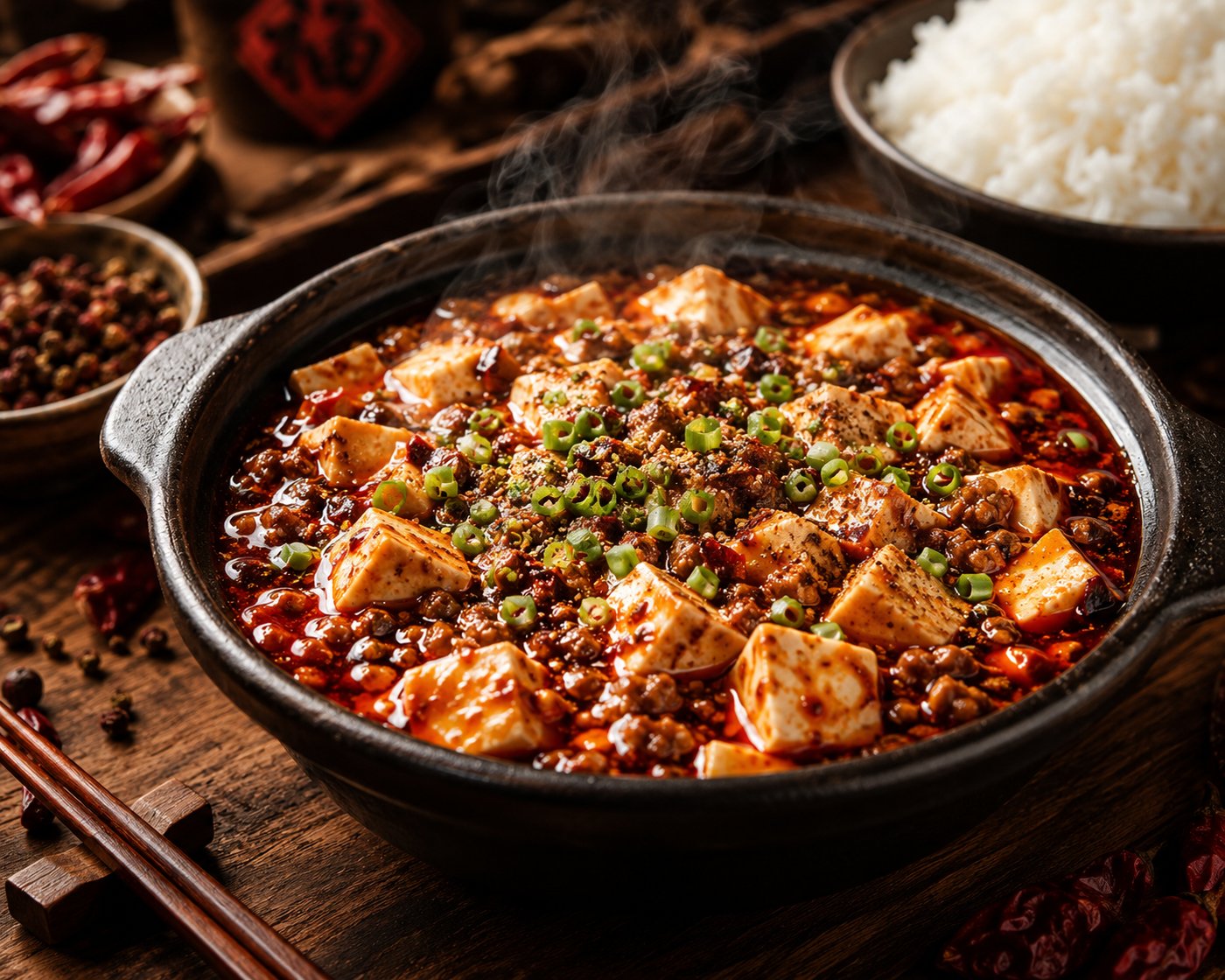
Original recipe estimate: Approx. 25 min
The required stock or water is already hot.
The ingredient is explicitly hot stock or water; the method uses hot stock. The time applies with the stock already prepared. Rice is served separately.
Origin & original sources
- Cuisine
- China
- Origin of this version
- China, Sichuan (Chengdu)
- Original name
- 麻婆豆腐
- Source languages
- Chinese
See the source references for the documented version and its context.
2 original sources1 Authenticity and sources
Mapo tofu combines tender tofu with a bold chilli-bean paste and the tingling aroma of Sichuan pepper. The Sichuan reference DB51/T 3126–2023 describes Chen mapo tofu with beef, Pixian doubanjiang, douchi and green garlic. Our quantities and some steps differ: this is an editorial home-kitchen version, not a verified formula from the original restaurant. The historical Meishichina link could not currently be read. The earlier claim of eight characteristics, accompanied by a list of only seven, has been removed.
- 美食天下 – 正宗麻婆豆腐 · Chinese · accessed 22 July 2026
- Sichuan DB51/T 3126–2023 – comparison version, Annex E.2 (Chinese PDF mirror) · Chinese · accessed 19 October 2026
2 Ingredients
Editorial home-kitchen quantities, not a verified original-restaurant formula. Slurry water scales separately; use the slurry only until the sauce reaches the required thickness. Salt and blanching water as needed; rice is separate. Chinese light soy sauce is explicitly specified.
Main ingredients
- 400 g Soft tofu (嫩豆腐 – tender but firm enough to cut (not firm smoked tofu))
- 100 g Minced beef (牛肉末 – beef for this version; keep chilled until needed)
Seasoning base (the heart of the dish)
- 30 g Pixian doubanjiang (郫县豆瓣 – Sichuan chilli bean paste, roughly chopped)
- 5 g Douchi (豆豉 – fermented black soybeans, chopped)
- 5 g Chilli flakes / powder (辣椒面)
- 2 g Whole Sichuan pepper (花椒 – ideally 汉源; toasted and ground into 花椒面)
- 15 g Garlic, finely chopped (蒜末)
- 10 g Ginger, finely chopped (姜末)
Liquids and finishing
- 40 ml Rapeseed oil (菜籽油 – traditional Sichuan oil)
- 10 ml Shaoxing rice wine (料酒)
- 10 ml Soy sauce (酱油 – Chinese light soy sauce (生抽), specified editorially)
- 5 g Sugar (糖 – just to round out the flavour)
- 150 ml Hot stock or water (高汤 / 热水)
- 20 g Cornflour (cornstarch) (Reserve for thickening; use only enough for the required consistency)
- 1 stalk Green garlic (蒜苗, ~20 g, sliced into rounds – added at the end)
- Salt (盐 – use sparingly; doubanjiang is already very salty)
- 40 ml Cold water for the starch slurry (additional to the broth; stir before each addition)
Use your specialist ingredients again
Documented ingredient connections, including optional variations and side dishes. Check each recipe for its full ingredients and quantities.
Shaoxing rice wine
- Liquids and finishing: Shaoxing rice wine · 料酒
More recipes using this ingredient:
Pixian doubanjiang
- Seasoning base (the heart of the dish): Pixian doubanjiang · 郫县豆瓣 – Sichuan chilli bean paste, roughly chopped
No other verified connection in the archive yet.
Douchi
- Seasoning base (the heart of the dish): Douchi · 豆豉 – fermented black soybeans, chopped
No other verified connection in the archive yet.
3 Method
- Toast the Sichuan pepper: Toast the Sichuan pepper briefly in a dry pan over low heat until fragrant, without blackening it. Cool and grind finely. Reserve some for the finish.
- Prepare the tofu: Cut the tofu into cubes about 2 cm across. Gently simmer in additional lightly salted water for about 2 minutes, then drain carefully. Mix the cornflour with the separately listed cold water until smooth. Have the hot broth, seasonings and washed, sliced green garlic ready.
- Fry the beef: Heat the rapeseed oil in a wok. Fry the minced beef over medium heat until crumbly, fully cooked and crisp in places. Break up large lumps. Use clean utensils after handling raw meat.
- Fry the seasoning base: Reduce the heat. Add the chopped doubanjiang, douchi, chilli powder and some toasted Sichuan pepper. Move gently until fragrant and the oil turns reddish; do not burn the paste. Briefly cook the garlic and ginger with it.
- Deglaze: Pour in the rice wine and Chinese light soy sauce, then bring briefly to the boil. The specific soy sauce type is an editorial clarification of the earlier unspecified ingredient.
- Simmer the tofu: Add the hot broth and sugar. Slide in the tofu carefully and simmer gently for about 5 minutes. Ease a spatula under it from the edges or move the wok; do not stir vigorously. Briefly cook the green garlic towards the end. Taste only now and add a little salt if needed.
- Thicken gradually: Stir the slurry before each addition. Add a little to the simmering sauce, distribute gently and bring back to a simmer. Add only enough for the sauce to coat the tofu while remaining fluid; do not automatically use the whole reserve.
- Serve: Remove from the heat, scatter over the reserved Sichuan pepper and serve hot with separately cooked rice. The pepper garnish belongs to this version; it is not presented as a secret, universal identifying feature of a restaurant.
Archivist’s notes
- Quantity status: The existing formula is retained as an editorial home-kitchen version. The Chinese reference gives different beef, oil, broth and seasoning amounts. It does not verify our complete formula or staged thickening as an exact original-restaurant recipe; no in-house cooking trial has been carried out.
- Thickening: 20 g cornflour and 40 ml cold water make a reserve. The amount needed depends on starch type, liquid released by the tofu and evaporation. Do not force any excess into the sauce.
- Move the tofu gently; carefully easing a spatula underneath is allowed. The earlier absolute ban on stirring was unnecessary. Beef and green garlic remain ingredients in this version.
- Chinese light soy sauce is specified here. It is different from dark soy sauce and Japanese usukuchi shōyu. Doubanjiang and douchi already contribute salt; adjust additional salt only after cooking.
Alternatives usable in Europe
- 郫县豆瓣 → good Sichuan doubanjiang from an Asian food shop; as a last resort, mild tobanjan plus chilli powder.
- 花椒 → Sichuan pepper from a spice supplier; do not replace it with black pepper, which lacks the 麻.
- 豆豉 → fermented black beans; omit if necessary rather than replacing with soy sauce.
- 蒜苗 → thin leek (green part only) or spring onion greens as an approximation.
- 菜籽油 → neutral oil; rapeseed oil comes closest to the original.
Nutrition
Not calculated. No reproducible nutrition calculation is available for this recipe version. The tofu type, beef fat content, specific seasoning products, additional salt and finished dish weight are not sufficiently documented. The former serving column assumed one third of the dish, although the recipe also allows two servings. Rice is a separate accompaniment. Earlier estimates, including the plate with rice, are preserved in the audit archive; missing values do not mean zero.
Not calculated. No reproducible nutrition calculation is available for this recipe version. The tofu type, beef fat content, specific seasoning products, additional salt and finished dish weight are not sufficiently documented. The former serving column assumed one third of the dish, although the recipe also allows two servings. Rice is a separate accompaniment. Earlier estimates, including the plate with rice, are preserved in the audit archive; missing values do not mean zero.
| Nutrient | per 100 g | per serving |
|---|---|---|
| Energy | not calculated | not calculated |
| Protein | not calculated | not calculated |
| Fat | not calculated | not calculated |
| Carbohydrate | not calculated | not calculated |
| Salt | not calculated | not calculated |
Image: our own AI-generated illustration of the dish.