
Original recipe estimate: Approx. 45 min
Marinate the chicken for 15 min; meanwhile toast and cool the peanuts and prepare the Gongbao sauce and vegetables. Wok cooking is very brief, with 2–3 min for the chicken; the 45-minute estimate covers the described method without an additional rest.
Origin & original sources
- Cuisine
- China
- Origin of this version
- China · Sichuan · Chengdu
- Original name
- 宫保鸡丁 (Gōngbǎo jīdīng)
- Source languages
- Chinese
See the source references for the documented version and its context.
4 original sourcesWhat goes with it
In this recipe: Gongbao sauce
1 Authenticity and sources
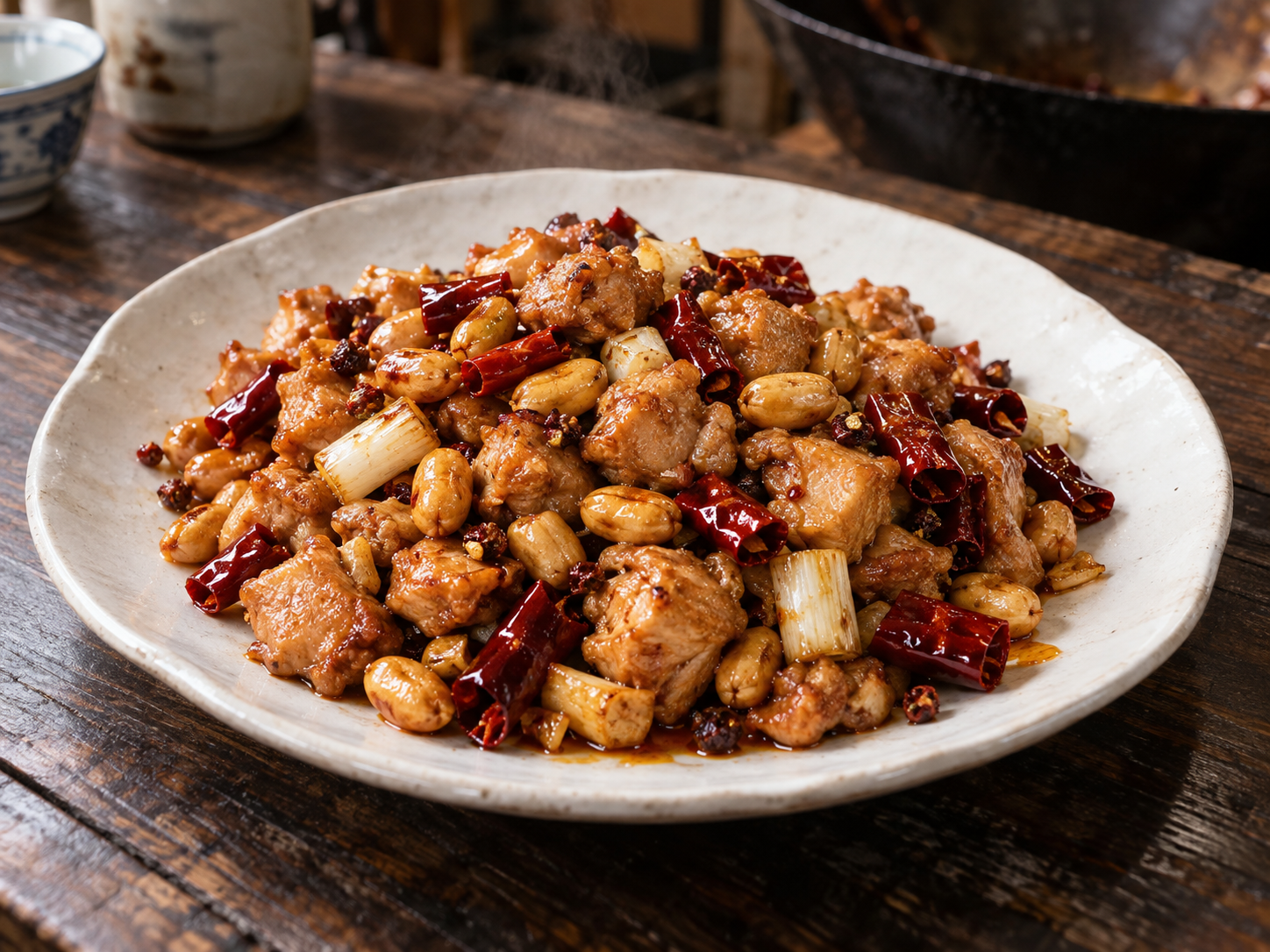
Gōngbǎo jīdīng is the Sichuan version of a dish with interconnected regional traditions. Its precise origins cannot be conclusively established; its characteristic ingredients are chicken thigh, peanuts, dried chillies, red huājiāo, spring onion, ginger and garlic. The Gongbao sauce, mixed in advance from soy sauce, Chinese vinegar, sugar, rice wine and a little starch, should coat the cubes only thinly. The aim is hú là lìzhī wèi: a delicate sweetness first, followed by sourness, saltiness, gentle chilli heat and a tingling sensation — with red oil, but no pool of sauce. This metric archive formulation combines source descriptions; its exact seasoning quantities are not a fully documented conversion of one original recipe.
- Chengdu Museum – The Gongbao Jiding debate · Chinese · accessed 5 September 2026
- Xinhua / Globe – Jiangbao Jiding and Gongbao Jiding · Chinese · accessed 5 September 2026
- Chongqing Publishing Group / CBG – This is Sichuan cooking: Gongbao Jiding · Chinese · accessed 5 September 2026
- Guangyuan Municipal Government – Dish two: Gongbao Jiding · Chinese · accessed 5 September 2026
2 Ingredients
Editorial amounts for four servings. Weigh chicken raw without skin/bones, peanuts as raw peeled kernels and vegetables trimmed. Use whole huājiāo husks unground. Keep 70 ml frying oil and 10 ml marinade oil separate; weigh both starch amounts dry.
Chicken and aromatics
- 500 g Boneless, skinless chicken thigh (鸡腿肉 jītuǐ ròu; 500 g raw meat after removing skin and bones, cut into even 1.5-cm cubes)
- 100 g Raw shelled peanuts (花生米 huāshēngmǐ; weigh raw kernels without shells or red skins before frying)
- 18 g Whole dried red chillies (干辣椒 gān làjiāo; weigh without stalks, cut into 2-cm segments; not fresh chillies)
- 3 g Red Sichuan pepper (花椒 huājiāo; weigh whole husks without hard black seeds, use unground)
- 70 g White parts of spring onions (葱段 cōngduàn; weigh trimmed white parts without roots, cut into 1.5-cm pieces)
- 15 g Ginger (姜末 jiāngmò; weigh peeled, finely chop)
- 15 g Garlic (蒜末 suànmò; weigh peeled, finely chop)
- 70 ml Neutral peanut or rapeseed oil (total frying oil: about 30 ml for peanuts, then add about 40 ml; marinade oil is separate)
Marinade
- 15 ml Chinese rice wine (黄酒 huángjiǔ or 绍兴酒 Shàoxīng jiǔ)
- 3 g Fine salt
- 15 g Potato or sweet potato starch (淀粉 diànfěn; weigh dry starch, not a prepared starch-and-water slurry)
- 10 ml Neutral oil (for the marinade only, additional to the listed frying oil)
Gongbao sauce
- 25 ml Chinese light soy sauce (生抽 shēngchōu)
- 30 ml Chinese aromatic black vinegar (香醋 xiāngcù)
- 28 g Sugar
- 15 ml Chinese rice wine (黄酒 or 绍兴酒)
- 60 ml Light unsalted chicken stock or water (prepared stock, not concentrate; the full amount is for the sauce)
- 8 g Potato or sweet potato starch (weigh dry starch; additional to the 15 g in the marinade)
- 1 g Fine salt
Use your specialist ingredients again
Documented ingredient connections, including optional variations and side dishes. Check each recipe for its full ingredients and quantities.
Light soy sauce · Shēngchōu
- Gongbao sauce: Chinese light soy sauce · 生抽 shēngchōu
More recipes using this ingredient:
3 Method
- Marinate the chicken: Mix the diced chicken thigh with rice wine and salt. Work in the starch and 10 ml oil thoroughly until the cubes have only a velvety coating. Marinate covered in the refrigerator for 15 minutes; this should not form a thick breading.
- Toast the peanuts slowly: Put about 30 ml oil and the peanuts into a cold wok. Toast slowly over low to medium heat until golden, then remove immediately and leave to cool. Return them only at the very end so they stay crisp.
- Mix the Gongbao sauce: Stir the soy sauce, Chinese vinegar, sugar, rice wine, stock or water, starch and salt until smooth. Stir again immediately before pouring it in, as the starch settles.
- Release the chilli and huājiāo aromas: Keep the oil used for the peanuts in the wok and add the remaining approximately 40 ml from the 70 ml frying allowance; the separate 10 ml marinade oil is already on the chicken. Stir the chilli segments and whole, unground red huājiāo husks briefly in the oil, about 10 to 15 seconds. Control the heat so they become fragrant without turning black; increase it for the chicken afterwards. Briefly add the ginger, garlic and spring onion.
- Cook the chicken quickly over high heat: Add the marinated chicken to the wok, separate the pieces immediately and stir-fry over high heat for 2 to 3 minutes. The cubes should be just cooked through, tender and glossy. The 2 to 3 minutes are a guide, not proof of doneness: continue cooking as needed until the centre of the largest cubes is fully cooked. For a larger quantity, work in small batches and allow additional time.
- Finish almost dry: Stir the sauce again, pour it around the edge of the wok and toss immediately. As soon as it thinly coats the chicken cubes and red oil becomes visible, add the peanuts. Toss briefly once more and serve without any excess sauce.
Archivist’s notes
- The Sichuan sauce is glossy and only lightly thickened, not thick, sweet and sticky, or soupy. The aim is red oil on the plate, not a pool of sauce.
- Whole dried chillies and red huājiāo release their aromas into the hot oil very briefly. Bitter, burnt chillies or black pepper distort the characteristic seasoning.
- Bell peppers, carrots, cucumber, cashews, pineapple, ketchup, hoisin sauce and peanut butter do not belong to this documented Sichuan tradition.
- Pixian doubanjiang is not a core ingredient in this classic Gōngbǎo jīdīng and is therefore not added unnecessarily.
- Quantity basis: Four servings is an editorial division, not a fixed plated weight. The 500 g is already boned raw chicken meat; buy more if using whole thighs. Make the full marinade and sauce from their separate lists: in total, 23 g dry starch, 4 g added salt, 30 ml rice wine and 80 ml oil. These totals are input amounts, not consumed amounts. The complete seasoning formula remains editorial and is not presented as an exact source conversion or a measured recipe yield.
Alternatives usable in Europe
- Red huājiāo → use whole red Sichuan pepper husks and briefly release their aroma in oil, unground, for this recipe. Do not add a separate dry-toasting or grinding step. Black pepper, pink peppercorns and Nepalese timut are not equivalent substitutes.
- Chinese aromatic vinegar → look for 香醋 xiāngcù in Chinese specialist shops. Alternative usable in Europe: Chinese black vinegar; not balsamic vinegar or Western sweet chilli sauce.
- Chinese rice wine → use 黄酒 or Shaoxing rice wine. Alternative usable in Europe: dry Shaoxing cooking wine, not Western red wine.
- Raw shelled peanuts → toast in oil at home until golden. Salted or sugar-coated snack peanuts change the texture and seasoning.
Nutrition
Not calculated: product data, quantities actually eaten and measured finished weight are missing. The complete recipe yield is undetermined.
Not calculated. Earlier unverified archive estimates are preserved in the audit archive and no longer displayed as nutrition values. Missing values do not mean zero.
| Nutrient | per 100 g | per portion |
|---|---|---|
| Energy | not calculated | not calculated |
| Protein | not calculated | not calculated |
| Fat | not calculated | not calculated |
| Carbohydrate | not calculated | not calculated |
| Salt | not calculated | not calculated |
Image: our own AI-generated illustration of the dish.