
Original recipe estimate: Approx. 3 hours 45 min
Editorial plan: 90 min bone broth, up to 120 min braising, 20 min hot rest and about 55 min for preparation, heating, frying, straining and serving. Blanch the shin only towards the end of the broth stage. 285 min is a planning figure; tenderness may require longer. No cooking trial.
Origin & original sources
- Cuisine
- Taiwan
- Origin of this version
- Taiwan · Southern Taiwan and 眷村 military dependents’ village cooking
- Original name
- 紅燒牛肉麵 (Hóngshāo niúròu miàn)
- Source languages
- Chinese (Taiwan, traditional characters), German
See the source references for the documented version and its context.
4 original sources1 Authenticity and sources
This Taiwanese home-kitchen version combines beef shin, chilli bean paste, spices and wheat noodles. The agricultural sources explain history and different preparations; Liberty Times presents its own home-cooking method. None establishes our complete gram formula or this exact cooking sequence. The separately prepared bone broth and the quantities are therefore explicitly an editorial combination. Several accounts also exist of the origins of Taiwanese beef noodle soup.
- Ministry of Agriculture food and agriculture education platform – Beef: Taiwanese beef noodles, from a foreign land to home · Chinese (Taiwan, traditional characters) · accessed 11 August 2026
- Agricultural Knowledge Portal – Put a pot of water on: let’s eat beef noodles · Chinese (Taiwan, traditional characters) · accessed 11 August 2026
- Liberty Times Food – Mum’s own recipe: red-braised beef noodle soup · Chinese (Taiwan, traditional characters) · accessed 11 August 2026
- BfR – Foodborne infections at home (supplementary kitchen hygiene) · German · accessed 19 October 2026
2 Ingredients
Editorial home-kitchen version with clarified quantity definitions and method. Not a complete source conversion; cooking trials and measured final yields remain outstanding.
Red-braised beef broth
- 1200 g Beef shank (牛腱; boneless, preferably whole, with connective tissue; keep refrigerated until needed)
- 500 g Beef bones (For the broth)
- 2600 ml Water (2,200 ml for the bone broth, 400 ml for the aromatics pan; additional blanching/noodle water and evaporation replacement as needed)
- 50 g Taiwanese spicy bean paste (辣豆瓣醬; from Taiwan, not a European chilli sauce substitute)
- 65 ml Light soy sauce (生抽; for the braising broth)
- 20 ml Dark soy sauce (老抽; only for colour and depth)
- 35 ml Taiwanese rice wine (米酒)
- 22 g Rock sugar (冰糖)
- 80 g Ginger (老薑; sliced)
- 70 g Garlic (蒜頭; lightly crushed)
- 120 g Spring onions (蔥; total weight for the broth: greens into the bone broth, whites into the paste; garnish listed separately)
- 220 g Onions (Roughly chopped)
- 250 g White radish (白蘿蔔; large chunks)
- 3 pieces Star anise (八角)
- 3 g Cinnamon bark (桂皮)
- 2 g Sichuan pepper (花椒)
- 2 g Fennel seeds (小茴香)
- 2 g Dried mandarin peel (陳皮)
- 30 ml Neutral vegetable oil (For frying the paste)
- 8 g Fine salt (Seasoning allowance, only after tasting; bean paste and soy sauces already contribute salt)
To serve
- 720 g Fresh wheat noodles (麵條; fresh weight, not dry weight; cook separately according to the package)
- 320 g Pak choi (青江菜; briefly blanched)
- 120 g Taiwanese pickled mustard greens (酸菜; finely chopped and briefly rinsed if needed)
- 30 g Spring onion greens (蔥花; additional garnish, not taken from the spring onion allowance for the broth)
Use your specialist ingredients again
Documented ingredient connections, including optional variations and side dishes. Check each recipe for its full ingredients and quantities.
Light soy sauce · Shēngchōu
- Red-braised beef broth: Light soy sauce · 生抽; for the braising broth
More recipes using this ingredient:
Dark soy sauce · Lǎochōu
- Red-braised beef broth: Dark soy sauce · 老抽; only for colour and depth
No other verified connection in the archive yet.
3 Method
- Blanch the bones: Start with only the bones in additional water. Once boiling, blanch for 5–7 min. Discard the water, carefully remove clinging scum from the bones and clean the pot. Avoid splashes and clean the sink afterwards. Keep the raw beef shin refrigerated until shortly before it is needed.
- Start the broth: Put the bones in a pot with 2,200 ml fresh water, the onion, half the ginger and the green parts of the spring onions listed for the broth. Bring to a simmer and cook gently for 90 min; replace evaporation with hot water as needed. Reserve the spring onion whites for the paste. Keep the additional green garnish separate.
- Blanch the shin and fry the paste: Towards the end of the broth cooking time, bring the shin to the boil in a second pot with additional water and blanch for 5–7 min. Drain and continue cooking immediately; do not leave it partially cooked throughout the broth stage. Heat the oil in the braising pot and sauté the remaining ginger, garlic and reserved spring onion whites. Fry the bean paste over medium heat until fragrant without burning it.
- Braise the shin: Immediately add the shin to the paste and deglaze with rice wine. Add the light and dark soy sauces. Use the remaining 400 ml water to loosen the pan juices, then pour in the hot bone broth through a sieve. Place the spices in a bag and add with the rock sugar and radish. Choose a suitable pot; the shin should be largely covered. Add extra hot water if needed.
- Cook until tender: Cover and braise over low heat for about 90–120 min, longer if needed. The connective tissue should be tender and a skewer should enter with little resistance, while the shin remains sliceable. Remove the spice bag earlier if the aroma is strong enough. Rest the shin in the hot broth for 20 min, maintaining at least 60 °C. Slice across the grain and keep hot for serving.
- Adjust the broth and cook noodles and greens: Lift out the radish and keep hot, then strain the braising broth. Measure the broth and allocate it to the bowls; starting water is not a guaranteed final yield. If too concentrated or salty, dilute with hot water and bring to the boil. Only then add salt if needed. Cook fresh noodles in separate water according to the package and drain; blanch the pak choi separately from the broth too.
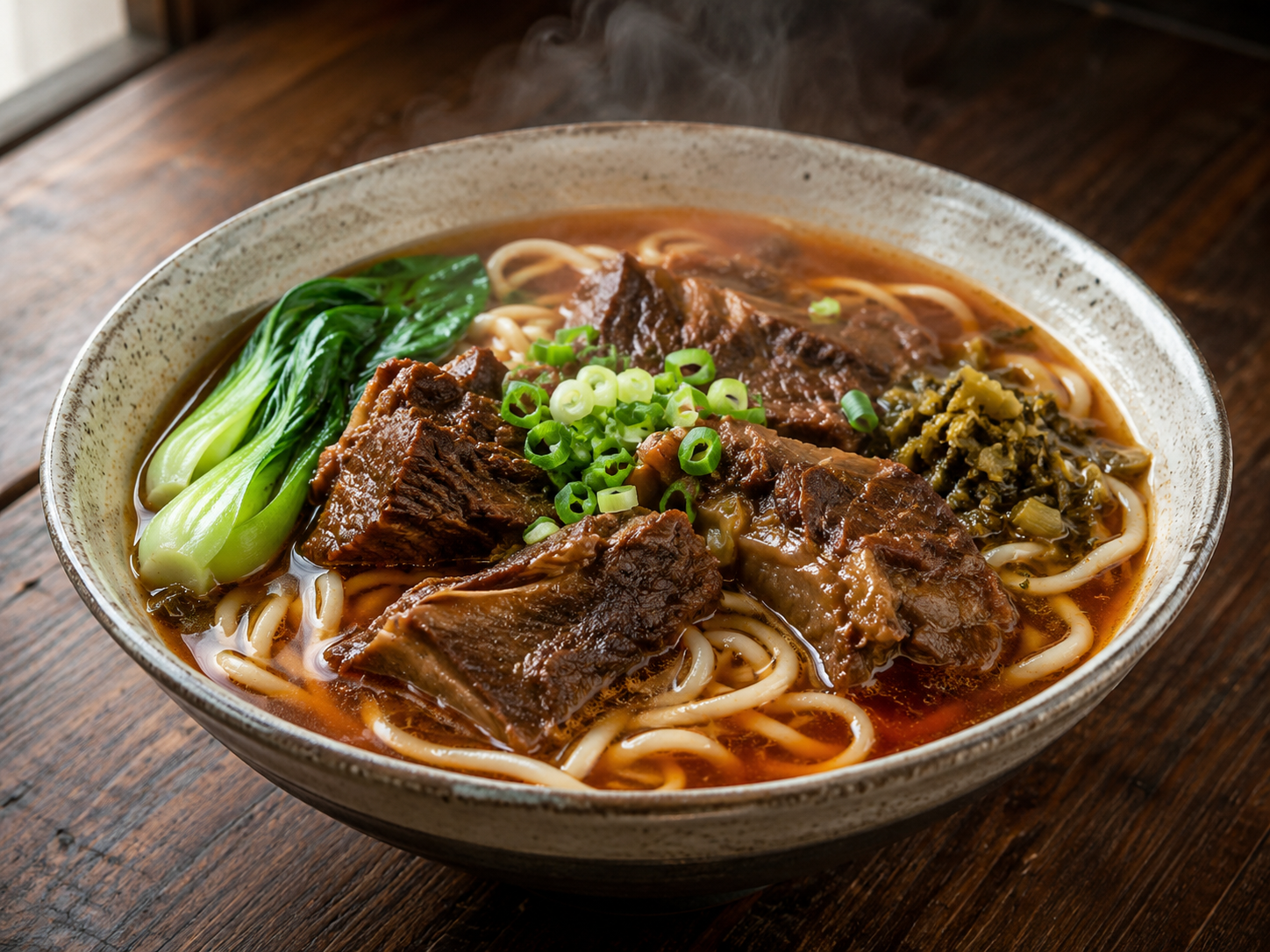
- Assemble the Taiwanese bowls: Divide the noodles among four deep bowls, add several slices of beef shank and radish to each, and pour over the hot reddish-brown broth. Arrange the pak choi, 酸菜 and spring onion greens separately on top. Mix at the table as desired.
Archivist’s notes
- The red colour comes from frying Taiwanese 辣豆瓣醬 and adding a little dark soy sauce — not from tomato purée, paprika powder or a floating layer of chilli oil.
- The broth should be dark reddish-brown but clear. Constant vigorous boiling clouds it and dries out the beef shank; gentle simmering keeps both the tendons and meat succulent.
- 牛肉麵 varies between homes and shops. This version follows the classic red-braised style without egg, sweetcorn, bamboo shoots, lime or ramen toppings.
- 酸菜 provides the characteristic salty, sour accent. Use only a little and briefly rinse very salty products before chopping; it is an accent, not a large side dish.
- Quantity status: The existing gram values and spice combination are editorial home-kitchen quantities, not an exact conversion of the three Taiwanese sources. The 2,600 ml water is now fully allocated. The 120 g spring onions for the broth and 30 g garnish are separate allowances. Extra water needs and final yield depend on the pot, lid and heat.
- Bean paste, soy sauces and mustard greens vary in saltiness by product. The salt allowance is not a mandatory addition. A cooking trial with weighed final yield and recorded products remains outstanding.
- Promptly cool cooked leftovers below 7 °C in shallow containers and use within 2–3 days under refrigeration. When reheating, reach at least 70 °C for 2 min throughout.
Alternatives usable in Europe
- 辣豆瓣醬 → look for Taiwanese spicy bean paste, ideally from Gangshan, in a Taiwanese or well-stocked Chinese shop. Neither sambal oelek, gochujang, sriracha nor European pepper paste provides this fermented chilli flavour.
- 米酒 → use Taiwanese rice wine. An alternative is unsweetened Shaoxing wine; do not use salted cooking sherry or sweet rice wines.
- 酸菜 → choose Chinese pickled mustard greens, not German sauerkraut. If necessary, omit them rather than alter the bowl with the flavour of sauerkraut.
- Beef shank → ask a butcher for beef shin or boneless shin slices. Lean stewing beef does not replace the gelatinous tendon structure.
Nutrition
Nutrition not calculated: No reproducible calculation is documented for this beef noodle soup. Bone weight is not edible yield; skimming, evaporation and the broth actually served affect the result. Fresh noodles absorb water during cooking. The bean paste, soy sauces and pickled mustard greens also require specific product data. Four large servings are a recipe assumption, not a measured serving weight. Previous estimates have been archived.
Nutrition not calculated: No reproducible calculation is documented for this beef noodle soup. Bone weight is not edible yield; skimming, evaporation and the broth actually served affect the result. Fresh noodles absorb water during cooking. The bean paste, soy sauces and pickled mustard greens also require specific product data. Four large servings are a recipe assumption, not a measured serving weight. Previous estimates have been archived.
| Nutrient | per 100 g | per serving |
|---|---|---|
| Energy | not calculated | not calculated |
| Protein | not calculated | not calculated |
| Fat | not calculated | not calculated |
| Carbohydrate | not calculated | not calculated |
| Salt | not calculated | not calculated |
Image: our own AI-generated illustration of the dish.