
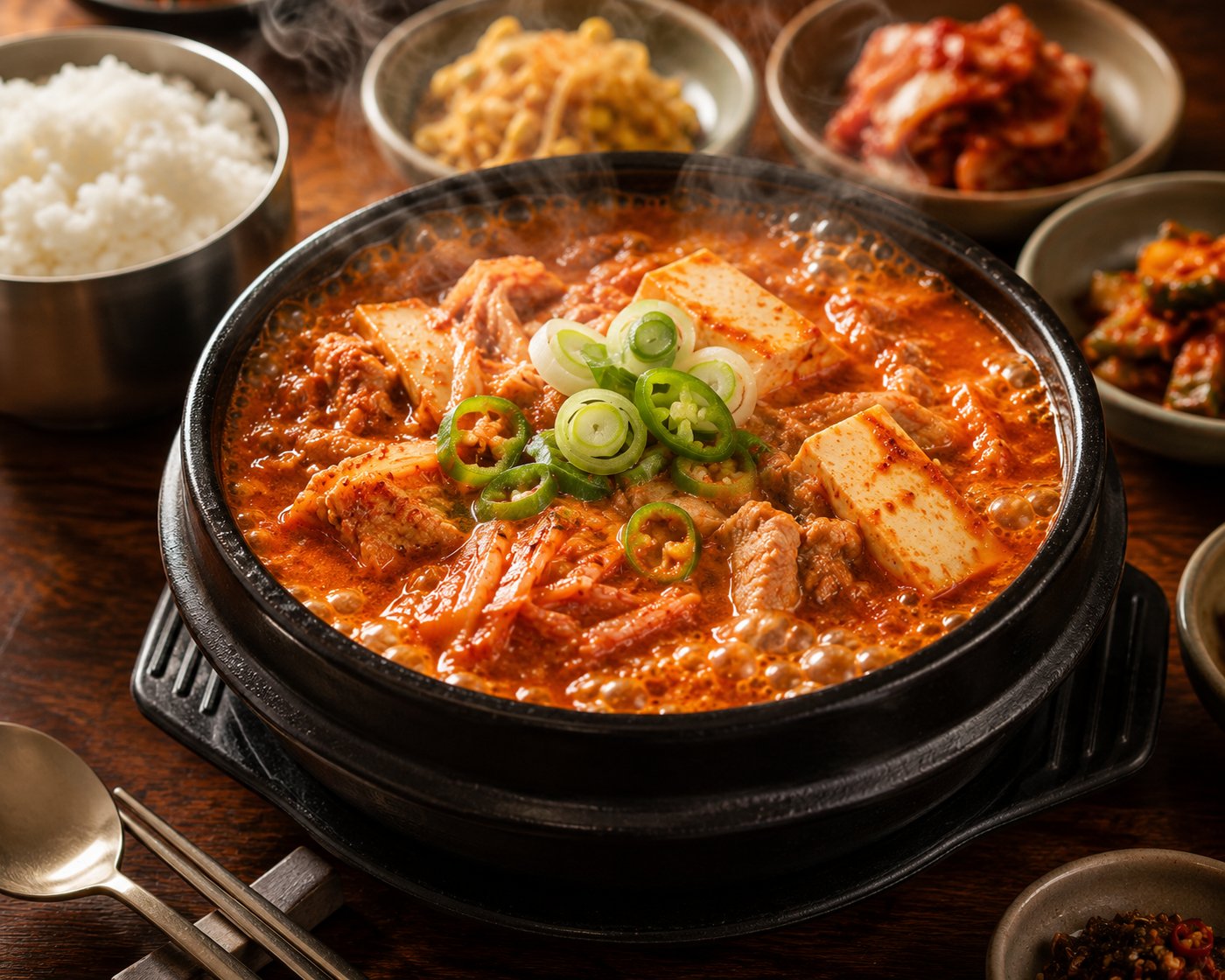
Original recipe estimate: Approx. 40 min
Up to 30 min of initial simmering, then 10 min with tofu, plus about 15 min for chopping, sautéing and bringing to the boil (steps 1–4). Mature kimchi is an ingredient already on hand; making it is not a step in this recipe. Cook rice separately.
Origin & original sources
- Cuisine
- Korea
- Origin of this version
- Korea (South Korea)
- Original name
- 김치찌개
- Source languages
- Korean, German
See the source references for the documented version and its context.
2 original sources1 Authenticity and sources
Kimchi-jjigae is Korean home cooking: mature, tangy kimchi forms the foundation of this hearty stew. Our version combines it with pork and tofu. 핑콩이’s post on 만개의레시피 serves as a Korean comparison; its quantities and frying sequence differ. Our home-kitchen formula is not an exact translation of that post, a universal standard or a recipe published directly by Baek Jong-won.
- 만개의레시피 – Baek Jong-won’s pork kimchi-jjigae · Korean · accessed 22 July 2026
- BfR – supplementary cooking and cooling guidance · German · accessed 19 October 2026
2 Ingredients
Editorial home-kitchen version, not an exact translation of the comparison recipe. Vegetables now scale individually. 200 ml brine plus 600 ml water or broth together form the starting liquid. Add soup soy sauce and saeu-jeot gradually to taste. Piece and spoon measures are not verified gram weights.
Main ingredients
- 300 g Pork belly or collar (돼지고기 삼겹살/목살 – even, thin bite-sized pieces)
- 400 g Mature kimchi (묵은지/신김치 – sour, cut into pieces)
- 200 g Tofu (두부 – firm, sliced)
Broth and base
- 200 ml Kimchi brine (김치국물)
- 600 ml Water or anchovy broth (물 / 멸치육수)
- 1 tbsp Perilla oil (들기름 – for sautéing)
Seasoning
- 1 tbsp Chopped garlic (다진마늘)
- 1.5 tbsp Gochugaru (고춧가루 – chilli flakes)
- 0.5 tbsp Doenjang (된장 – soybean paste)
- 1 tbsp Guk-ganjang (국간장 – soup soy sauce)
- 1 tbsp Saeu-jeot (새우젓 – salted shrimp)
- 1 tsp Sugar (설탕 – balances the acidity)
- 0.5 Onion (양파 – sliced)
- 1 Cheongyang chilli (청양고추 – sliced)
- 1 Daepa (large Korean spring onion) (대파 – trimmed and sliced; size varies)
Use your specialist ingredients again
Documented ingredient connections, including optional variations and side dishes. Check each recipe for its full ingredients and quantities.
Gochugaru
- Seasoning: Gochugaru · 고춧가루 – chilli flakes
No other verified connection in the archive yet.
Doenjang
- Seasoning: Doenjang · 된장 – soybean paste
No other verified connection in the archive yet.
3 Method
- Prepare and fry: Slice the onion, Cheongyang chilli and daepa; cut the tofu into slices. Warm the perilla oil over medium heat without letting it smoke. Fry the pork in batches, add the kimchi and stir-fry together for a few minutes. Briefly cook the garlic and listed sugar with it. This sequence belongs to our version.
- Season and add liquid: Briefly stir in the gochugaru and doenjang without scorching them. Add the 200 ml kimchi brine and 600 ml water or prepared, preferably unsalted anchovy broth, then bring to the boil. These liquids together form the starting amount; do not add an extra 800 ml water.
- Simmer and season: Add the onion and simmer gently for about 20–30 minutes until the kimchi and pork are tender. Add a little hot water if too much evaporates. Gradually season to taste from the listed guk-ganjang and saeu-jeot allowances: the kimchi and brine may already be salty. Taste only after sufficient cooking; several thicker pork pieces must reach at least 70 °C for 2 minutes at the centre.
- Add tofu and finish: Add the tofu and Cheongyang chilli and simmer gently for another 5–10 minutes. Briefly cook the daepa towards the end. Before serving, the entire stew, including the centre of the tofu, must reach at least 70 °C for 2 minutes; heat longer if needed. Serve hot with separately cooked rice. Promptly divide leftovers into shallow containers, cool and refrigerate.
Archivist’s notes
- Quantity status: 400 g kimchi, 200 ml brine, 600 ml water or broth and 200 g tofu remain editorial home-kitchen amounts. The Korean comparison source uses a different quantity basis and does not list tofu. No in-house cooking trial has been carried out.
- The former combined vegetable row is split into half an onion, one Cheongyang chilli and one daepa. These already archived piece counts now scale individually; they are not verified gram weights.
- Mature kimchi adds acidity and depth; fresh kimchi tastes milder and is not inherently inauthentic. Check condition, storage instructions and suitability for eating. Greater age or acidity is not automatically better.
- Perilla oil, saeu-jeot and doenjang shape this version. Doenjang seasons the dish; it does not make spoiled meat usable. Guk-ganjang remains explicitly Korean soup soy sauce.
- Belly is fattier than many neck cuts; both are options here. Cooking times depend on the cut and pot. Temperature and cooling guidance is supplementary BfR advice, not evidence for the Korean recipe quantities.
Alternatives usable in Europe
- Choose mature kimchi from a Korean grocer. Do not assume a universal ripening time; follow product and storage instructions.
- 들기름 → perilla oil from an Asian grocery shop; toasted sesame oil is a less typical alternative.
- 새우젓 → salted shrimp; alternatively, use fish sauce sparingly with a little salt.
- Obtain guk-ganjang, Korean soup soy sauce. Other soy sauces change saltiness and flavour; there is no fixed equivalent substitution ratio.
- 청양고추 → Cheongyang chilli; another hot green chilli is an alternative.
Nutrition
Not calculated. No reproducible nutrition calculation is available for this recipe version. The pork cut and fat content, kimchi and brine, tofu, broth and seasoning products, spoon weights, vegetable quantity and finished stew weight are not sufficiently documented. The former serving column assumed one quarter, although the recipe specifies three to four servings. Rice is a separate accompaniment. Earlier estimates are preserved in the audit archive; missing values do not mean zero.
Not calculated. No reproducible nutrition calculation is available for this recipe version. The pork cut and fat content, kimchi and brine, tofu, broth and seasoning products, spoon weights, vegetable quantity and finished stew weight are not sufficiently documented. The former serving column assumed one quarter, although the recipe specifies three to four servings. Rice is a separate accompaniment. Earlier estimates are preserved in the audit archive; missing values do not mean zero.
| Nutrient | per 100 g | per serving |
|---|---|---|
| Energy | not calculated | not calculated |
| Protein | not calculated | not calculated |
| Fat | not calculated | not calculated |
| Carbohydrate | not calculated | not calculated |
| Salt | not calculated | not calculated |
Image: our own AI-generated illustration of the dish.