
Original recipe estimate: Approx. 35 min
The rice is already cooked, cooled appropriately and available cold.
The required amount of chicken is fully cooked and prepared as needed.
Cold rice from the previous day and cooked shredded chicken are explicitly required in the ingredient list. Allow 35 min from that starting point for the pounded paste, wok cooking, fried eggs and serving. Cooking and cooling the rice and cooking the chicken beforehand are not included; acar, kerupuk and bawang goreng are ready-made accompaniments.
Origin & original sources
- Cuisine
- Indonesia
- Origin of this version
- Indonesia · Central Java, Solo/Yogyakarta; home and warung cooking varies across the country
- Original name
- Nasi goreng kampung
- Source languages
- Indonesian
See the source references for the documented version and its context.
4 original sources1 Authenticity and sources
Nasi goreng kampung is a simple Central Javanese home- and warung-cooking tradition from Solo and Yogyakarta, not a single fixed national recipe. Cold rice with separate grains is fried with freshly pounded bumbu ulek made from chilli, shallots, garlic and toasted terasi; kecap manis gives this darker version colour and a caramel-like, salty depth. Ketchup, oyster sauce and arbitrary Western additions do not belong in this documented version.
- detikFood – Essential spice mixture for nasi goreng kampung · Indonesian · accessed 4 September 2026
- detikFood – Nasi goreng kampung recipe and cooking tips · Indonesian · accessed 4 September 2026
- detikFood – Nasi goreng kampung with rich seasoning · Indonesian · accessed 4 September 2026
- Indonesia.Travel – Indonesian specialities · Indonesian · accessed 4 September 2026
2 Ingredients
Unquantified serving accompaniments are used as needed. Their quantities are unspecified and are not numerically multiplied when the serving count changes.
Rice and additions – nasi dan pelengkap
- 400 g Cold cooked white rice (nasi putih dingin; from the previous day, preferably with separate grains / nasi pera)
- 45 ml Neutral frying oil
- 100 g Cooked shredded chicken (ayam suwir; ideally ayam kampung)
- 60 g White cabbage (Finely shredded)
- 50 g Mustard greens (sawi hijau; cut into 3 cm lengths)
- 25 g Spring onion (daun bawang; sliced diagonally)
- 60 ml Sweet Indonesian soy sauce (kecap manis)
- 1.5 g White pepper (merica putih)
- 3 pieces Eggs (As telur mata sapi)
Bumbu ulek – pounded spice paste
- 25 g Long red chillies (cabai merah keriting)
- 30 g Shallots (bawang merah)
- 6 g Garlic (bawang putih)
- 5 g Toasted candlenut (kemiri)
- 5 g Toasted shrimp paste (terasi udang)
- 3 g Salt
To serve
- as needed Indonesian starch or shrimp crackers (kerupuk kanji or kerupuk udang)
- as needed Indonesian cucumber and carrot pickles (acar timun-wortel)
- as needed Fried shallots and green bird’s-eye chillies (bawang goreng and cabai rawit hijau; adjust to the desired heat)
Use your specialist ingredients again
Documented ingredient connections, including optional variations and side dishes. Check each recipe for its full ingredients and quantities.
Kecap manis
- Rice and additions – nasi dan pelengkap: Sweet Indonesian soy sauce · kecap manis
More recipes using this ingredient:
3 Method
- Separate the rice: Break up the cold rice completely with your hands or a spoon. Fresh, still-moist rice steams in the wok and turns soft rather than keeping separate grains.
- Toast the terasi and pound the bumbu ulek: Warm the terasi briefly in a small dry frying pan until distinctly fragrant. Pound as finely as possible in a mortar with the chillies, shallots, garlic, toasted kemiri, salt and white pepper.
- Cook the spice paste thoroughly: Heat the oil in a very hot wajan or wok. Stir-fry the bumbu ulek until aromatic, darker in colour and no longer raw-smelling. This step forms the foundation of the dish.
- Briefly fry the additions: Add the shredded chicken, white cabbage and sawi hijau. Fry briefly over high heat so that the vegetables remain distinct and do not release liquid.
- Toss the rice until dry: Add the rice and break it up vigorously until each grain is coated in bumbu. Only now pour the kecap manis around the edge of the wok and immediately mix it in. Fry hot, dry and lightly smoky — do not braise.
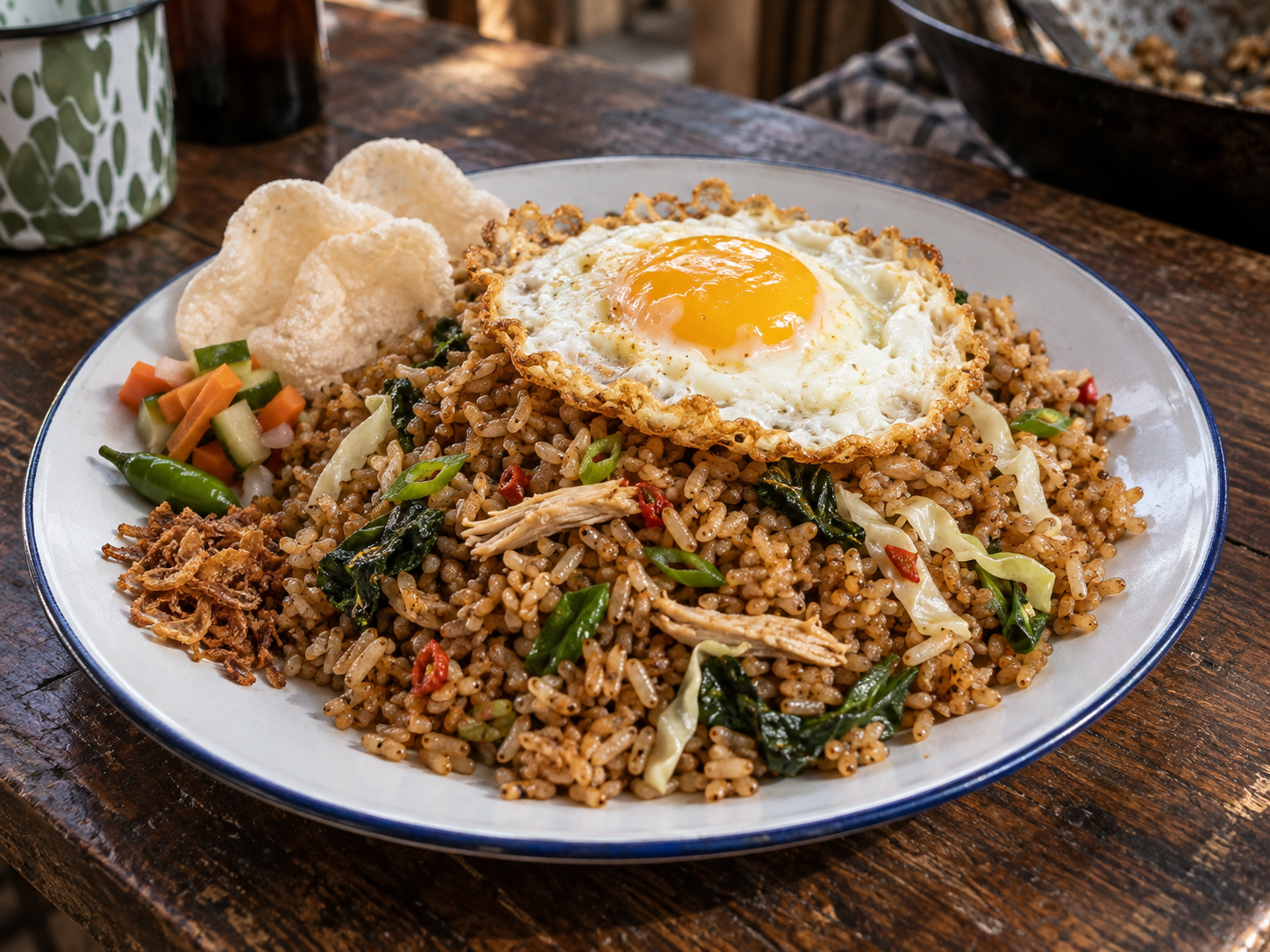
- Serve warung-style: Fold in the daun bawang only during the final seconds. Divide among three plates and top each with a telur mata sapi, kerupuk, acar, bawang goreng and green cabai rawit if desired.
Archivist’s notes
- Nasi goreng kampung is not a single fixed recipe across the country. This page deliberately documents a darker Central Javanese home and warung version with terasi and kecap manis, rather than the Malaysian version with ikan bilis and kangkung.
- Toast the terasi udang before grinding and cook the bumbu thoroughly in the wok. Raw shrimp paste has a pungent smell and does not develop the required fermented depth.
- Nasi pera or completely cooled leftover rice produces separate grains. Toss the rice over high heat, but never braise it in sauce or moisture.
- Ketchup, sweet chilli sauce, oyster sauce, sesame oil, butter, sausage, bacon, mixed seafood and frozen mixed vegetables turn this version into a different dish.
Alternatives usable in Europe
- Terasi udang → solid Indonesian shrimp paste. Alternatives usable in Europe: none as an equivalent base; without terasi the dish loses its fermented core.
- Kemiri → candlenut; use only toasted or cooked. An alternative usable in Europe is raw macadamia, likewise fried or cooked with the other ingredients; it replaces the texture, not the full flavour.
- Kecap manis → thick, sweet Indonesian soy sauce. Do not replace it with Chinese dark soy sauce, regular soy sauce, ketchup or sweet chilli sauce.
- Sawi hijau and kerupuk → look in Indonesian or Southeast Asian shops. Do not treat a Western mixed salad or potato crisps as equivalent replacements.
Nutrition
Not calculated. No reproducible calculation is documented for this recipe. The previous table and serving note were inconsistent. Product data, oil and sauce actually eaten, accompaniments and finished yield are not documented as a calculation basis. Earlier estimates are preserved in the audit archive. Missing values do not mean zero.
Not calculated. No reproducible calculation is documented for this recipe. The previous table and serving note were inconsistent. Product data, oil and sauce actually eaten, accompaniments and finished yield are not documented as a calculation basis. Earlier estimates are preserved in the audit archive. Missing values do not mean zero.
| Nutrient | per 100 g | Per portion |
|---|---|---|
| Energy | not calculated | not calculated |
| Protein | not calculated | not calculated |
| Fat | not calculated | not calculated |
| Carbohydrate | not calculated | not calculated |
| Salt | not calculated | not calculated |
Image: our own AI-generated illustration of the dish.